Background
In 2024, mpox was declared a public health emergency of international concern for the second time in two years. Brazil was significantly impacted by the 2022 multinational mpox outbreak and has observed a recrudescence in diagnoses since late 2023, primarily driven by sexual transmission. The implications of mpox and HIV coinfection are still not fully understood. This study aims to characterize individuals diagnosed with mpox in Rio de Janeiro, Brazil, with a focus on their HIV status.
Methods
Prospective cohort of people with laboratory confirmed mpox assessed at INI-Fiocruz, a state-level referral center. Sociodemographic, behavioral, and clinical characteristics were compared according to HIV status (Chi-squared/Fisher’s test or Wilcoxon rank-sum test for categorical or quantitative variables, respectively).
Results
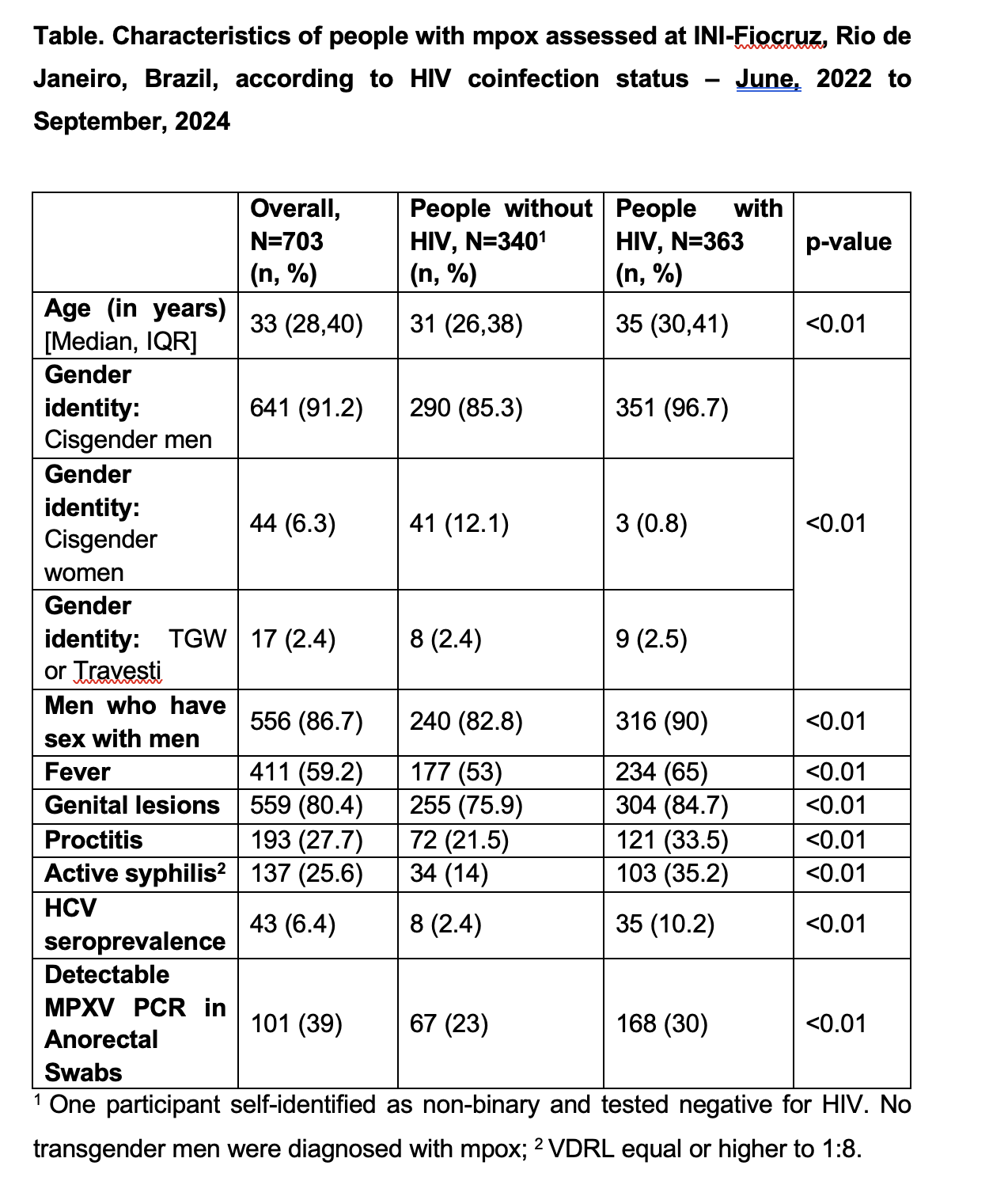
From June/2022 to September/2024, 711 people with confirmed mpox (3 with suspected reinfection) were enrolled, of whom 98.9% (n=703) had a known HIV status. Among these, 51.6% were people with HIV (PWH) and 38.8% (n=132/340) were on PrEP. The median age was 33 years (IQR:28-40), with the majority being cisgender men (91.2%) who reported sex with men (86.7%). Notably, 60% of participants experienced a delay of more than five days from symptom onset to their first assessment at INI-Fiocruz. Most identified as black/pardo (61.4%) and had post-secondary education (57.7%). PWH were older, more likely to identify as cisgender men and report sex with men. They also exhibited higher rates of fever, genital lesions, proctitis, active syphilis and HCV coinfection, along with a higher positivity rate for MPXV in anorectal swabs (Table). Among PWH and mpox, 85% had HIV-RNA viral load of less than 200 copies/mL and 87% had CD4+ above 350 cells/mm3 (median 645 [IQR:468-907]). Despite a significant hospitalization rate of 10.4%, mpox lethality was low at 0.4%. HIV status did not influence mpox-related hospitalization; however, all participants who died were PWH with CD4+ counts below 350 cells/mm³.
Conclusions
This study highlights the intersection of mpox and HIV in Brazil, revealing a high prevalence of HIV among those affected. Concurrent STIs may worsen clinical outcomes for individuals living with HIV, emphasizing the need for integrated prevention strategies. Strengthening HIV and STI prevention and care services is essential for managing mpox as a global health emergency, ultimately reducing morbidity and mortality associated with both conditions.
Table or Figure