Background
In sub-Saharan Africa, clinical outcomes among adolescents with HIV (AWH) on antiretroviral therapy (ART) remain sub-optimal. Differentiated service delivery (DSD) models for ART may facilitate better outcomes, but evidence on their effectiveness among AWH is lacking. We evaluated DSD uptake and outcomes among AWH living in KwaZulu-Natal (KZN), South Africa, following the introduction of DSD for adolescents in mid-2020.
Methods
We analysed routinely collected, de-identified data from 125 primary care clinics. AWH aged 10-18 years, stable-in-care (on ART for >6 months with recent viral load (VL) <50 copies/mL) and on first-line ART in June 2020 were analysed and followed to June 2023. The proportion of AWH enrolling in DSD for external pick-up points (the predominant DSD form in KZN, henceforth referred to as DSD), and the effect of DSD enrolment on time to the composite outcome of viraemia (VL>50 copies/mL) or loss-to-care (>365 days late for a visit) was estimated. The probability of DSD enrolment was modelled using logistic regression with generalized estimating equations and covariates for district, age in 2020, gender, time on ART, regimen, previous exposure to multi-month dispensing, history of viraemia, and a polynomial function for months of follow-up. The hazards of becoming lost or viraemic was modelled using inverse-probability-of-treatment-weighted pooled logistic regression, and risk probabilities were calculated with 95% confidence intervals (CI) estimated using bootstrapping.
Results
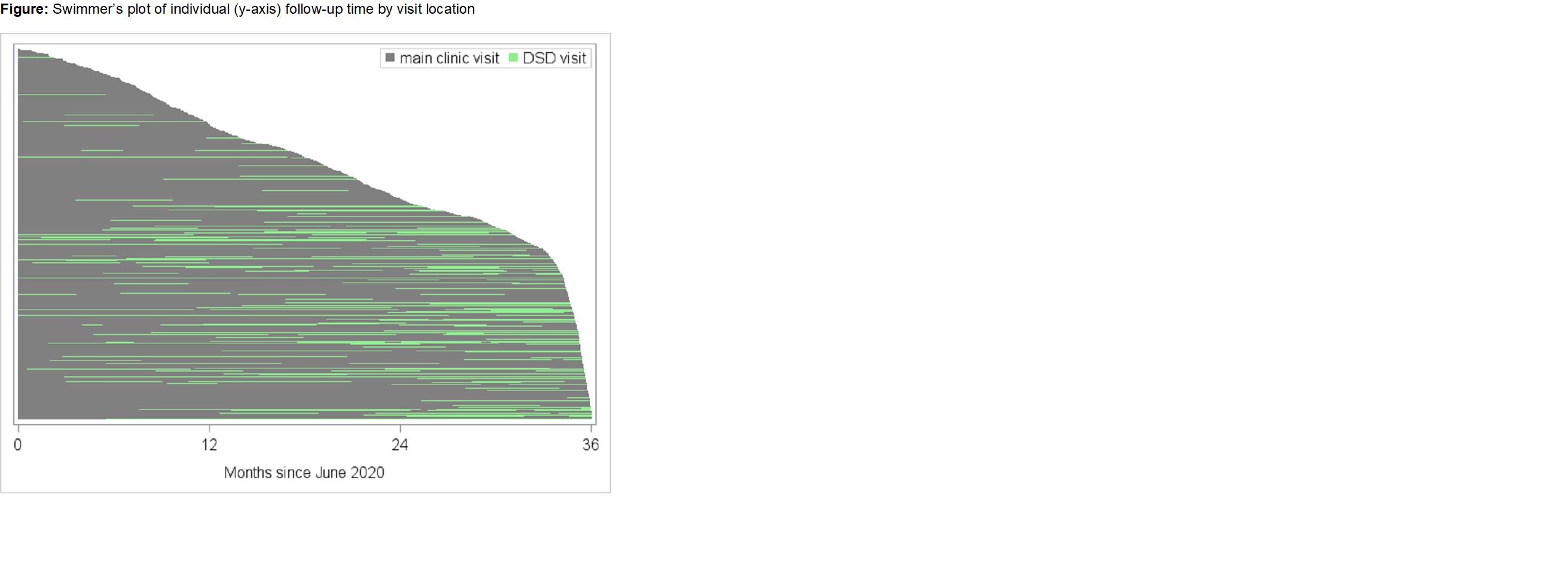
In June 2020, 5766 AWH were on first-line ART. Of these, 2142 were missing a recent VL, 1181 had a VL>50copies/mL, 6 did not have baseline ART regimen data, 162 had tuberculosis and 52 were pregnant. Of the 2223 AWH included for analysis, median age was 14 years and 60% were female. During follow-up, 758 (34%) enrolled into DSD, thereafter, collecting ART mostly through DSD (69% of follow-up), returning to clinic-based care intermittently (Figure). In total, 5% (2% versus 6% in exposed versus never exposed to DSD) became lost-to-care and 37% (46% versus 20% in exposed versus never exposed) became viraemic, with a median (interquartile range) VL of 465 (150-3970) copies/mL. The estimated 36-month probability (95% CI) of becoming lost or viraemic was 35.2% (31.7-38.8%) among those referred to DSD and 50.9% (48.7-53.0%) among those not.
Conclusions
DSD enrolment was associated with lower viraemia/lost-to-care rates, but overall clinical outcomes of AWH remain concerning.
Table or Figure