Background
The public health impact of data to care (D2C) programs has been limited by difficulty identifying and reaching out-of-care persons with HIV (PWH) using HIV surveillance data alone but may be improved by incorporating other data sources.
Methods
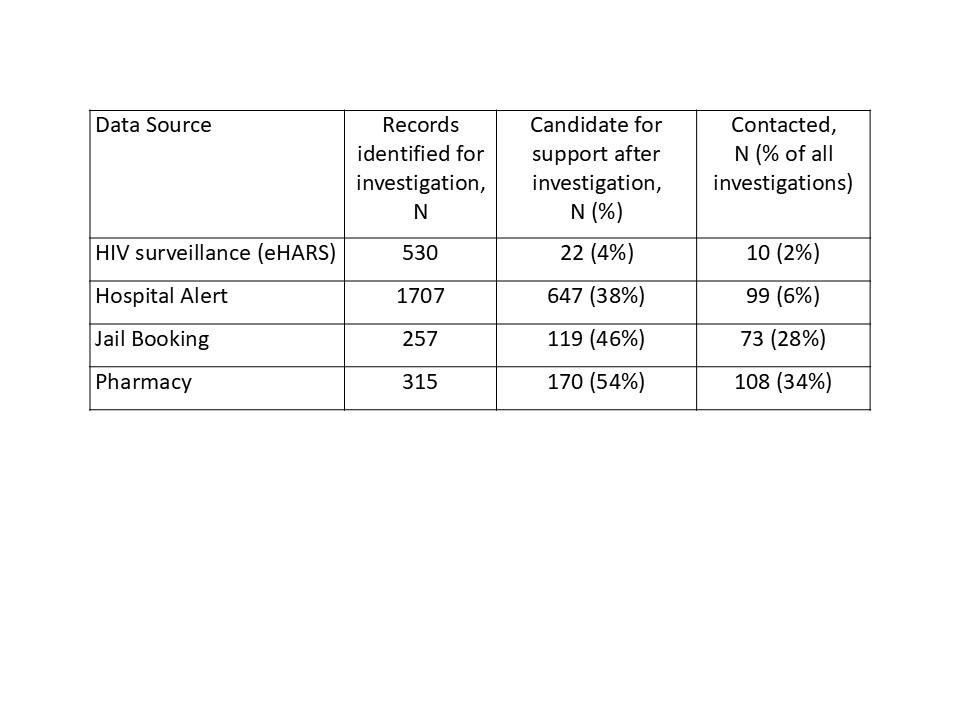
We compared the following sources used for D2C in King County, WA during 9/2023-9/2024: the enhanced HIV/AIDS Reporting System (eHARS, CDC surveillance database), jail booking records matched with surveillance data, hospital alerts (emergency department visits or inpatient admissions) matched with surveillance data, and pharmacy records of late medication pick-up from one HIV specialty pharmacy. Criteria for D2C investigation varied by source but included persons with no evidence of recent care [no CD4 or viral load (VL) result reported in the past 12-15 months], persistent viremia, or late antiretroviral medication refills (35-65 days). Health department staff investigated cases using public health databases and medical records, attempted to directly contact PWH to help with re-engagement in HIV care and treatment, and recorded investigation dispositions and contact outcomes in standardized fields in an electronic database. PWH could be identified more than once or through multiple sources; investigations were the unit of analysis. We defined the number of records from each source for which the investigation confirmed or suggested the PWH was truly out-of-care, viremic or off medications and living in King County (“candidates for support”) and, separately, the number that led to a successful health department contact with identified persons.
Results
A total of 2,812 records were identified for investigation (Table). Compared to eHARS data alone, all other sources yielded a higher percentage of candidates for support (4% vs. 38-54%). Hospital alerts generated the most records, but only 6% led to successful contact, largely because many persons identified through that source were already enrolled in low-barrier HIV care. Pharmacy records yielded the highest number of persons successfully contacted.
Conclusions
Using surveillance data alone for D2C is an inefficient way of identifying out-of-care PWH, but in combination with other data sources, D2C programs can reach more people who may benefit from support relinking to care. Since jail booking records are publicly available, incorporating jail records into D2C programs is likely to be broadly feasible.
Table or Figure