Background
Major adverse cardiovascular events (MACEs) are now a leading cause of morbidity and mortality in people with HIV (PWH). Data on the long-term outcomes of PWH who have survived a MACE are lacking.
Our aim was to evaluate overall survival and its predictors in PWH who survived a MACE.
Methods
Retrospective cohort study on PWH followed at IRCCS San Raffaele, Milan, who experienced at least one MACE between 1st/Jan/2008 and 31st/Dec/2023.
Follow-up (FU) accrued from the first MACE (baseline, BL) until death/last visit. To evaluate the outcomes of MACE survivors, we excluded from the analysis those who died within 30 days of baseline.
MACEs included: myocardial infarction; hospitalization for unstable angina; stroke; transient ischemic attack; peripheral arterial ischemia; arterial revascularization; cardiovascular death.
Survival curves estimated using Kaplan–Meyer method. Univariate Cox regressions and Mantel-Haenszel method estimated the mortality hazard ratio (HR) and 95% Confidence Interval (95%CI) of continuous and nominal variables, respectively. Factors associated with mortality evaluated by multivariate Cox regression.
Results
Among 7719 PWH, 358 (4.6%) had a MACE and 39/358 (11%) died within 30 days after BL.
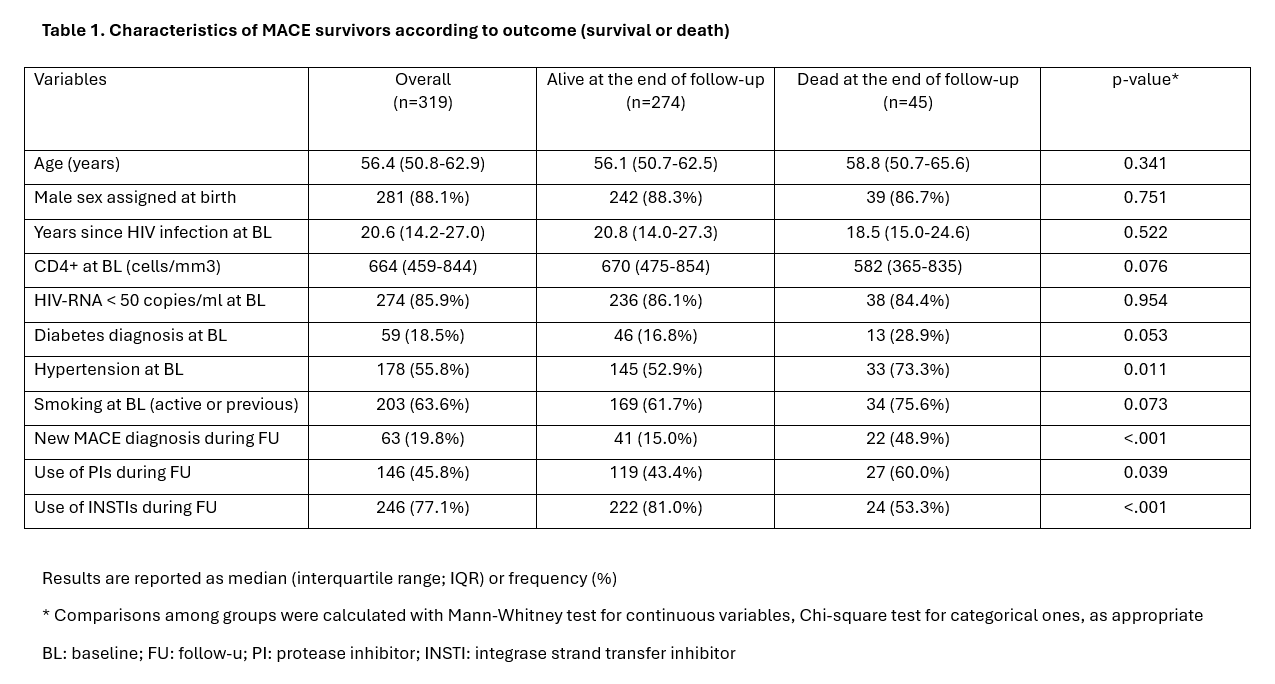
Characteristics of the 319 MACE survivors are shown in Table 1.
During a median FU of 5.6 years (IQR=2.7-9.3), the overall probability of survival at 5 and 10 years in MACE survivors was 89% (95%CI=0.90-0.96) and 80% (95%CI=0.74-0.86), respectively.
Survival probabilities were lower in PWH with diabetes (HR=3.0, 95%CI=1.3-6.8), hypertension (HR=2.7, 95%CI=1.5-4.9), and active smoking (HR=2.0, 95%CI=1.1-3. 6) at BL and in those who had a new MACE diagnosis (HR=4.6, 95%CI=2.3-9.4), used protease inhibitors (HR=4.1, 95%CI=2.0-8.4) or did not use integrase inhibitors (HR=4.8, 95%CI=2.4-9.6) during FU.
After adjustment for age, sex, and CD4+ cell count at BL, as well as PI use, LDL cholesterol levels, and last available HIV RNA during FU, diabetes [AHR: 2.4 (95%CI=1.0-5. 5)], hypertension [AHR: 2.5 (95%CI=1.1-5.4)], and smoking at BL [AHR: 3.1 (95%CI=1.4-7.0)] together with lack of use of INSTI during FU [AHR: 4.3 (95%CI=1.9-9.5)] were associated with mortality.
Conclusions
Among PWH who survive a MACE, the five-year mortality is 11%. In our cohort, classic cardiovascular risk factors at BL and an antiretroviral regimen without INSTIs during FU were associated with a worse prognosis.
For this population, implementation of preventive approaches and careful reassessment of ART are needed.
Table or Figure