Background
Long acting injectable (LAI) antiretrovirals hold enormous potential for treatment and prevention of HIV in low- and middle-income countries (LMIC) but significant access challenges exist. One obstacle for generic LAIs is the assessment of “equivalence” with originator products. Accepted standards of bioequivalence for oral generic products may be sub-optimal because small differences may be accentuated over long dosing intervals, and the need for phase III studies would present major funding and timeline obstacles to access. Partial AUCs and/or truncated pharmacokinetic (PK) assessments have been postulated as possible approaches to accelerate approval of generic LAIs. The current study sought to assess potential feasibility of such an approach through re-analysis of published PK for cabotegravir (CAB) LAI.
Methods
A single 800 mg dose CAB LAI plasma PK profile (32 week duration) from the literature was fitted with an empirical PK model. A 1-compartment disposition model was used, and profile shape warranted a 2-fraction 1st order input depot release. Repeated fits successively truncating the last timepoint of the profile from the dataset were undertaken. PK model parameter estimates for truncated profiles were then compared to those from the full profile.
Results
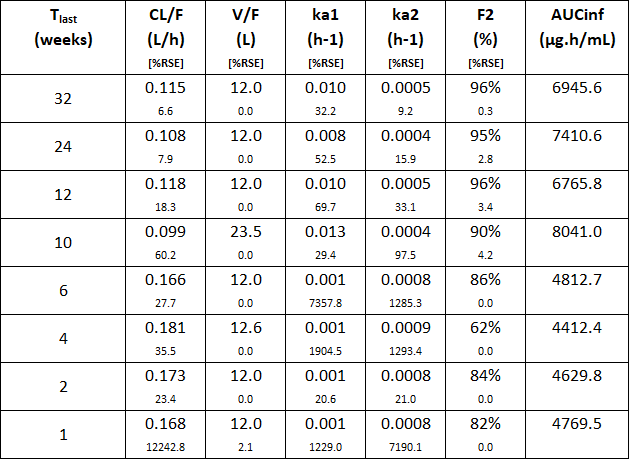
Adequate fitting of the model was obtained. With the dataset truncated up to the first 12 weeks, parameter estimates remained within 10% deviation from those obtained using the full profile (Table 1). Truncation to 10 weeks resulted in 14% and 16% deviation in estimates of CL/F and AUC0-inf relative to estimates from the full profile. Subsequent truncation resulted in significant deviation of estimates from those achieved with the full profile for all parameters (>26% deviation) with poorer precision of estimates reflected in higher relative standard errors.
Conclusions
Analysis was undertaken using a single dataset for CAB LAI, which represents a best-case scenario for a generic product by mimicking an identical product given to the same recipients. Despite this low bar, truncation of the profiles to below 10 weeks for 800mg fittings was unable to accurately predict parameters determined from the full profile. The analysis sheds light on the complexity of the challenge and may be useful to inform further development of strategies for accelerated “equivalence” evaluation for generic LAI.
Table or Figure