Background
Persistent inflammation and immune activation are hallmark features of HIV disease, and associated with long-term brain health disorders, such as neurocognitive impairment even in treated people with HIV (PWH). As PWH age, the interactions between aging, inflammation, and brain health are important to understand. The Systemic Immune-Inflammation Index (SII) has prognostic value as an indicator of immune activation and systemic inflammation in clinical conditions, but few studies have examined its utility in PWH. The current study examined the hypothesis that inflammation, measured by the SII, would have worse effects on neurocognition for older than younger PWH.
Methods
Participants were 1,867 PWH enrolled in studies affiliated with the HIV Neurobehavioral Research Program from 2003-2023. Neurocognition was assessed using demographically adjusted T-scores across 7 domains. The SII was calculated from cell counts ([neutrophils X platelets]/lymphocytes). Multiple linear regressions tested the effects of inflammation, age (dichotomized as older [>50] or younger [<50]), and their interaction on neurocognition, adjusting for covariates (e.g., sex, nadir and current CD4, antiretroviral therapy (ART) use, viral suppression, and estimated duration of HIV).
Results
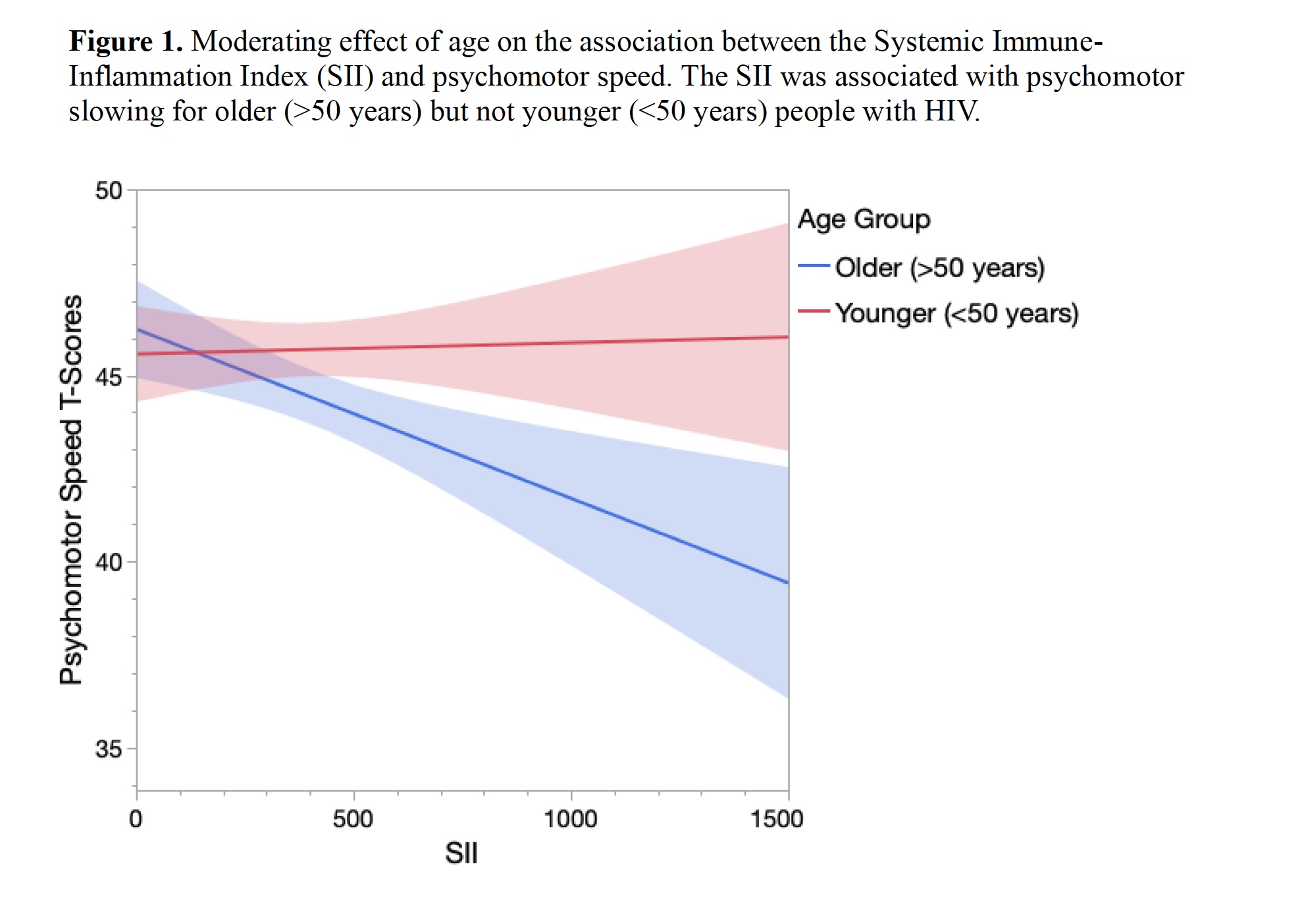
Across all participants (80% male; 46% older; 35% White; 66% AIDS; 61% virally suppressed; 81% on antiretroviral therapy [ART]), the SII was associated with lower global neurocognition, verbal fluency, processing speed, learning, and recall (p<.05). Although there was no difference in SII by age (p>.10), there was a significant age x SII interaction for psychomotor speed (β=-.73, SE=.316, p=.022), such that inflammation was associated with worse psychomotor functioning for older PWH (β=-1.51, SE=.470, p=.001) but not younger PWH (p>.10). The SII-psychomotor functioning association remained significant in a subgroup of virally suppressed older PWH (N=606; β=-1.15, SE=.525, p=.029).
Conclusions
The SII was associated with poorer performance in multiple neurocognitive domains and globally in PWH. Most of these effects were not modified by age, except for psychomotor speed, highlighting domain specific sensitivity to inflammation among older PWH and treatment-related implications (e.g., anti-inflammatory medications). Findings also highlight the utility of the SII in identifying psychomotor functioning in older PWH, that should be further examined for its prognostic value in future studies.
Table or Figure