Background
Recent studies have reported that older adults with HIV infection are at elevated risk of age-associated dementia despite antiretroviral therapy (ART). We investigated the hypothesis that delayed HIV diagnosis or initiation of ART could contribute to greater risk of developing dementia later in life.
Methods
We conducted a retrospective cohort study of people with HIV who received care at Kaiser Permanente healthcare systems in Northern California, Southern California, and Mid-Atlantic States (Maryland, Virginia, Washington DC) between 1/1/2000 and 12/31/2023. Included individuals were aged ≥50, had at least 1 documented ART prescription fill, at least 1 year of continuous health plan enrollment, and no prior diagnosis of dementia. Low CD4 count (i.e., <200 cells/µl) at 1st documented ART prescription fill was used as a proxy for delayed HIV diagnosis or ART initiation. The outcome of interest was incident dementia, identified using ICD codes in the electronic health record. The association of low CD4 count at 1st ART prescription with incident dementia was evaluated using Cox regression, with age as the time scale and adjustment for the following covariates: HIV RNA level at 1st ART prescription, calendar year of 1st ART prescription (to account for temporal trends in ART prescription), sex, race/ethnicity, neighborhood-level education, smoking, substance use disorders, depression, cardiovascular disease, diabetes, hepatitis C infection, obesity, and number of outpatient visits in the year before study inclusion. To account for the competing risk of death, a sensitivity analysis was done using a Fine-Gray subdistribution hazard model.
Results
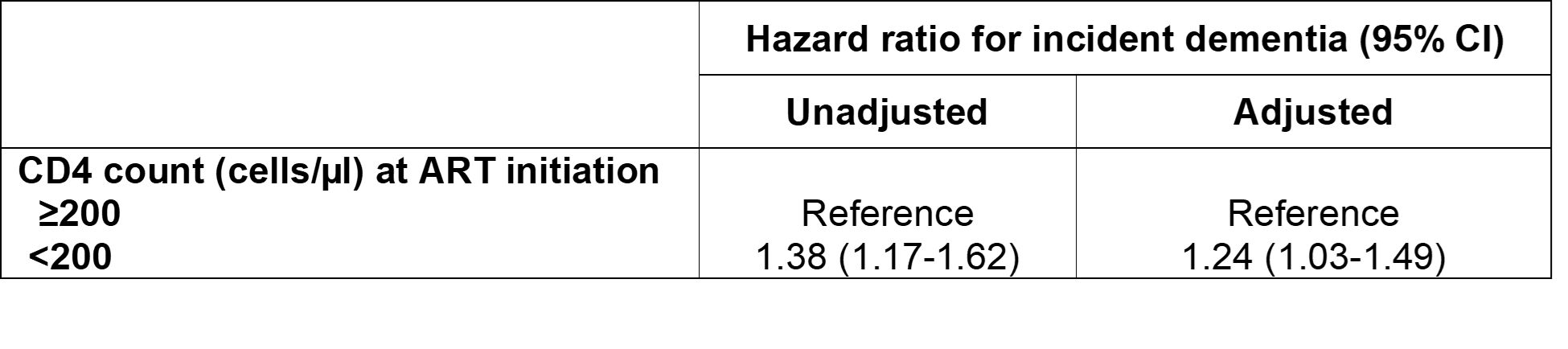
The study included 23,201 people with HIV with documented ART prescriptions (mean age at study inclusion: 54.0 years, 87.1% men, 46.1% White, 22.7% Black, 20.7% Hispanic, 3.1% Asian or Pacific Islander, 6.6% other or unknown race/ethnicity). During follow-up (mean 6.8 years, SD: 5.8), we observed 748 cases of incident dementia. Low CD4 count at 1st ART prescription was associated with greater risk of developing dementia (adjusted hazard ratio: 1.24, 95% CI: 1.03-1.49; see Table). After accounting for deaths during follow-up, results were similar (adjusted hazard ratio: 1.23, 95% CI: 1.02-1.49).
Conclusions
Findings suggest that delayed HIV diagnosis and ART initiation are associated with risk of developing age-associated dementia. These findings emphasize the importance of continuing assertive HIV screening in the community.
Table or Figure