Background
Coinfections of Mycobacterium tuberculosis (MTB) and human immunodeficiency virus (HIV) represent a significant global health challenge. Patients infected with MTB are at elevated risk of progressing to active tuberculosis (TB), a risk that can be mitigated by preventive therapy. However, current testing methods frequently fail to identify individuals who will later develop active TB, particularly among people with HIV (PWH).
Methods
We developed random forest models to predict progression to active TB using clinical data collected at the time of HIV-1 diagnosis. The model was developed using a training and test set approach within the Swiss HIV Cohort Study (SHCS), which included 55 PWH who developed active TB within six months of enrollment and 1432 matched controls without active TB, enrolled between 2000 and 2023. After internal validation within SHCS, external validation was performed using data from the Austrian HIV Cohort Study (AHIVCOS), comprising 43 incident TB cases and 1005 controls.
Results
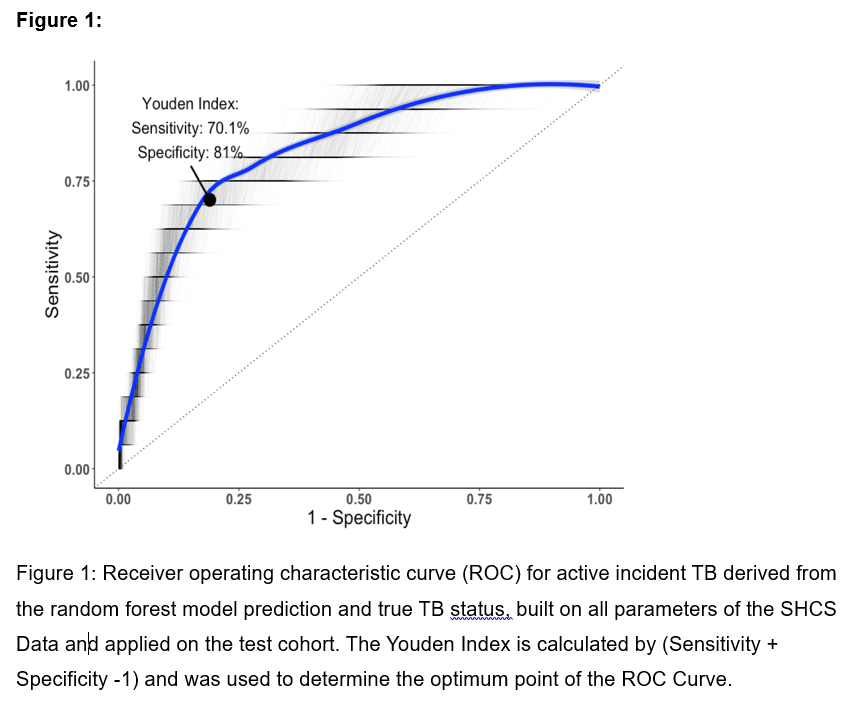
The model predicted active TB with an area under the receiver operating characteristic (ROC) curve (AUC) of 0.83 (95% CI 0.8-0.86) in the SHCS. After adjusting for demographic variables and re-fitting the model with fewer parameters, the AUC was 0.72 for Swiss PWH and 0.67 for Austrian PWH. Demographic parameters, particularly region of origin and ethnicity, significantly influenced model performance, likely due to varying TB incidence rates. Socioeconomic factors, such as profession and education, along with mode of HIV transmission, also impacted the model’s predictions. Additionally, laboratory metrics such as CD4 cell count and HIV RNA levels, which reflect immune system status, were critical in predicting TB progression. Overall health markers, such as BMI, creatinine, and hemoglobin, also affected model accuracy. The model outperformed standard diagnostic tools (tuberculin skin test and interferon-gamma release assay) in identifying high-risk individuals, demonstrated by a lower number needed to diagnose (1.96 vs. 4).
Conclusions
Machine learning-based models show considerable potential to improve care for PWH, as they require no additional data collection, incur minimal costs, and enhance the identification of those who could benefit from preventive TB treatment.
Table or Figure