Background
Second-generation integrase inhibitors are the cornerstone of antiretroviral therapy (ART) worldwide. Recently, WHO reported higher levels of dolutegravir (DTG) resistance in some low and middle-income countries compared to clinical trial data. As resources for resistance testing remain limited, we implemented a prospective reflex testing strategy (ITREMA-2) to prioritize resistance testing to those most likely to benefit.
Methods
All individuals with viral loads (VL) ≥400 c/mL from two hospitals in Johannesburg were offered participation. Plasma DTG (pDTG) levels were determined using a semi-quantitative enzyme immunoassay (ARK Diagnostics). Samples with pDTG ≥20 ng/mL were classified as detectable. Resistance testing was performed on all samples with detectable pDTG levels and on a random subset with undetectable pDTG. Mutations were assessed with Stanford HIVdb v9.6.
Results
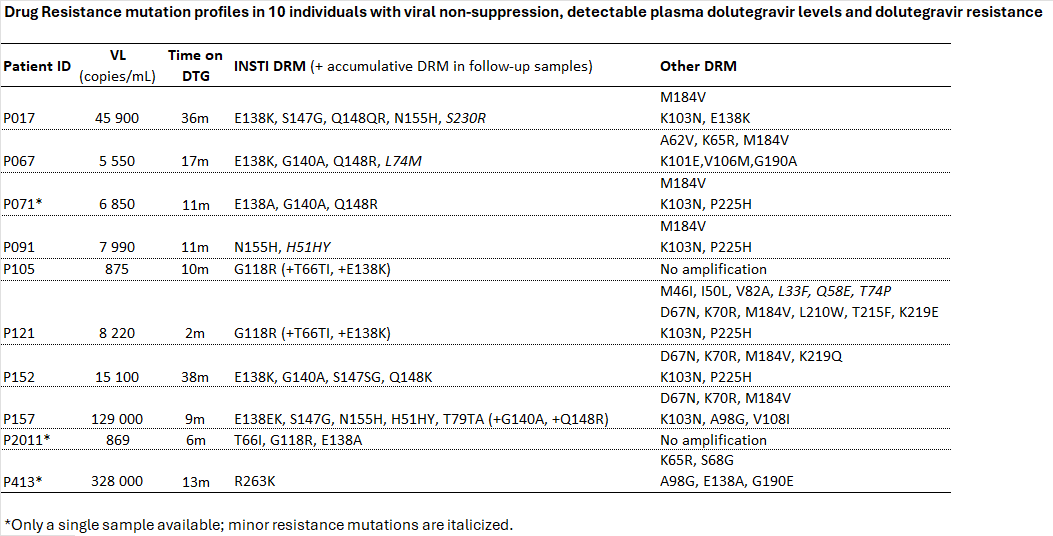
Between April 2023 and September 2024, 208 out of 210 eligible individuals with ≥12 weeks DTG exposure and VL≥400 cp/mL participated (288 samples). Most were female (57%), mean age of 42 years (SD +/- 13), median log10 VL of 4.1 cp/mL (IQR: 3.1-4.9), median duration of ART was 89 months (IQR: 46-155), including DTG for 11 months (IQR: 6-24 months). pDTG was below detection limits in 175 samples (60%), indicating non-adherence. Only 33% of individuals with VL≥1000 c/mL had detectable pDTG levels versus 64% of those with VL 400-1000 c/mL (p<0.001). Detectable pDTG levels were not associated with sex, age, regimen, facility, duration of DTG, total ART duration, prior PI or NNRTI exposure. As part of the reflex strategy, 96 sequences were generated from 75 individuals with detectable pDTG levels. DTG resistance was detected in 13% (10/75) of individuals showing diverse mutation profiles. Accumulation of integrase mutations was observed in 3 individuals within 7 months of follow-up (Table). At least eight individuals with DTG resistance had prior NNRTI and/or PI exposure. DTG resistance was not detected in the 17 randomly selected virally unsuppressed individuals with undetectable pDTG levels.
Conclusions
Prevalence of DTG resistance in virally unsuppressed individuals with detectable pDTG levels was 13%; higher than reported from unselected individuals in routine care. Reflex pDTG exposure testing offers an objective and easily implementable measure to identify virally unsuppressed individuals with non-adherence, optimizing the allocation of limited resources for those most likely to benefit.
Table or Figure