Background
Children who are HIV-exposed, uninfected (CHEU) have had higher incidence and earlier cytomegalovirus (CMV) acquisition than children who are HIV-unexposed, uninfected (CHUU), which may contribute to the higher morbidity and mortality observed among CHEU. To determine whether this difference in CMV acquisition persists in the era of optimized, universal ART, we assessed the probability, timing, and correlates of primary CMV infection within a recent birth cohort of CHEU and CHUU.
Methods
Women without HIV and women living with HIV on ART for ≥6 months were recruited in pregnancy (28-42 weeks gestation) from a maternal-child health clinic in Nairobi, Kenya between December 2018-March 2020; 89% of mothers with HIV initiated ART before pregnancy. Mother-infant pairs were followed for 12 months postpartum with weekly data and sample collection. Quantitative PCR was used to measure log10-CMV DNA levels in infant urine/saliva and maternal saliva/breast milk. The probability and timing of infant CMV acquisition were determined by Kaplan-Meier survival analysis. Correlates of CMV acquisition were assessed using Cox proportional hazards regression models stratified by exclusive breastfeeding (EBF) status and adjusted for infant sex, HIV exposure, and household crowding.
Results
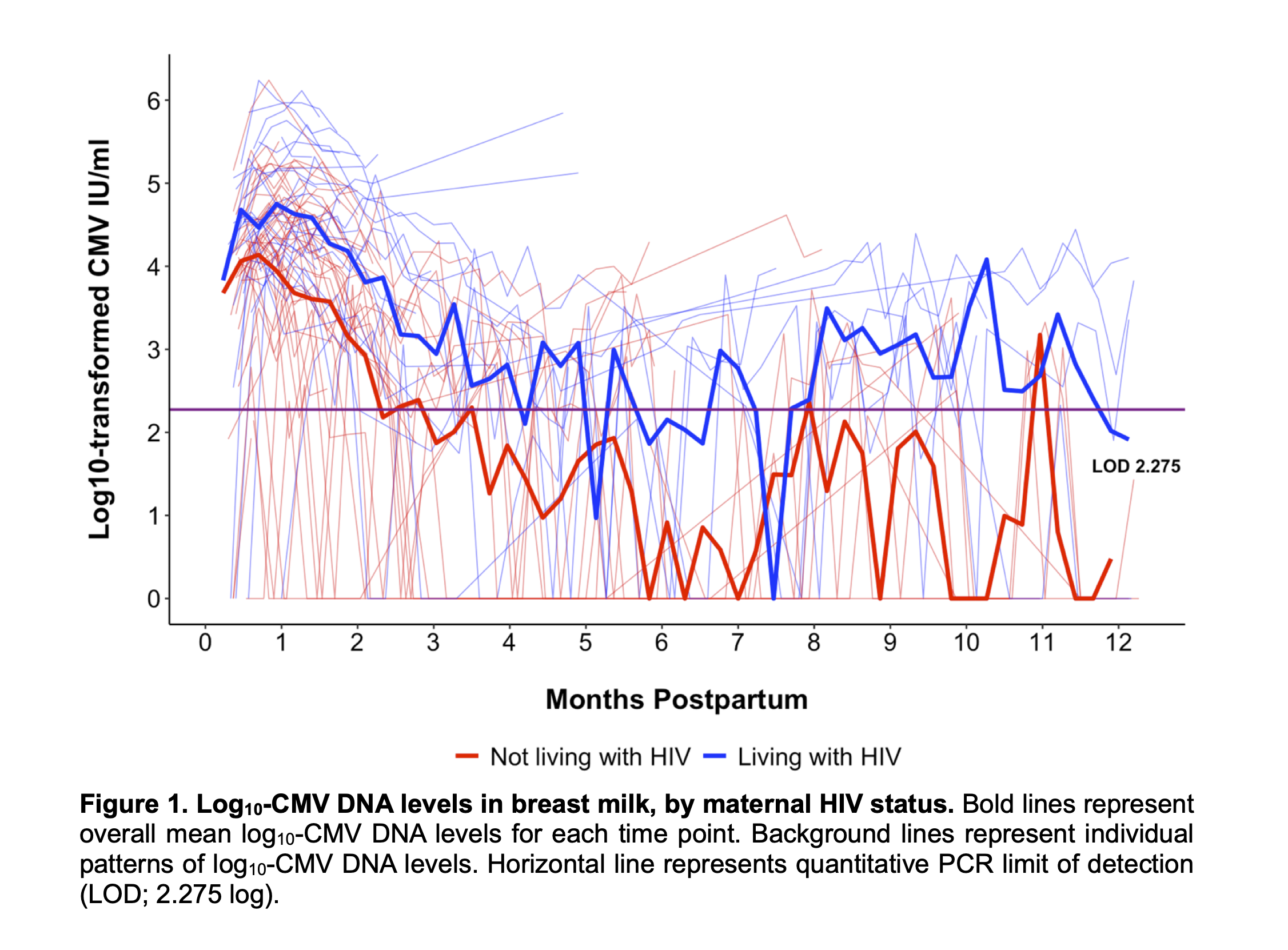
Fifty-three (74%) of 72 infants (22 CHEU, 31 CHUU) acquired CMV. Median time to infection was 2.4 months (IQR 2.0-4.7) and did not differ by HIV exposure (log-rank p=0.7). HIV exposure did not affect the hazard of CMV acquisition when infants were EBF (adjusted hazard ratio [aHR]= 1.24, 95% CI: 0.69-2.23, p=0.471) or not EBF (aHR=0.52, 95% CI: 0.10-2.68, p=0.438). However, the hazard was two times greater per log10 increase in breastmilk CMV DNA both when infants were EBF (aHR=2.09, 95% CI: 1.48-2.95, p<0.001) and received mixed feeds (aHR=1.98, 95% CI: 1.26-3.10, p=0.003); this finding did not differ by HIV exposure. Women living with HIV had higher CMV DNA levels in breast milk despite initiating ART before (89%) or in early (11%) pregnancy (Figure 1).
Conclusions
Probability of CMV acquisition was similar between CHUU and CHEU whose mothers initiated optimized ART before pregnancy, and 74% of infants acquired CMV in the first 3 months of life. Breast milk remains a primary source of CMV acquisition for all infants. Though mothers with HIV had higher breast milk CMV DNA levels despite receiving optimized ART before or in early pregnancy, this did not translate to higher risk of CMV acquisition among CHEU.
Table or Figure