Background
A cascade of inflammatory responses begins after HIV infection, prompting cytokine production and leading to a persistent inflammatory state which is associated with an increased risk of adverse outcomes and death. We assessed correlates of baseline serum proinflammatory cytokine levels and their association with hospitalization outcomes in a cohort of severely-ill ART-naïve Kenyan children living with HIV (CLHIV).
Methods
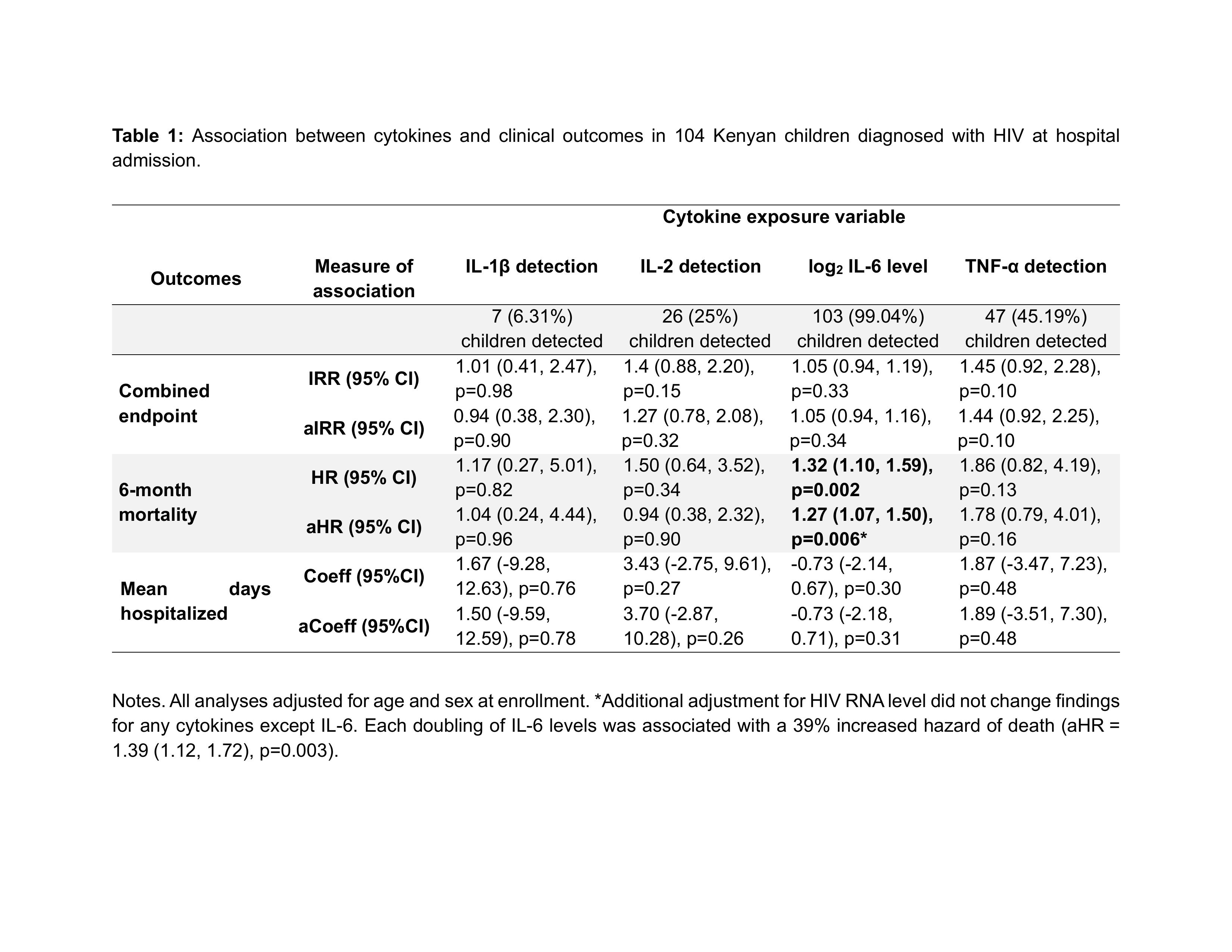
Admission serum samples of 104 CLHIV with median age at enrollment of 2.05 years (IQR=0.99, 6.02) from the PUSH Study (NCT02063880) were used to measure levels of IL-1β, IL-2, IL-6, and TNF-α. A priori study endpoints were death within 6-months of admission, combined endpoint of death or continued hospitalization at 15-days, and mean number of days spent in hospital. Potential correlates were assessed using Poisson and linear regression. Models were used to estimate 6-month hazard ratio of death (Cox regression), relative risk of combined endpoint (Poisson regression), and duration of hospitalization (linear regression); all analyses were adjusted for sex and age at admission.
Results
IL-6 was detected in 103(99.04%) children, IL-1β in 7(6.31%), IL-2 in 26(25%), and TNF-α in 47(45.19%). IL-1β detection was independently associated with higher log10 cytomegalovirus (CMV) DNA-level (p<0.01) and pneumonia diagnosis (p<0.01). Receipt of steroids was associated with lower prevalence of IL-1β detection (p<0.01). Total neutrophil count (p<0.01), hemoglobin level (g/dL) (p<0.01), and CD4% (p<0.01) were independently associated with decreased IL-2 detection. Higher C-reactive protein (p<0.01) and higher CD4% (p<0.01) were associated with higher IL-6 levels. Each doubling of IL-6 levels was associated with a 27% increased hazard of death (aHR=1.27 (95%CI=1.07, 1.50), p<0.01). No correlates of TNF-α were identified. No association between any cytokines and hospitalization duration or the combined outcome were found.
Conclusions
These findings provide novel insights into drivers of inflammation in severely-ill ART-naïve CLHIV and suggest IL-6 is a prognostic marker for increased risk of death in this population.
Table or Figure