Background
Chronologic aging has been reported to impair antibody responses to influenza (flu) vaccination with greater impairment in PWH occurring at a younger age than in people without HIV (PWoH). High-dose (HD) vaccine, with four times more antigen than standard-dose (SD), is recommended for people ages ≥65 years to improve effectiveness but has not been widely studied in PWH.
Methods
237 participants (PWH, virally suppressed, and PWoH) consisting of young (Y, 18-40 years; PWH, N=42 and PWoH, N=56) and old, (O, ≥60 years; PWH, N=67 and PWoH, N=72) were enrolled into the study (NCT04487041) and given SD vaccine during the 20-21, 21-22, or 22-23 flu seasons. The following season, HD vaccine was given to a subset of participants (OPWH: N=37; OPWoH: N=37; YPWH: N=15; YPWoH: N=18). Serum hemagglutination inhibition (HAI) titers to H1N1 (H1), H3N2 (H3), B/Yamagata (BYam), and B/Victoria (BVic) antigens were measured at 0-, 28-, and 180-days post-vaccination (dpv). As recent H3 viruses do not bind red blood cells, we could not assess H3 HAI responses to HD. Nonparametric tests and linear regression were performed in R. P values <0.05 were deemed significant.
Results
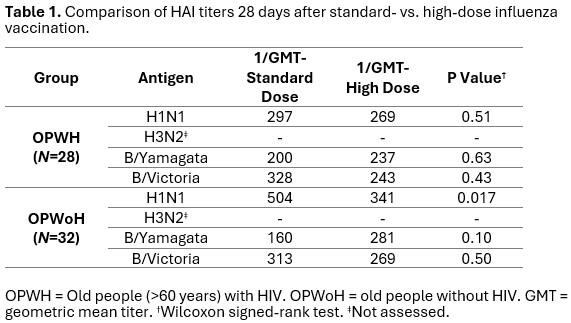
Baseline titers did not differ between PWH and PWoH but compared to Y, O had lower H3 (1:65 vs. 1:110, P<0.01) and BVic (1:100 vs. 1:134, P<0.01), higher BYam (1:58 vs. 1:45, P<0.05), and similar H1 titers. At 28 dpv-SD, although H1, H3, and BYam titers increased more than two-fold from baseline in all groups, log2 fold-change (FC) from 0 dpv to H1 was lower in O than in Y (1.7 vs. 2.3, P<0.05). Moreover, H1 titers (1:298 vs.1:425, P<0.01) and FC (1.7 vs. 2.1, P=0.06) were lower in PWH than in PWoH. After HD, at 28 dpv, H1 titers remained lower in O (1:306 vs. 1:430, P<0.05) and PWH (1:279 vs. 1:401, P=0.07) compared to Y and PWoH. On paired analysis at 28 dpv-HD, H1 titers did not differ from SD in OPWH (Table 1) and, unexpectedly, decreased in PWoH (1:504 vs. 1:341, P <0.05). At 180 dpv-HD, titers for all antigens dropped significantly from 28 dpv levels and no longer differed from the baseline, for all groups. In a regression model which controlled for age, race, HIV status, and vaccination history, HD was associated with improvements only in 28 dpv BVic responses (β=757, P<0.05).
Conclusions
SD and HD vaccination drive strong, transient responses to flu antigens. Old individuals and PWH have decreased H1 responses. Our data indicate that HD vaccine demonstrates limited efficacy in further enhancing immune responses of older PWH.
Table or Figure