
Background
Single tablet regimens (STRs) revolutionized HIV treatment, improving adherence and clinical outcomes; however, many people with HIV (PWH) on complex regimens (CRs) cannot take available STRs due to viral resistance, intolerance, contraindications, or drug-drug interactions. A novel STR of bictegravir (BIC) and lenacapavir (LEN) may offer an alternative treatment option. ARTISTRY-1 (NCT05502341) is a randomized, open-label trial evaluating BIC and LEN in PWH with virologic suppression (VS) on a CR. In Phase 2, BIC+LEN maintained VS through Week (W) 48 in PWH, most of whom had baseline resistance. We report Phase 3 efficacy and safety of BIC/LEN STR.
Methods
PWH with VS on a stable CR were randomized 2:1 to switch to once-daily oral STR of BIC/LEN (75/50 mg) or continue their CR. The primary endpoint was HIV-1 RNA ≥50 copies(c)/mL (US FDA Snapshot algorithm; noninferiority margin 4%) at W48. Secondary endpoints included HIV-1 RNA <50 c/mL and change in CD4 cell count at W48, and incidence of adverse events (AEs) through W48; exploratory endpoints included treatment satisfaction (HIVSTQ status version) at W48.
Results
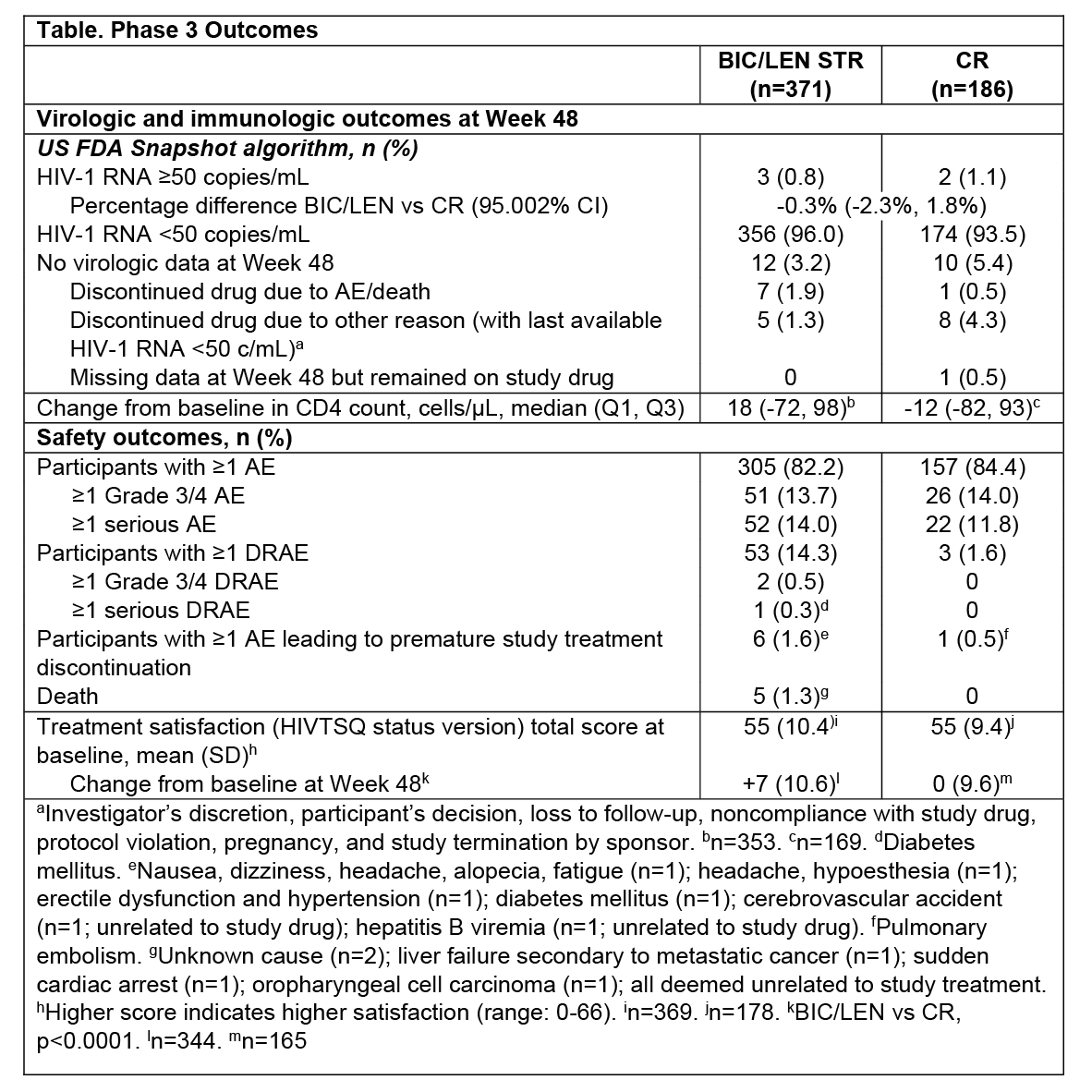
Overall, 557 PWH were randomized and treated; 371 switched to BIC/LEN and 186 continued CR. At baseline, median (range) age was 60 (22-84) years; 18% were female. The median (range) HIV treatment duration was 28 (3-45) years and 80% had ≥1 comorbid condition of dyslipidemia, hypertension, diabetes, or chronic kidney disease. Participants were taking a median (range) of 3 (2-11) antiretroviral tablets/day; 77% were on a protease inhibitor. At W48, 0.8% (3/371) and 1.1% (2/186) of participants had HIV-1 RNA ≥50 c/mL in the BIC/LEN and CR groups, respectively (% difference [95.002% CI]: -0.3% [-2.3, 1.8]); 96.0% (356/371) and 93.5% (174/186) participants had HIV-1 RNA <50 c/mL, respectively. No participant had emergent resistance. Outcomes are shown in the Table. Drug-related AEs (DRAEs) were more frequent in the BIC/LEN vs. CR group (14.3% vs. 1.6%); Grade 3/4 DRAEs (0.5% vs. 0) and serious DRAEs (0.3% vs. 0) were rare and similar in both groups. At W48, mean (SD) change from baseline in treatment satisfaction total score was +7 (10.6) in those who switched to BIC/LEN and 0 (9.6) in the CR group (p<0.0001).
Conclusions
BIC/LEN STR maintained high levels of VS and was noninferior to CR at W48. BIC/LEN was generally well tolerated, and led to increased treatment satisfaction. These results support BIC/LEN STR as a new and efficacious treatment option for PWH on a CR.
Table or Figure