Background
Islatravir (ISL), a nucleoside reverse transcriptase (RT) translocation inhibitor, and lenacapavir (LEN), a capsid (CA) inhibitor, have pharmacokinetic profiles supportive of once-weekly (QW) oral dosing. GS-US-563-6041 (NCT05052996) is a Phase 2, open-label study evaluating QW ISL+LEN in virologically suppressed people with HIV-1. At Week (W) 48, ISL+LEN maintained high rates (94.2%) of viral suppression (VS; HIV-1 RNA <50 copies/mL [c/mL]). Here, we report W48 interim HIV-1 resistance analyses.
Methods
Participants received either ISL (2 mg QW from Day [D] 1) + LEN (600 mg D1 and D2; then 300 mg QW) orally (n=52) or remained on once-daily oral bictegravir/emtricitabine/tenofovir alafenamide (B/F/TAF; n=52). Proviral DNA sequencing of HIV-1 protease (PR), RT, and integrase (IN) was performed at screening, and historical genotypes were collected if available. Absence of known primary nucleoside RT inhibitor (NRTI) or non-NRTI (NNRTI) resistance (-R) by genotype was required for eligibility. Genotypic (HIV-1 CA, PR, RT, and IN) and phenotypic resistance analyses were performed at virologic failure (VF; HIV-1 RNA ≥50 c/mL, subsequently confirmed and ≥200 c/mL, or HIV-1 RNA ≥200 c/mL at study drug discontinuation or last visit).
Results
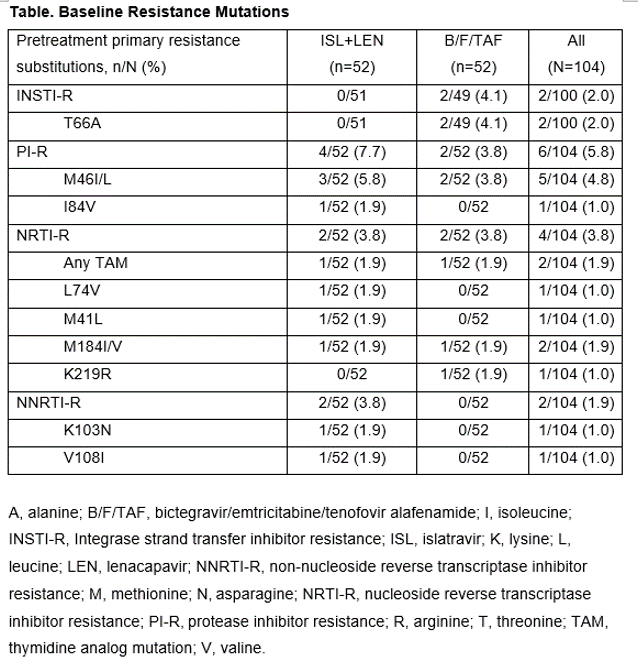
Pre-existing primary resistance-associated mutations were detected in the study population, including five participants who enrolled based on historical genotype and were found to have pre-existing resistance on screening archive genotype after enrollment: 4 (3.8%) participants with NRTI-R, 2 (1.9%) with NNRTI-R, 6 (5.8%) with PR inhibitor-R, and 2 (2.0%) with IN strand transfer inhibitor-R (Table). Of those with VS at W48 (ISL+LEN: 49/52; B/F/TAF: 48/52), two had pre-existing M184V/I in RT (one per arm). Three participants in the ISL+LEN arm had missing data at W48 and did not meet resistance analysis criteria; all three had VS at their last visit. One participant without archived genotypic resistance (including M184I/V) receiving ISL+LEN with HIV-1 RNA ≥50 c/mL at D1 met criteria for resistance analysis, but did not have treatment-emergent drug resistance, and subsequently resuppressed by W30 while maintaining ISL+LEN. No participants in the B/F/TAF arm met criteria for resistance testing.
Conclusions
ISL+LEN maintained high rates of VS, including one participant with pre-existing M184V. No participants with VF developed study drug resistance. These findings support the ongoing evaluation of ISL+LEN as an oral, QW treatment for HIV-1 infection.
Table or Figure