Background
UNAIDS estimates, derived by fitting mathematical models to national surveillance data, indicate that HIV incidence in sub-Saharan Africa has declined substantially since 2000. We assessed whether the level and age distribution of HIV incidence from mathematical-model derived estimates, which are critical to guide epidemic response strategies, are consistent with empirical HIV incidence observations.
Methods
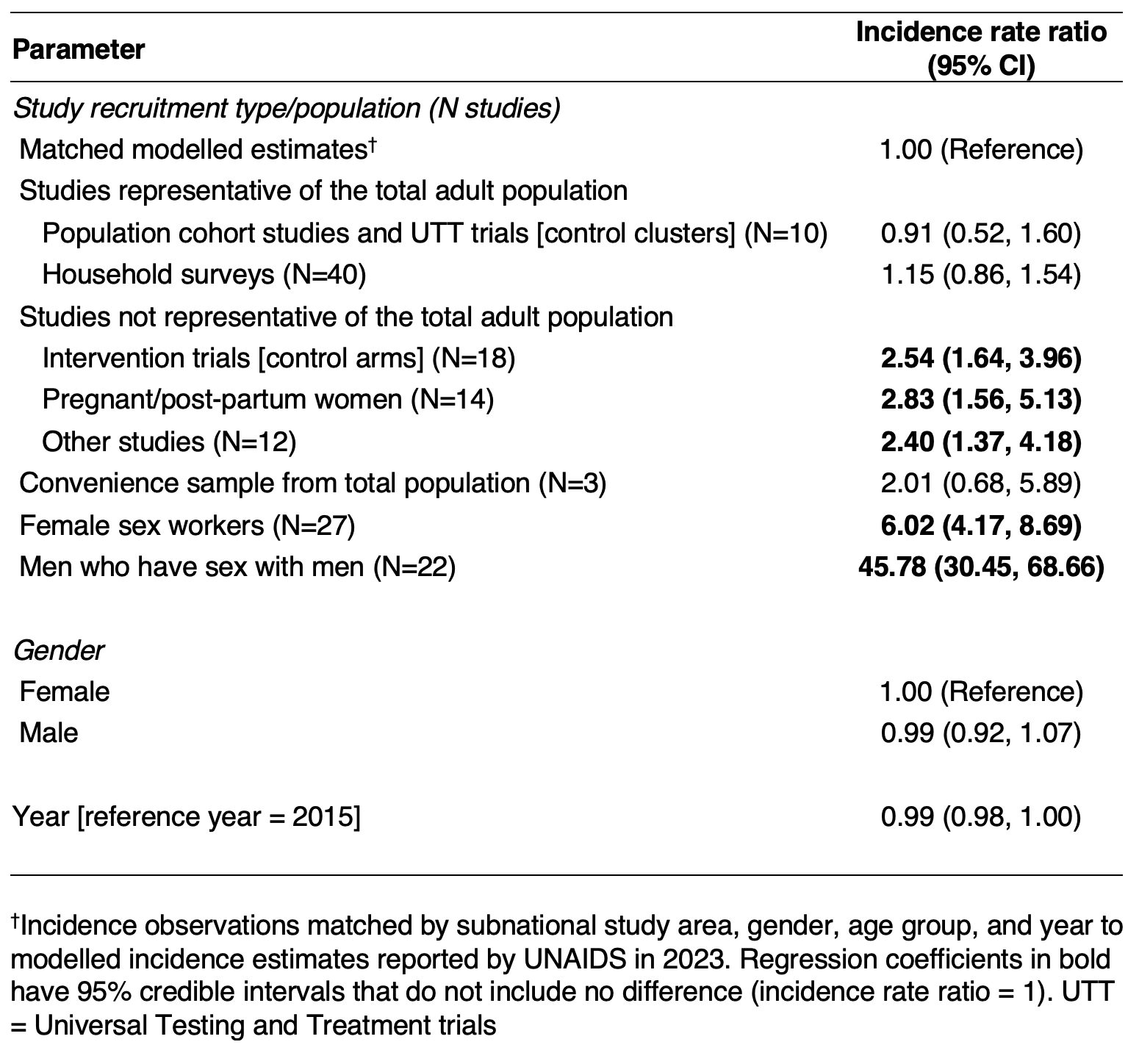
We matched empirical HIV incidence observations from cohort studies, control arms of intervention trials, and Population-Based HIV Impact Assessment household surveys in sub-Saharan Africa conducted 1990-2022 to UNAIDS HIV incidence estimates by study area, gender, age group, and year. Using two Bayesian mixed-effect Poisson regression models we estimated (1) incidence rate ratios (IRR) between all empirical observations and matched modelled incidence estimates with covariates for gender, year, and study type/population; and (2) temporal patterns in age-specific incidence from population-based cohort studies alone.
Results
Incidence data were included from 3479 observations from 148 studies conducted in 21 countries, comprising 20,000 infections and 2.3 million person-years. Across population cohorts in South Africa, Uganda, Zimbabwe, and Kenya, HIV incidence among adults aged 15-49 declined by 75-90% between 2010-2023, and declined 3% (95%CI 2-4%) faster per year among young adults 15-24 compared to age 25+ years. Modelled incidence declined similarly to cohort data, but did not reflect the different rates of decline by age group. Relative to matched modelled estimates, incidence observations from representative household surveys (IRR 1.15 95%CI 0.86, 1.54) and population-based cohorts/Universal Testing and Treatment trials (IRR 0.91 95%CI 0.52-1.60) were not significantly different. Studies among pregnant women (IRR 2.83 95%CI 1.56, 5.13) and control arms of intervention trials (IRR 2.54 95%CI 1.64, 3.96) had significantly higher incidence than modelled incidence estimates.
Conclusions
Incidence from modelled estimates were consistent for level and trend with population-representative studies, but significantly lower than studies with non-representative inclusion criteria, including those among pregnant women and most HIV prevention/vaccine efficacy trials. Incidence has declined steeply among population cohort studies and modelled estimates. The age pattern of incidence in modelled estimates should be revised to capture the aging of the epidemic indicated by cohort studies.
Table or Figure