Background
The prevalence of gestational diabetes (GDM) is increasing globally, including in settings where HIV is prevalent. GDM is associated with pregnancy loss and large-for-gestational age (LGA) deliveries but there are no data on whether these associations are altered by maternal HIV and/or antiretroviral therapy.
Methods
The ORCHID study enrolled pregnant women with HIV (WLH) receiving tenofovir+lamivudine+dolutegravir and a comparison group of HIV-seronegative (HIV-) women (eligibility: age >16y, <18w gestational age (GA) at enrollment, not known with diabetes or hypertension) in Cape Town, South Africa. Pregnancy dating was from research sonography. A 75g oral glucose tolerance test was administered at enrollment and at 32-34 weeks GA; GDM was defined according to WHO 2013 criteria or by clinician diagnosis. In analysis, LGA was based on Intergrowth reference standards. Separate logistic regression models were fit to assess the interaction between GDM and HIV with pregnancy loss (>20w GA) and LGA deliveries, adjusting for known confounders.
Results
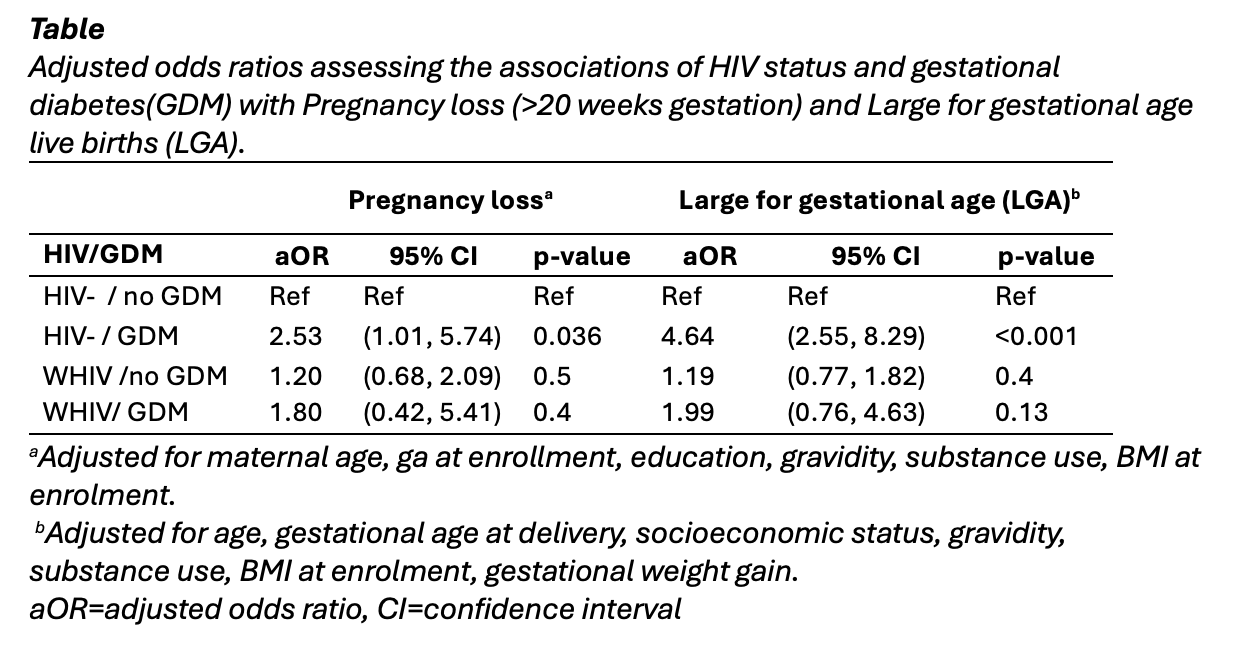
A total of 1817 women (1044 HIV-; 773 WHIV; mean age 28y; median GA at enrollment, 14 weeks) were included in this analysis. 7.8% of WLH and 9.1% of HIV- women were diagnosed with GDM during the study. Birth outcomes were known for 98% of women and included 3.6% with pregnancy loss and 9% LGA live births. Overall women with GDM had increased odds of pregnancy loss (aOR 2.07, 95% CI: 0.97, 4.04), and LGA (aOR 3.17, 95% CI: 1.96, 5.01) compared to women without GDM. These associations were driven by the outcomes of HIV- women (Table). Among HIV- women, rates of pregnancy loss (7.4% vs 3.2%) and LGA (30% vs 7.4%) were significantly higher in women with GDM compared to women without. In contrast, among WLH rates of pregnancy loss (5% vs 3.6%) and LGA (14% vs 8%) were similar between women with and without GDM. In separate multivariable models testing the interaction between HIV and GDM on birth outcomes (not shown) there was evidence for a weaker association between GDM and LGA in WLH compared to HIV- women (interaction odds ratio, 0.36, p=0.061) but no such evidence involving pregnancy loss (interaction odds ratio, 0.59, p=0.5).
Conclusions
These novel findings suggest that maternal HIV infection may attenuate the known effects of GDM on LGA deliveries. Further research is required to understand what mechanisms may drive such an attenuation, and more generally to the long-term implications of GDM diagnoses for WLH and their infants.
Table or Figure