Background
The prevalence of obesity among women with HIV (WWH) is nearly 2-fold higher than in men with HIV, especially in sub-Saharan Africa. Obesity is closely associated with dysglycemia, and in the context of HIV frequently necessitates the co-administration of the first-line antiretroviral dolutegravir (DTG) and the insulin sensitizer metformin. However, a drug interaction exists whereby DTG inhibits the exclusive renal clearance of metformin. A pharmacokinetic study determined that DTG increased the overall metformin plasma exposure by 79%, prompting regulatory and guideline recommendations to limit the maximum metformin dose to 1000 mg/day when co-administered with DTG. The study was conducted in 15 white, male, non-obese healthy volunteers, in contrast to the largest target population of black African, obese WWH. Importantly, obesity has been linked to lower metformin exposures, and our study aimed to verify the metformin pharmacokinetic exposure in the specific target population of obese WWH.
Methods
We conducted intensive plasma sampling over 8 timepoints in virally-suppressed WWH receiving metformin 1000 mg and DTG 50 mg daily at steady-state. Both drugs were administered with a moderate-fat meal under observation. Dual-energy X-ray absorptiometry (DEXA) was performed to quantify body fat composition. Non-compartmental analysis of metformin and DTG concentrations was performed, and our findings compared to the reference study. Linear regression was used to identify covariates associated with metformin exposure.
Results
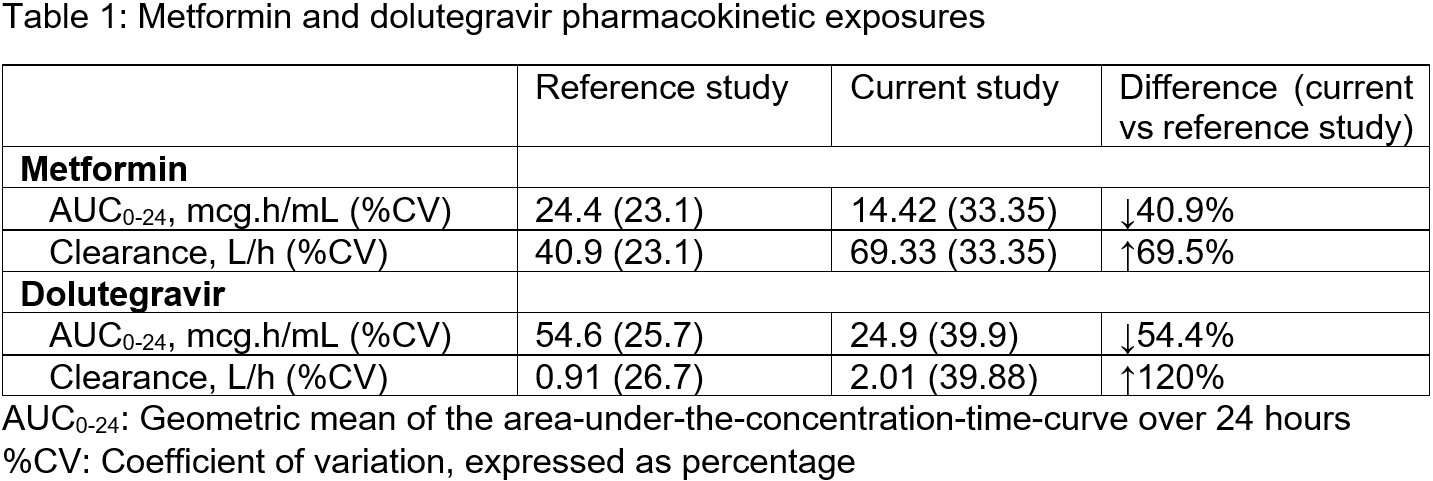
We enrolled 15 participants with a mean body mass index of 45.6 kg/m2 (range 35.6–56.7). Metformin and DTG exposures in obese WWH were approximately half of that in the non-obese healthy volunteers (Table 1). Metformin and DTG clearance were 1.7- and 2.2-fold higher, respectively. We did not detect an association between body fat composition and metformin or DTG exposures.
Conclusions
Limiting metformin to 1000 mg daily is likely to lead to subtherapeutic exposures in obese WWH on DTG. Lower metformin exposures appear to be due to the reduced inhibitory effect of the lower DTG exposure on metformin clearance. Increased volume of distribution due to obesity may also contribute to lower exposures. Our study included obese patients only, and we could therefore not establish an association of body composition with pharmacokinetic exposures. Future studies should include the full range of body mass indices, and determine optimal metformin dosing when co-administered with DTG.
Table or Figure