Background
Early antiretroviral therapy (ART) and continuous suppression drastically limit the size of the HIV reservoir in adults; however, long-term follow up data on the size and composition of the reservoir in children who initiated ART during the first weeks of life remain limited. We studied the effect of early ART on the long-term dynamics of HIV reservoir markers in Thai children suppressed on ART for up to 10 years.
Methods
Forty-nine children with perinatal HIV who initiated ART within a median of 10 IQR [5-14] weeks of life were followed annually (up to 9.9 years). All children received continuous ART during the follow-up period. We quantified total and integrated HIV DNA in CD4 T cells by real-time PCR and measured the frequency of CD4 T cells producing multiply spliced RNA (msRNA) after PMA/ionomycin stimulation by TILDA. Mixed-effects models were used to measure longitudinal decays in each HIV reservoir marker.
Results
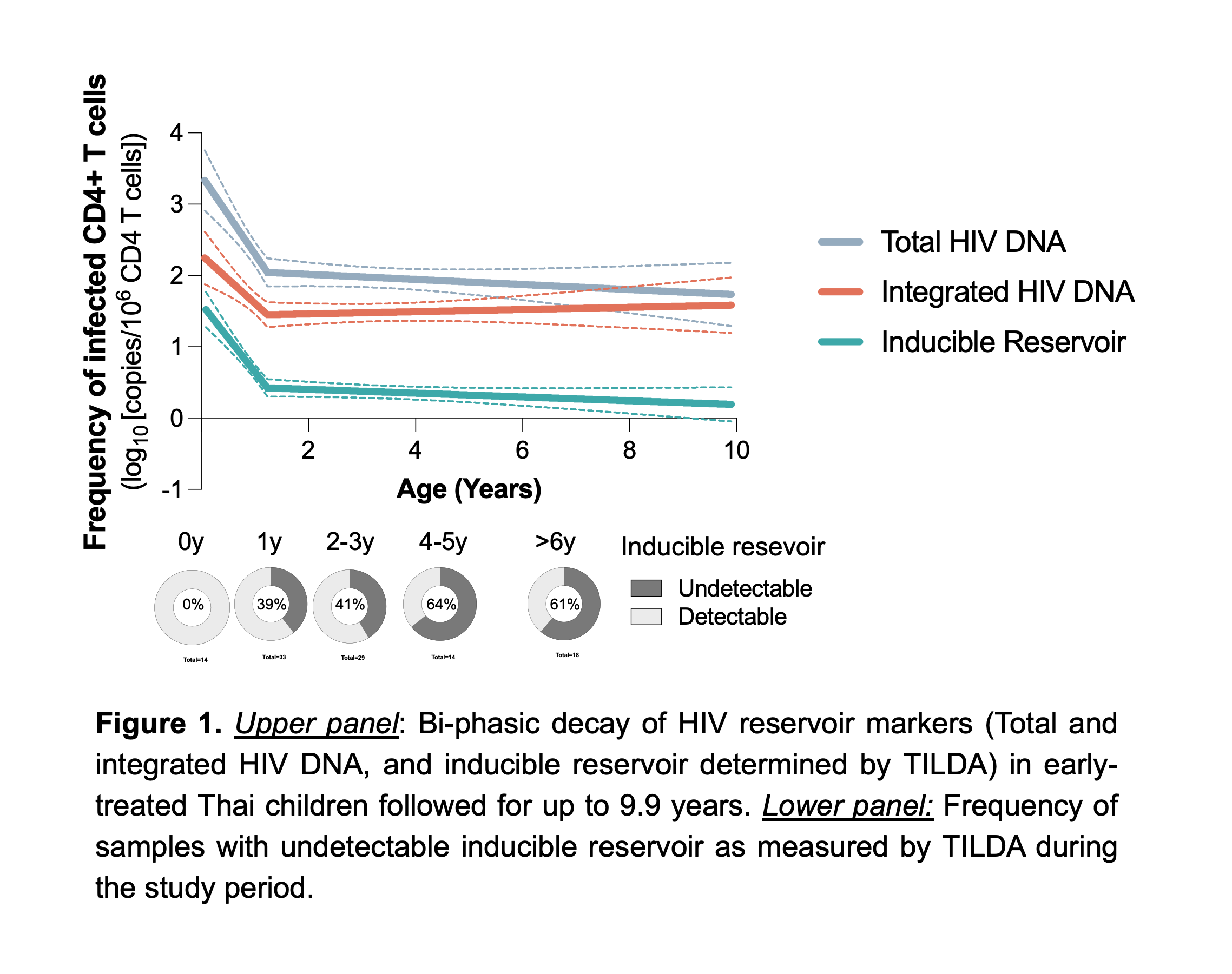
Total HIV DNA, integrated HIV DNA and inducible reservoir were detected in all children at high levels before ART initiation (2189 IQR [691-10011], 139 IQR [51-845] and 50 IQR [1-114] infected cells per 106 CD4 T cells, respectively). Longitudinal analysis over a median 4.9 IQR [2.9-7.3] years of ART revealed a biphasic decay of the 3 HIV reservoir markers, with a rapid initial decline followed by a slower decay. During the first-phase decay, similar half-lives of total HIV DNA, integrated HIV DNA and TILDA measures were observed (decay of -1.10, -0.68 and -0.96 log10 infected cells/year, respectively, p<0.001 in all cases). During the second phase, HIV reservoir markers remained stable (-0.04, 0.02 and -0.03 log10 infected cells/year, respectively, decay p=ns). Despite no apparent decrease in the size of inducible reservoir, the proportion of participants with detectable TILDAs decreased with time on ART: TILDA+ cells were detected in all children at baseline (100%, n=14), in 60% after 1 to 3 years on ART (n=62), and in less than 40% of the participants after 4 years of therapy (n=32).
Conclusions
A large pool of HIV-infected cells is rapidly established in vertically infected Thai infants. Early ART initiation (within 3 months of life) is associated with a rapid initial decay of all HIV reservoir markers, followed by a stable second-phase. The proportion of children with detectable inducible reservoir as measured by TILDA continues to decrease after 3 years on ART, suggesting that prolonged therapy may have long-term benefits in this population.
Table or Figure