Background
Metabolic dysfunction-associated steatotic liver disease (MASLD) and liver fibrosis are key drivers of morbidity and mortality in people with HIV (PWH). Semaglutide reduces steatohepatitis and liver fibrosis in the general population. Limited evidence exists in PWH for managing MASLD and liver fibrosis with semaglutide.
Methods
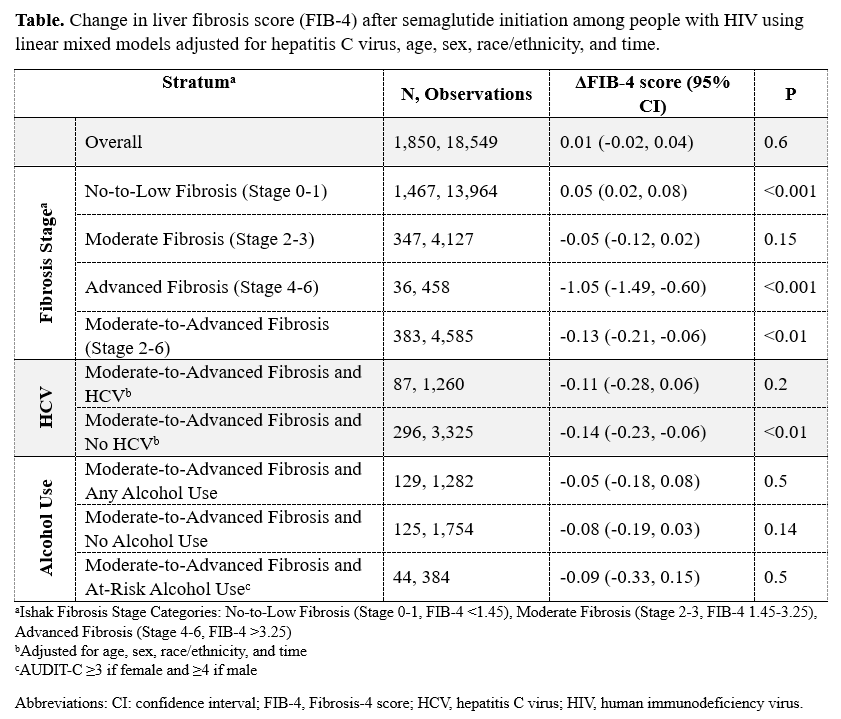
We studied adult PWH in care at 9 CNICS sites who initiated semaglutide for diabetes and weight loss and had liver fibrosis score (FIB-4) data from 4/2018 -11/2024. We grouped PWH by baseline FIB-4 scores corresponding to Ishak fibrosis stages: Stage 0-1 (no/low) (FIB-4 <1.45), Stage 2-3 (moderate) (FIB-4 1.45-3.25), and Stage 4-6 (advanced) (FIB-4 >3.25) . We used adjusted linear mixed models for a quasi-experimental, new-user analysis of semaglutide on liver fibrosis score with several a priori stratifications by fibrosis stage, HCV infection, and alcohol use . Baseline was semaglutide start date. Follow-up was from 4 years before semaglutide initiation until the first of: 11/2024, semaglutide discontinuation, loss to follow up, or death.
Results
Among 1,850 PWH at baseline (mean age 52 years, 27% female sex, 60% non-white race/ethnicity, 96% HIV RNA<200 copies/mL, mean CD4 797 ), 1,467 (79%) had no/low fibrosis, 347 (19%) had moderate fibrosis, and 36 (2%) had advanced fibrosis. Most PWH had co-occurring cardiometabolic conditions , drank alcohol (57%) with low levels of use (mean AUDIT-C 1.6 ), and did not have HCV (84%). Mean time on semaglutide was 218 days. Although semaglutide did not have a statistically significant association with change in liver fibrosis score in the overall cohort, semaglutide was associated with decreases in liver fibrosis score in PWH with baseline moderate-to-advanced fibrosis (ΔFIB-4: -0.13, P<0.01) with the greatest decreases in advanced fibrosis (-1.05, P<0.001). Estimates were comparable by HCV status and alcohol use among PWH with baseline moderate-advanced fibrosis.
Conclusions
Semaglutide was associated with decreased liver fibrosis scores in PWH who have moderate-to-advanced fibrosis and high levels of cardiometabolic conditions. Taken with findings in people without HIV, our study suggests semaglutide could play a role in managing MASLD and liver fibrosis in this population, especially as PWH age and experience the longer-term impacts of cardiometabolic disease. Further work addressing access and how best to implement these therapies for MASLD and liver fibrosis will be needed to maximize benefit in PWH.
Table or Figure