Background
VH4011499 (VH-499) is an HIV-1 capsid inhibitor currently in development as a long-acting antiretroviral agent for HIV-1. Here we describe VH-499 PK and its exposure-HIV-1 RNA response relationship to inform target exposures and dose selection for future clinical studies.
Methods
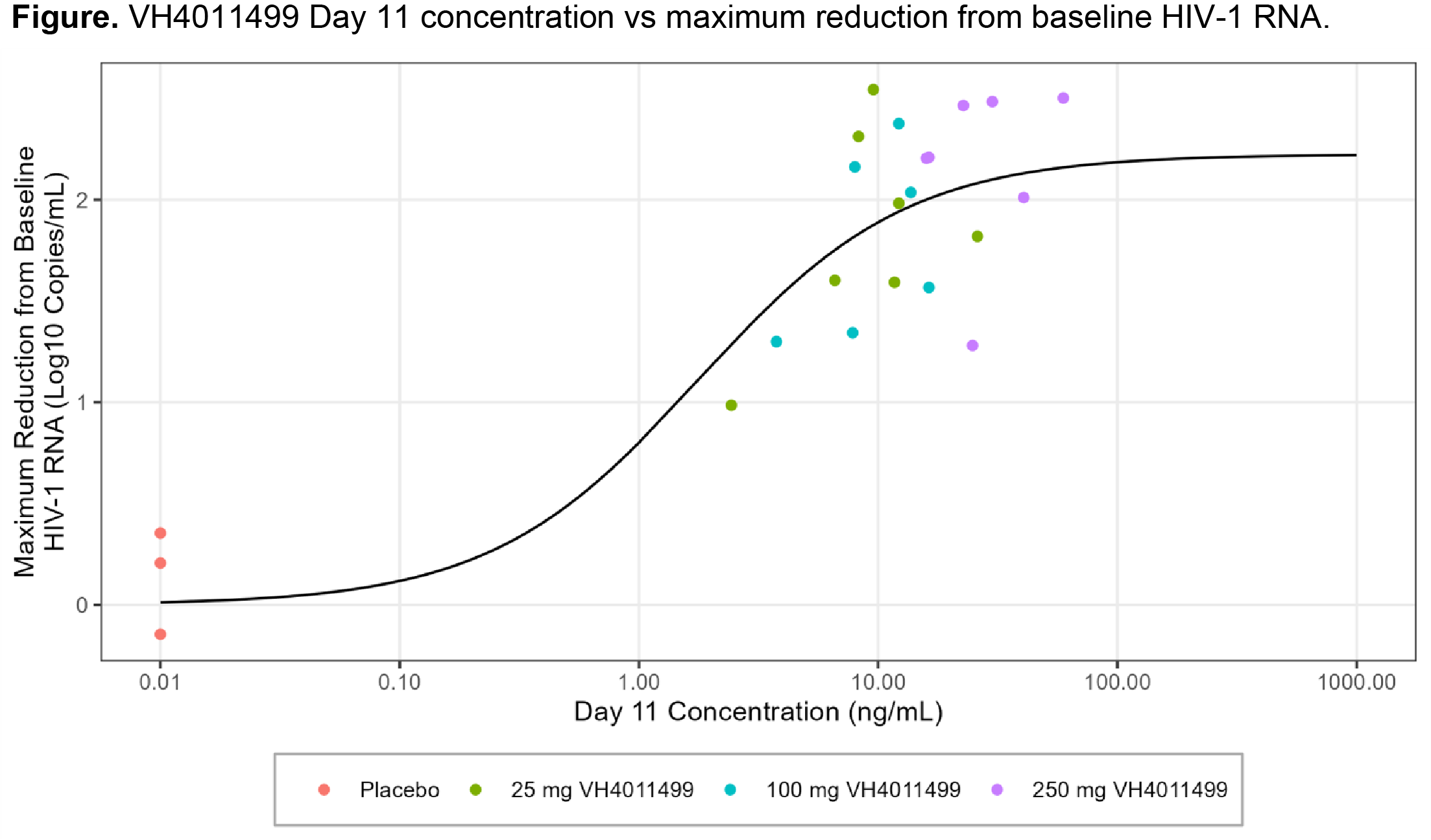
Data were analyzed from 2 phase 1 studies in participants without HIV where VH-499 tablets were administered orally (N=6, 200 mg single dose tablet, moderate fat; N=48, 25 mg and 200 mg in fasted and high fat states) and a phase 2a proof-of-concept (PoC) study (N=20 adults with viremia naive to ART; dosed 25, 100 and 250 mg on Days 1 and 6 for 10 days of monotherapy). A Population PK (POP PK) model was developed, and the impact of clinically relevant demographics and baseline characteristics (including food effect) was evaluated to characterize the PK of VH-499 tablets following oral administration. Exposure-response analysis was performed using relevant PoC data including maximum HIV-1 RNA reduction from baseline vs Day 11 VH-499 concentration using an Emax model. Model-based evaluation of the PK-PD relationship was supported by a priori knowledge of the viral load dynamics of lenacapavir (shared model structure and Emax for both VH-499 and lenacapavir). Model selection was guided by standard model selection criteria, likelihood ratio tests, goodness-of-fit diagnostics and visual predictive checks.
Results
The final POP PK model was a 1-compartment model of disposition with first-order absorption of the tablet formulation and first-order elimination. Relative bioavailability (RBA) of the tablet formulation decreased with increasing dose, in the fasted and moderate fat states. Bioavailability was decreased in the fasted state compared to the fed state. VH-499 exposure showed a strong relationship with HIV-1 RNA decline. A simple Emax model with Day 11 concentration adequately described the VH-499 exposure-response relationship (Figure).
Conclusions
These models helped to characterize VH-499 PK and the strong PK-PD relationship between VH-499 concentration and HIV-1 RNA reduction from baseline. This analysis helped to identify VH-499 target exposures, which will be used to optimize dose selection for long-acting formulations in future VH-499 clinical trials.
Table or Figure