Background
The male genital tract (MGT) is a crucial site for transmission of HIV and co-infecting viruses and functions as an immune-privileged area and key reservoir for HIV, where viral replication can persist despite suppressive ART. The MGT also hosts a distinct microbiota, which may influence viral dynamics and HIV persistence. While previous studies have used semen as a proxy for studying the MGT, here we focus on tissues to investigate the associations between HIV, CMV, EBV, and the genital microbiome.
Methods
Fresh MGT tissue (prostate, testes, epididymis, seminal vesicle) was collected during rapid autopsies (<6 hours of death) from PWH enrolled in San Diego’s Last Gift cohort between 2017 and 2024. CMV DNA, EBV DNA, and cell-associated HIV DNA and HIV RNA were quantified by ddPCR. Bacteriome composition was measured by 16SrRNA sequencing. Adjusted, mixed-effect and generalized linear models were used to assess the associations between CMV, EBV, and relative abundance of taxa (predictors) with HIV DNA and HIV RNA levels (outcomes). P-values were adjusted for multiple comparisons.
Results
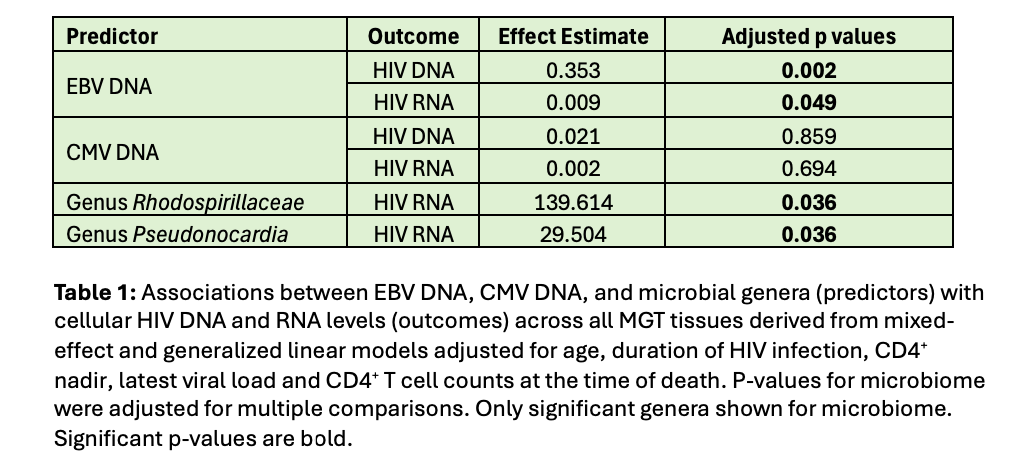
A total of 69 MGT samples from 18 men were analyzed. At time of death, average age was 65 years (range 30-88) and average CD4+ T cell count was 203 cells/µL (range 20-513), with 88% of participants virally suppressed. HIV DNA was detected in 42 samples (61%, average 54.3 copies/106 cells), RNA in 27 (39%, average 0.067 copies/106 cells), CMV in 37 (54%, average 1624.9 copies/106 cells), and EBV in 58 (84%, average 608.6 copies/106cells). Viral levels did not differ significantly across tissue types. After adjusting for relevant covariates, levels of EBV DNA, but not CMV DNA, were positively correlated with both cellular HIV DNA and HIV RNA levels across all MGT tissues (Table 1). In the MGT microbiome analysis, Shannon diversity did not significantly vary across tissue types. Across all MGT tissues, two bacterial genera, Rhodospirillaceae (phylum Proteobacteria) and Pseudonocardia (phylum Actinomycetota), were significantly associated with higher cellular HIV RNA levels (but not HIV DNA).
Conclusions
The associations of Rhodospirillaceae and Pseudonocardia with elevated HIV RNA, alongside EBV’s link to higher HIV DNA and RNA, suggest that microbial and viral interactions may drive local inflammation, promoting HIV persistence in the MGT. These findings point to inflammation-driven mechanisms that could be targeted for novel therapeutic strategies aimed at disrupting HIV reservoirs in tissues.
Table or Figure