Background
In treatment-naïve adults with HIV-1 and hepatitis B virus (HBV) co-infection, the ALLIANCE study showed that bictegravir/emtricitabine/tenofovir alafenamide (B/F/TAF) was noninferior for HIV-1 RNA suppression and superior for HBV DNA suppression compared to dolutegravir + emtricitabine/tenofovir disoproxil fumarate (DTG+F/TDF) at Week [W] 48. Suppression rates were maintained through W96, after which DTG+F/TDF participants switched to B/F/TAF for an additional 48W of open-label extension (OLE). Here, we report efficacy and safety of those who switched.
Methods
ALLIANCE (NCT03547908) was a randomized, double-blind, active-controlled Phase 3 study of B/F/TAF vs DTG+F/TDF in adults with HIV-1 and HBV. This analysis presents data from OLE baseline (BL) through OLE W48 for participants who switched to B/F/TAF from DTG+F/TDF after the 96W randomized phase. We report: OLE BL demographics/characteristics; HIV-1 RNA <50 copies (c)/mL, HBV DNA <29 IU/mL, HBV e-antigen/surface antigen (HBeAg/HBsAg) loss/seroconversion, alanine aminotransferase (ALT) normalization per 2018 American Association for the Study of Liver Diseases (AASLD) criteria at OLE W48 (missing=excluded [M=E]); and study drug–related treatment-emergent adverse events (TEAEs) up to OLE W48.
Results
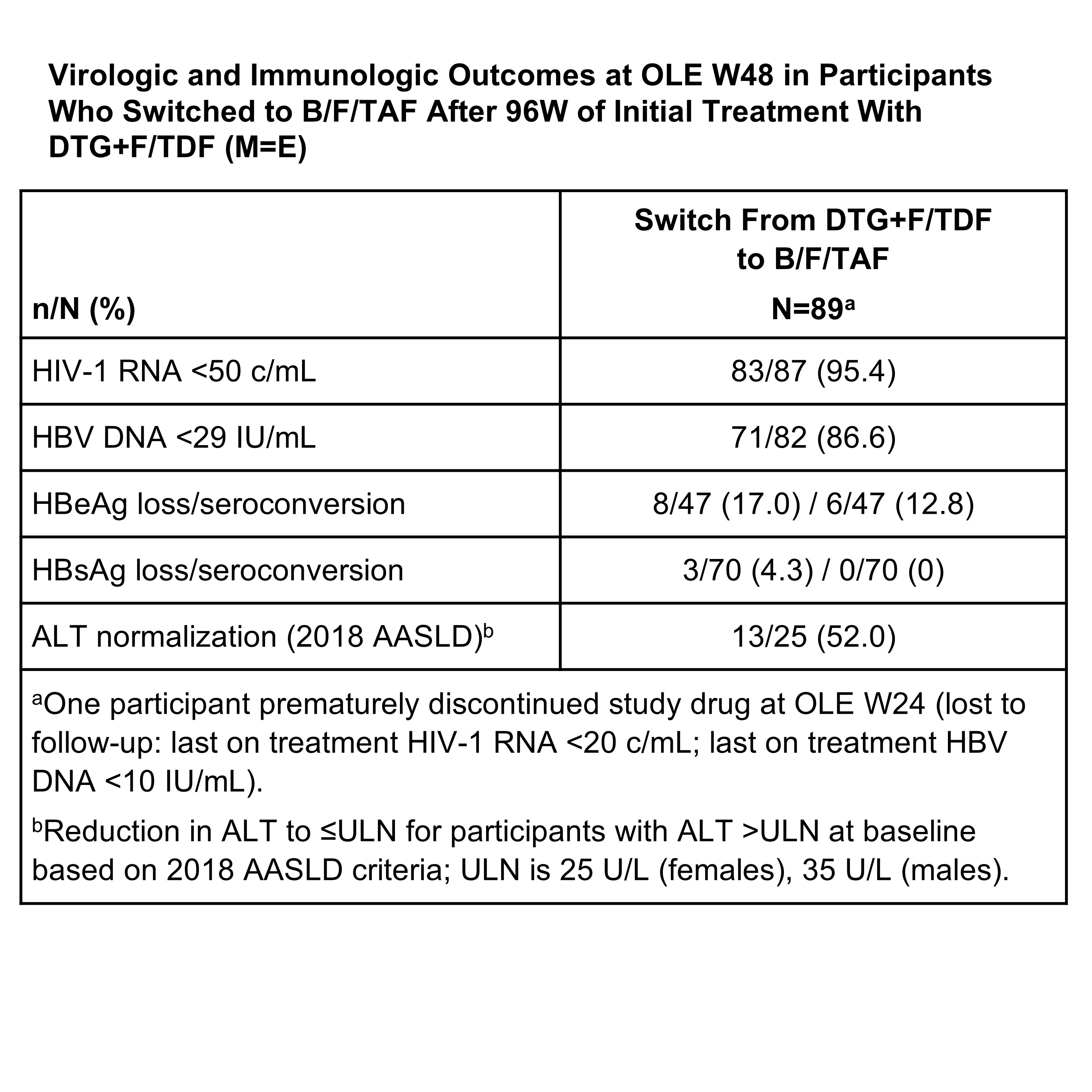
At OLE BL (N=89), 97.8% of participants were male at birth, 94.4% were Asian, median (range) age was 34 (22-61) years, 30.3% had ALT levels above the upper limit of normal (ULN), 58.4% were HBeAg positive, 96.6% had HIV-1 RNA <50 c/mL, and 83.1% had HBV DNA <29 IU/mL. In total, 88 participants (98.9%) who switched to B/F/TAF completed 48 W of OLE. At OLE W48, 95.4% had HIV-1 RNA <50 c/mL and 86.6% had HBV DNA <29 IU/mL (Table). HBeAg loss/seroconversion was 17.0%/12.8%; HBsAg loss/seroconversion was 4.3%/0%; ALT normalization was 52% (Table). Up to OLE W48, 17 (19.1%) participants experienced a study drug-related TEAE (none serious), of which 3 (3.4%) were Grade 3 or 4; no participants experienced a TEAE that led to discontinuation and none died.
Conclusions
B/F/TAF maintained high rates of HIV-1 and HBV viral suppression following switch from DTG+F/TDF, with further improvements in key clinical outcomes including HBeAg loss/seroconversion, HBsAg loss, and ALT normalization through 48W of open-label B/F/TAF treatment. Overall, B/F/TAF was well tolerated, with no study drug discontinuations due to TEAEs. These results demonstrate the efficacy and safety of B/F/TAF in people with both HIV-1 and HBV who switched from DTG+F/TDF.
Table or Figure