Background
Low-barrier care (LBC) improves viral suppression (VS) among persons with HIV (PWH) who have complex needs. We extend prior analyses of LBC effectiveness and identify patient characteristics associated with greater benefit.
Methods
This retrospective cohort analysis included PWH enrolled in the Max Clinic in Seattle, WA from Dec 2014–Dec 2023 who had ≥6 months of observation time pre-and post-enrollment. Patient characteristics were drawn from electronic health records and viral load (VL) results from HIV surveillance. Observation periods were divided into 6-month intervals from the earliest analysis date or, if later, HIV diagnosis date. VS (<200 copies/mL) in each interval was defined by the last VL in the interval. Intervals missing VLs carried forward VS status from the prior window once, if suppressed, or until the next result if unsuppressed. Max enrollment in each interval was either pre- or post- (one way entry), with the first post- interval having ≥3 months of enrollment. Due to data clustering, generalized estimating equations were used to estimate VS probabilities. Predictors included Max enrollment, gender, and 3 dichotomous risk factors: homelessness/unstable housing (HUH), substance use (SU; methamphetamine, opioids, or cocaine), and severe mental illness (SMI; psychotic, bipolar, or personality disorder) at enrollment. Interactions among variables and sensitivity analyses were run to identify a properly specified predictive model. Predicted probabilities of VS across risk combinations illustrate Max effects.
Results
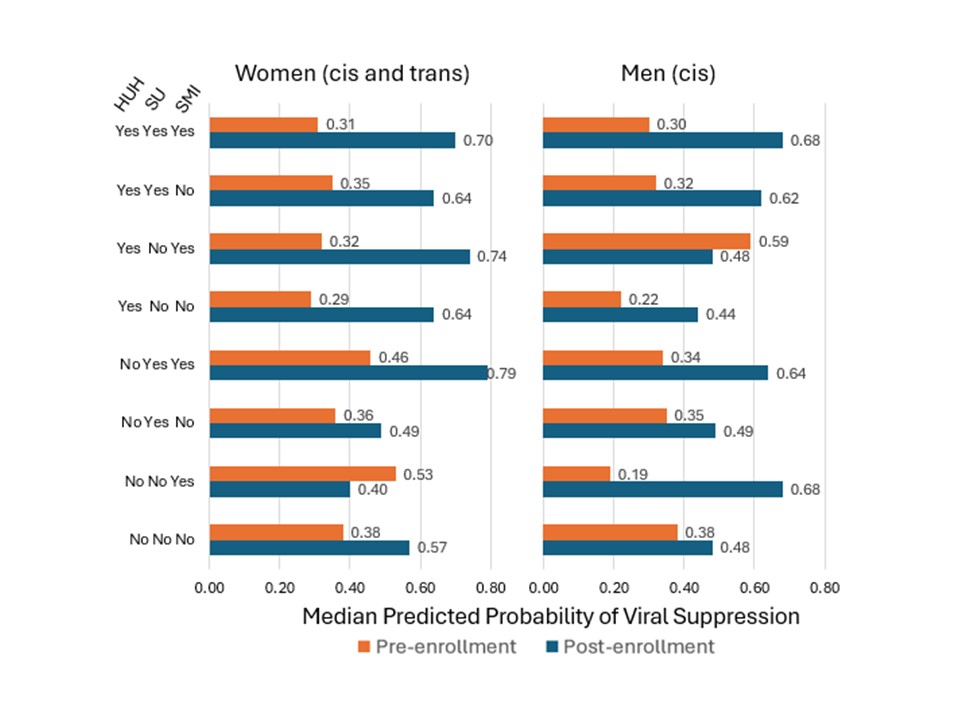
398 persons with 6928 6-month intervals were included; 76% cisgender men, 21% cisgender women, and 4% transgender women. 309 (78%) had HUH, 292 (73%) SU, and 112 (28%) SMI; 58 (15%) had none of these. Max Clinic enrollment was associated with an increase in VS [RR 1.78 (95% CI: 1.61-1.96; p<0.001)], with overall VS probabilities of 36% pre- and 60% post-enrollment. In bivariate analysis, VS was more likely among patients with HUH (RR 1.13, p=0.05), SMI (RR 1.13, p=0.04), and older age, but not SU (RR 1.14, p=0.09). A 5-way interaction of Max enrollment, HUH, SU, SMI, and gender was needed to fit the data, yielding risk profile and gender specific Max enrollment effects (Figure). Median VS in PWH with all 3 risks (pooled across gender) increased from 30% pre- to 70% post-enrollment vs. 38% to 52% among those with no risk factors.
Conclusions
VS increased with LBC enrollment across risk categories; PWH with multiple risk factors had the most improvement.
Table or Figure