Background
Nucleic acid testing (NAT) is a highly sensitive detection method routinely used to screen donated blood for human immunodeficiency virus (HIV), hepatitis B virus (HBV), and hepatitis C virus (HCV) in high-income countries. Despite this technology being available for decades, few low- and middle-income countries (LMIC) in sub-Saharan Africa (SSA) have implemented NAT. We aimed to quantify the risk to transfusion recipients this disparity in access to screening technology causes using data from Uganda, which implemented NAT in July 2022.
Methods
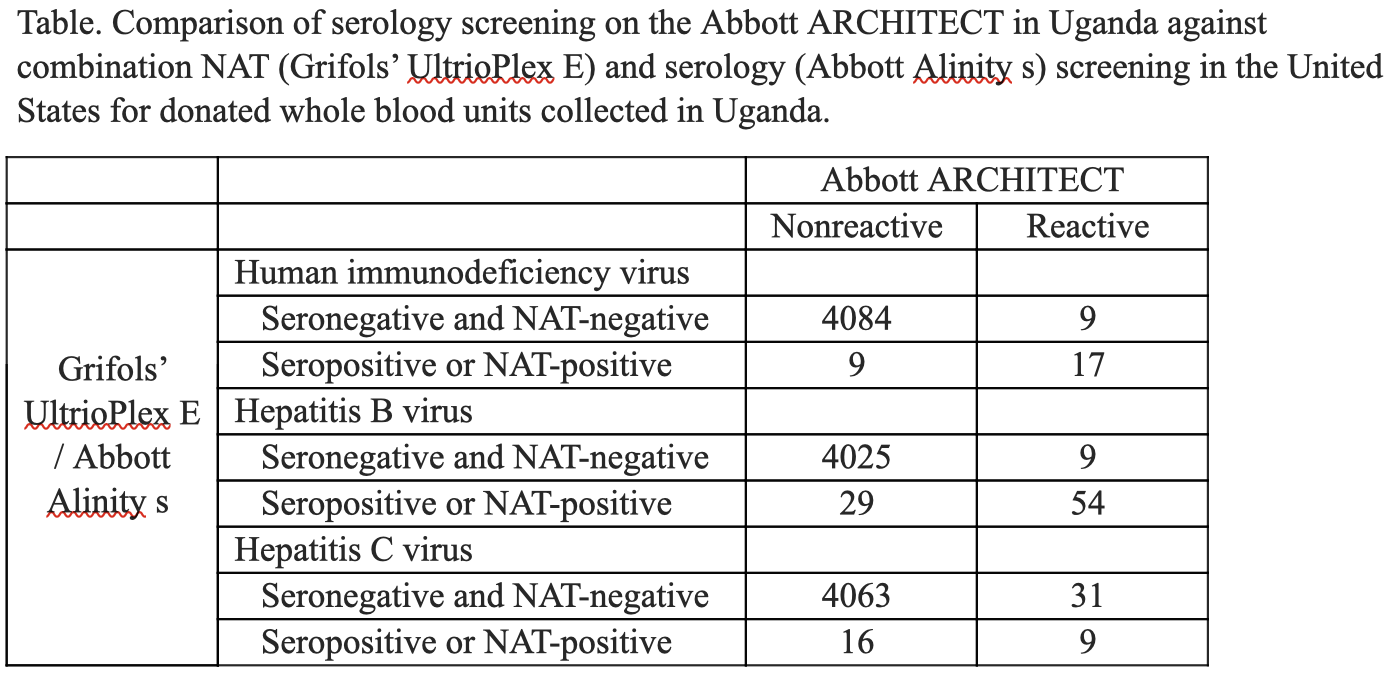
Units collected by the Uganda Blood Transfusion Service from October 2019 to June 2022 were tested for HIV, HBV and HCV on the Abbott ARCHITECT platform as part of routine serologic screening in Uganda. The units were retested by the American Red Cross in 2023 using a combination of individual unit NAT (Grifols’ Procleix UltrioPlex E Assay [UPE], detecting HIV-1,-2, HBV, and HCV simultaneously) and serology (Abbott Alinity s). Standard confirmatory methods were used for samples discordant between UPE/Alinity s. Pathogen-specific results were compared between ARCHITECT and UPE/Alinity s. Samples testing nonreactive by ARCHITECT but reactive by UPE/Alinity s were summarized by type of reactivity: seropositive only, NAT-positive only and seropositive and NAT-positive. The number of potentially infectious units (i.e., NAT-positive only or seropositive and NAT-positive) per 100,000 that were nonreactive by the ARCHITECT were estimated.
Results
Data from both the ARCHITECT platform and the UPE/Alinity s platforms were avilable for 4,123 units. Among 9 units that were HIV nonreactive on the ARCHITECT but reactive on UPE/Alinity s, 8 were potentially infectious, equating for 195.5/100,000 units. Among 29 units that were HBV nonreactive on the ARCHITECT but reactive on UPE/Alinity s, 27 were potentially infectious, equating to 666.0/100,000 units. Among 16 units that were HCV nonreactive on the ARCHITECT but reactive on UPE/Alinity s, 2 were potentially infectious, equating to 49.0/100,000 units.
Conclusions
The implementation of NAT for donor screening in Uganda, which issues >300,000 units to healthcare facilities a year, has likely prevented thousands of infectious units from entering the blood supply. However, Uganda is one of only a small number of LMIC in SSA that has been able to enact this change. Policies that ensure equitable access and distribution of donor screening tools should be enacted to support safe blood transfusions globally.
Table or Figure