Background
To inform pediatric HIV persistence inclusive of scenarios where antiretroviral therapy (ART) usage may not be completely suppressive, we sought to elucidate reservoir dynamics with and without occasional HIV RNA viremia.
Methods
In Kenyan children living with HIV who initiated ART between 1-12 months of age (median 3 months), we measured HIV RNA and HIV DNA (3-probe-classified intact vs. defective via our cross-subtype intact proviral DNA assay “CS-IPDA”) for up to 8 years of follow up. HIV RNA was quantified every 3-6 months resulting in median of 19 (range 1-32) HIV RNA observations. DNA was quantified approximately every 6 months during the first two years of ART and then every 2 years afterwards resulting in a median of 5 (range 1-10) HIV DNA measurements per child. We developed mathematical models to integrate HIV RNA and DNA data and estimate reservoir decay rates from 57 children who suppressed viremia as well as in an additional 65 children who did not fully suppress and/or experienced ART interruptions with HIV RNA viremia above 1000 copies/mL.
Results
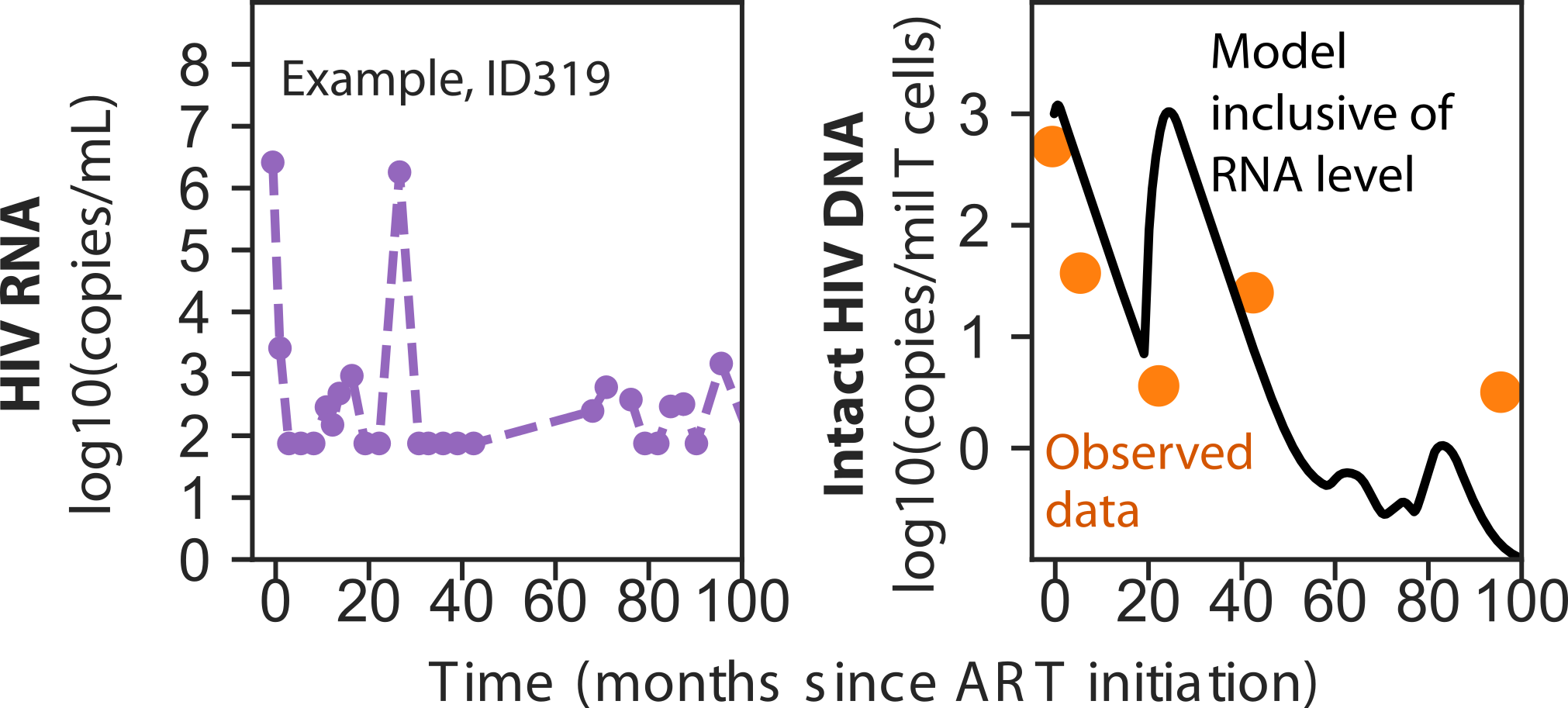
Our model linked periods of HIV RNA viremia to transient rises in both intact and defective HIV DNA. However, after HIV RNA resuppression, HIV DNA levels and decay rates returned to pre-viremic levels (Fig). Consistent with this, long term intact and defective HIV DNA decay rates were not different in CWH with and without treatment interruptions. Estimates (mean and [95% confidence interval]) for HIV DNA decay from CWH who suppressed HIV RNA below 1000 copies/mL by 6 months of ART were biphasic for year 0-1 and 1-8 of ART – intact HIV DNA: 2.7 [2–4.1] followed by 22 [10.5–∞] month half-life; defective HIV DNA: 8.6 [5.4–20.7] month half-life followed by 101 [54–845] month doubling time. We found that there was a moderate relationship between the number of months in which CWH had observed HIV RNA above 1000 copies/mL during follow-up and the HIV DNA level at study end, 8 years after ART initiation (Spearman rho=0.6, p=0.004 and rho=0.5, p=0.01 for intact and defective HIV DNA, respectively).
Conclusions
Models show viremia correlate with rises in HIV DNA, but rises were transient, suggesting most HIV DNA created during treatment interruptions is short lived. Our results also raise the possibility that in CWH, primary infection more effectively seeds long term reservoirs than treatment interruptions after ART is initiated.
Table or Figure