Background
Dual nucleos(t)ide reverse transcriptase inhibitor (NRTI)-free regimens are an attractive choice for simplification of antiretroviral therapy (ART) in treatment-experienced patients. Fixed-dose formulation of rilpivirine (RPV) plus dolutegravir (DTG) is recommended for ART optimization, while Doravirine (DOR) plus DTG is a more recent NRTI-free option. We aimed to compare virologic suppression (VS) in treatment-experienced persons with HIV following switch to DTG+DOR versus DTG+RPV.
Methods
We analyzed DC Cohort study participants ≥18 years during the period Jan 2017-June 2024. Participants with at least 1 year of DC Cohort enrollment were included if prescribed either DTG+DOR or DTG+RPV for ≥60 days. We collected demographics (age, sex, gender, race/ethnicity), chronic kidney disease (CKD) diagnosis, insurance type and viral load data. CD4 count and VS (HIV RNA<200 copies/mL) at regimen initiation was defined as the lab closest to regimen start date (within prior 12 months). In participants with VS pre-switch, Kaplan-Meier curves were used to show the probability of continued VS (HIV RNA<200 copies/mL) from 7 days post-switch until the earliest of 24 months post-switch or regimen cessation.
Results
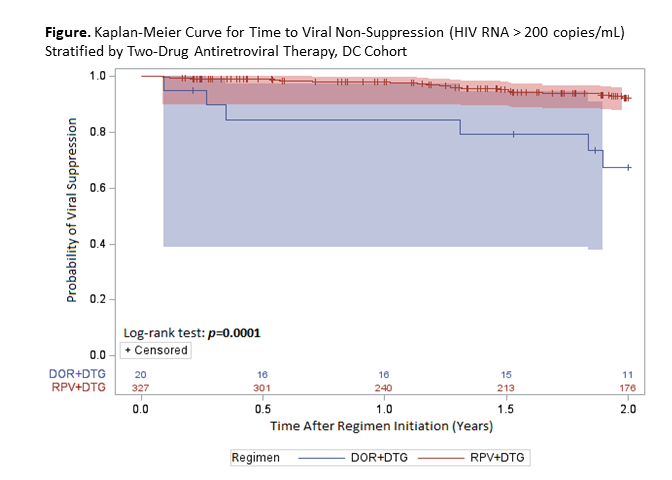
A total of 466 participants were included in the analysis (DTG+DOR group: N = 31; DTG+RPV group: N = 435) with median regimen duration 2.1 years (IQR: 1.0-4.1). The median age was 58.3 years (IQR: 50.5–64.5), and the majority were male (75.8%) and identified as Black (78.8%), with 40.1% with a prior CKD diagnosis. At regimen initiation, VS was observed in 77.4% of the DTG+DOR group versus 86.2% of the DTG+RPV group and median CD4 count was 634 cells/mm³ (IQR: 481–812) in the DTG+DOR group and 595 cells/mm³ (IQR: 432–853) in the DTG+RPV group. DTG+DOR recipients more frequently had public insurance (87.1%) and received care at academic sites (83.9%) than the DTG+RPV group (60.0% and 55.2%, respectively). Among 347 participants with VS at regimen initiation and post-switch VL data, a higher proportion maintained VS on DTG+RPV (308 of 327, 94.1%) compared to DTG+DOR (14 of 20, 70.0%). Log-rank testing indicates a significant difference between Kaplan-Meier curves for each regimen (Figure; p= 0.0001).
Conclusions
Observed differences in VS following switch to DRG+RPV and DTG+DOR may be due to differences in participant characteristics, adherence, viral resistance patterns, and the dual regimens. Further studies are needed to evaluate efficacy of dual NRTI-free regimens in real-world settings.
Table or Figure