Background
Diastolic dysfunction (DD) is increasingly prevalent among people with HIV (PWH) and is associated with a heightened risk of subsequent heart failure (HF). Key mechanisms of HF include left ventricular hypertrophy (LVH), left atrial abnormalities and cardiac fibrosis. Additionally, soluble suppression of tumorigenicity 2 (sST2) has emerged as a potential biomarker for cardiac stress and fibrosis. However, the roles of epicardial fat (EAT), coronary calcium, and sST2 in predicting DD, particularly in older PWH, remain poorly understood.
Methods
We conducted a cross-sectional study in Thai PWH aged ≥50 years. Transthoracic echocardiography, and non-contrast cardiac computed tomography were performed to assess diastolic function, coronary calcium (CAC) and epicardial adipose tissue (EAT), respectively. Serum ST2 and other lab parameters including HIV-related parameters were measured. DD was defined using the PWH specific Characterizing Heart Function on Antiretroviral Therapy (CHART) criteria. Multiple linear and logistic regression were used to assess associations between EAT, CAC score, and sST2 level with relevant echocardiographic parameters and DD.
Results
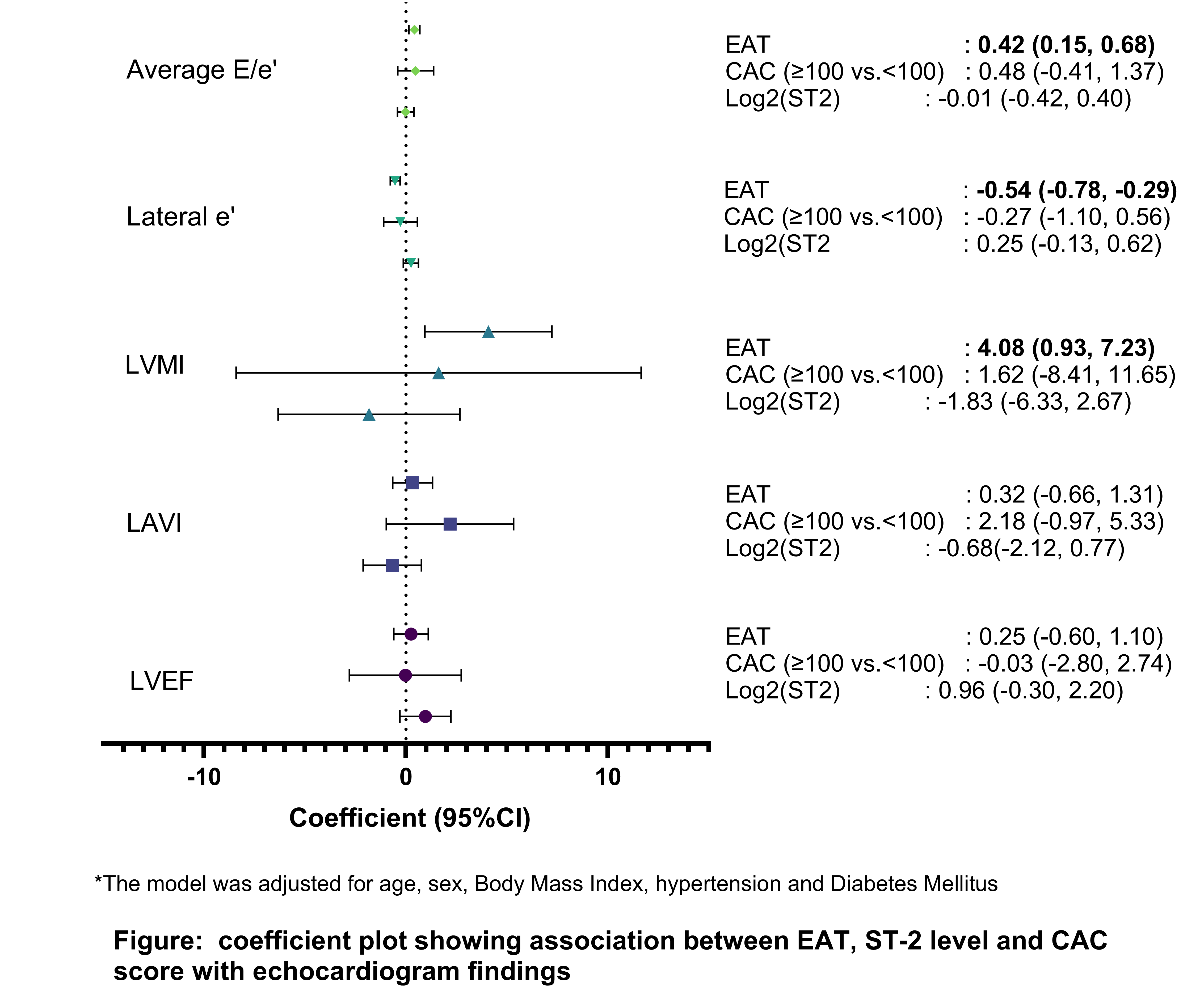
Among 283 PWH (male 62%, median [IQR] age 54 years [52-59]) included, 27% had body mass index (BMI) >25 kg/m2, while 41 and 17% had hypertension and diabetes mellitus (DM), respectively. Median duration of antiretroviral therapy (ART) was 16 years, with current CD4 and CD4/CD8 ratio at 617 (IQR 477-797) cells/µL and 0.96 (IQR 0.68-1.27), respectively. DD was detected in 40%; Mean (SD) EAT was 101 (40) cm3. After adjusting for age, sex, BMI, hypertension and DM, only increased EAT was positively associated with DD (OR 1.49; 95%CI 1.11-1.99 per 1 SD increase; p=0.007). No association was observed between DD and CAC score (OR 0.55-2.71) or sST2 (OR 0.51-1.06). Increasing EAT was significantly associated with increasing left ventricular mass index (LVMI) and average E/e’, and decreasing lateral e’. Although CAC score ≥100 was associated with LAVI after adjusting for age and sex, but the association attenuated after adjustment for BMI, hypertension and DM. (figure).
Conclusions
Increased EAT, but not CAC or sST2, is an independent predictor for DD providing enhanced benefit over established echocardiogram parameters. EAT levels also correlated with LVMI and average E/e’ among older PWH. Assessing EAT could be useful for identifying PWH at high risk of DD and prioritizing care delivery.
Table or Figure