Background
New anal cancer screening guidelines recommend annual anal cytology (PAP) for men who have sex with men (MSM) living with HIV (LWH) aged ≥35 years. Historically our center had offered screening to even younger (>18 years) MSM LWH. There is a growing interest in expanding age-based cancer screening thresholds, including for anal cancer. We assessed the prevalence and outcomes of anal cancer screening among MSM LWH under 35 to better characterize this age threshold.
Methods
We performed a retrospective study (2013-2023) of MSM LWH <35 years at our academic HIV center. We recorded the date and result of each anal PAP and high-resolution anoscopy (HRA; referral criteria were any abnormal PAP) performed between ages 18-34, as well as sociodemographic and HIV-related metrics. We compared characteristics between screened and unscreened cohorts and we report prevalence of high-grade dysplasia and anal cancer in the cohort.
Results
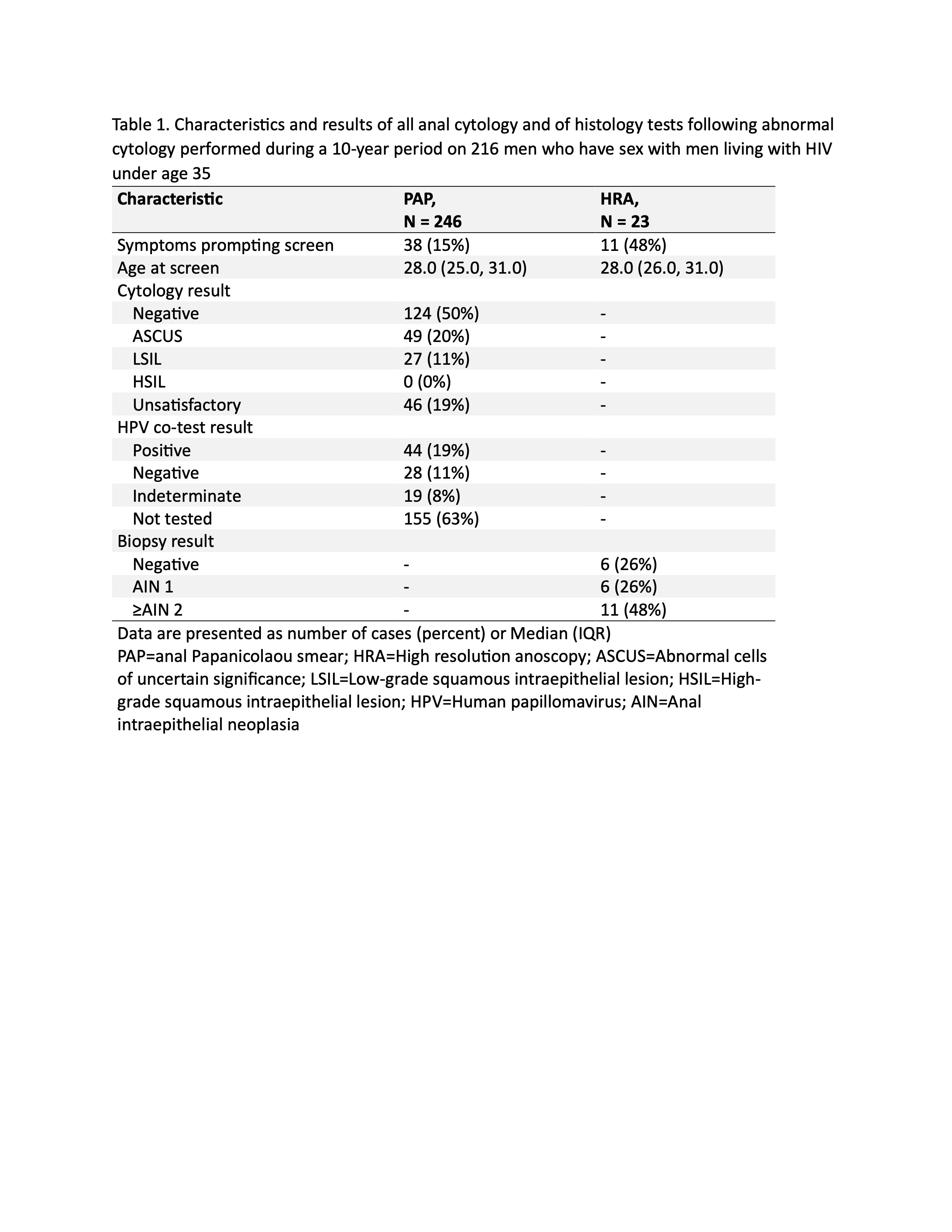
We identified 216 eligible MSM LWH (median [IQR] age 26.7 [23.9, 30.6] years); 24% were White, 44% non-Hispanic Black, 26% Hispanic; >90% were on antiretroviral therapy and 88% had viral load <1000 copies/mL, and 95% CD4 T-cell count >200 cells/mm3 at last visit. Of these, 127 (59%) had anal PAP at least once. There were no significant differences between screened and unscreened cohorts, except longer follow-up in the screened group (median 3.8 vs 1.6 years). Of those screened, 58 (46%) had ≥2 PAPs and 58 (46%) had ≥1 HPV vaccine dose. HPV vaccination was not associated with abnormal PAP (p=0.26) or HRA biopsy (p=0.59). Of 246 total PAPs, 19% were unsatisfactory, none showed high-grade dysplasia, and overall 76 (31%) were abnormal, only 23 of which were followed by HRAs of which 11(48%) reported high-grade dysplasia on biopsy (Table-1). In those receiving both PAP and HRA, positive predictive value (PPV) of any PAP abnormality for high-grade dysplasia was 47.8%. We identified 2 cases of anal cancer (diagnosed at ages 29 and 30): both had CD4 nadir <20, were diagnosed symptomatically with local disease and had received screening in the preceding year.
Conclusions
Over 10 years, uptake of anal cancer screening among young MSM LWH was variable. Anal PAP had a high rate of ‘unsatisfactory’ samples and poor PPV for high-grade dysplasia. Despite high prevalence of high-grade dysplasia in those undergoing HRA, the rarity of anal cancer, which was diagnosed early due to symptoms, supports excluding younger (<35 years) MSM LWH from asymptomatic screening.
Table or Figure