Background
Hepatic steatosis is an increasingly important comorbidity in aging people with HIV (PWH). Population-representative estimates of incidence, risk factors and association with liver-related events are not well understood. We evaluated the incidence of hepatic steatosis and its association with liver-related events and overall mortality within the NA-ACCORD.
Methods
Hepatic steatosis was defined using the hepatic steatosis index (HSI), a biomarker based on sex, liver aminotransferases, diabetes status, and body mass index. Steatosis was defined as an HSI >36. Adult PWH without viral hepatitis coinfection from 11 cohorts were followed from first HSI measurement after 1/1/2000 until first occurrence of a liver-related event (ascites, encephalopathy, variceal bleeding, or hepatorenal syndrome confirmed by adjudication), death, one year after last CD4 or HIV RNA, or 12/31/2015. We reported the incidence of and risk factors for hepatic steatosis and is association with liver-related events and overall mortality.
Results
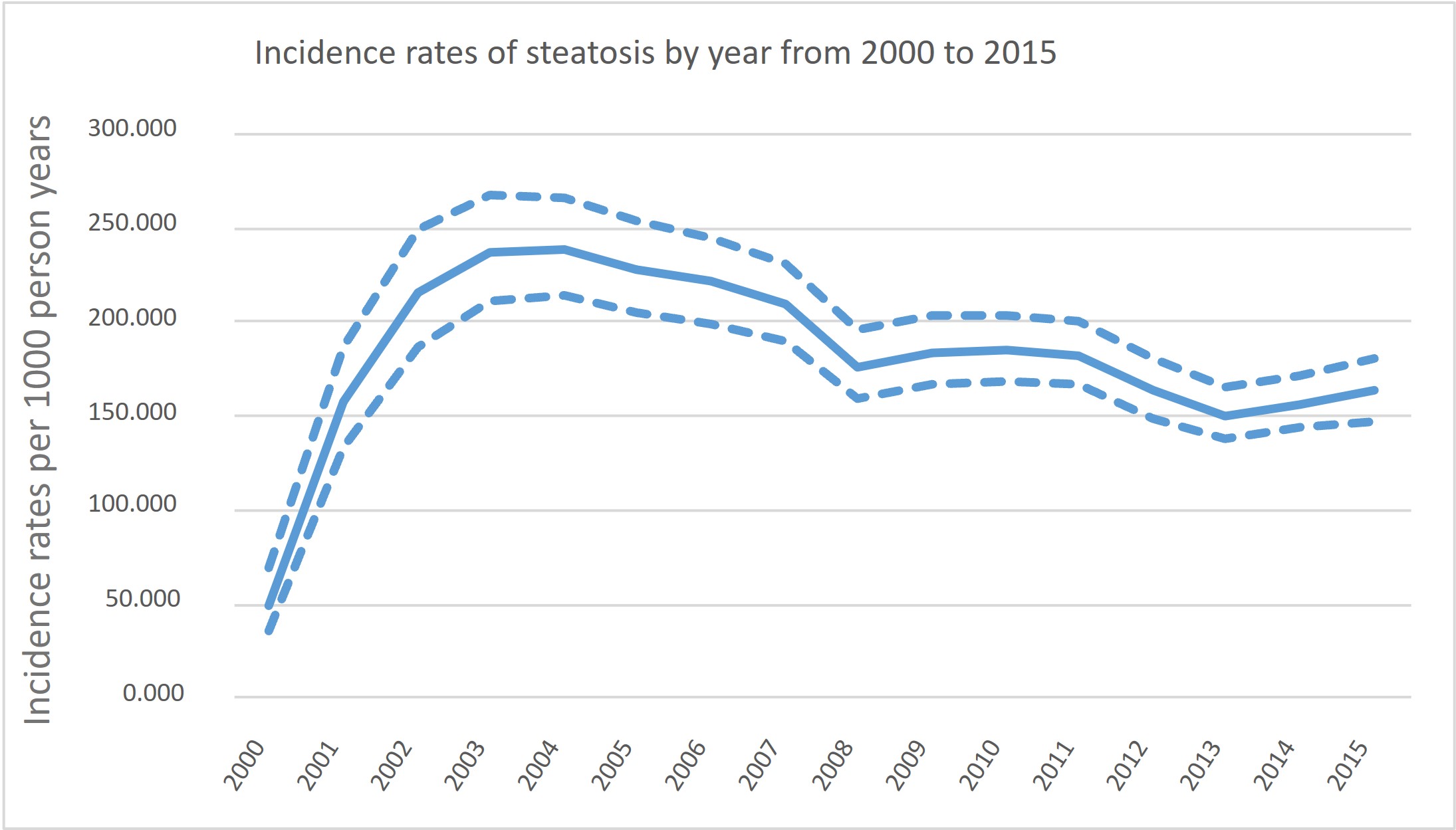
20,903 PWH without viral hepatitis (mean age 39 yrs, 81% males) were included. The incidence rate (IR) of hepatic steatosis was 180 per 1000 person-years (PY) (95% CI 173-185). The IR was 188/1000 PY (95% CI 177-201) from 2000-2004, 206/1000 PY (95% CI 196-217) from 2005-2008, and 168/1000 PY (95% CI 162-174) from 2009-2015 (Figure). After adjusting for age, ethnicity, smoking, alcohol use, and dyslipidemia, hypertension was independently associated with a higher risk of hepatic steatosis (adjusted hazard ratio [adjHR] 1.41, 95% CI 1.22-1.62) as was antiretroviral therapy exposure (adjHR 1.09, 95% CI 1.02-1.16), and higher CD4 cell count was protective against hepatic steatosis (CD4 204-386: adjHR 0.85, 95% CI 0.78-0.93; CD4 387-585: adjHR 0.80, 95% CI 0.73-0.87; CD4 >585: adjHR 0.75, 95% CI 0.68-0.82). The IR of hepatic steatosis on liver-related events was 1.7/1000 PY (95% CI 1.5-2.0) and on death was 15.2/1000 PY (95% CI 14.4-15.9). Hepatic steatosis was not associated with liver-related events but was associated with overall mortality (adjHR 1.02, 95% 1.01-1.04), after adjusting for age, ethnicity, smoking, alcohol use, CD4 cell count, dyslipidemia, and hypertension.
Conclusions
Hepatic steatosis was prevalent among PWH in this large North American cohort but did not increase the risk of liver-related events. However, its association with overall mortality underscores the need for further research into the long-term health implications of hepatic steatosis in PWH.
Table or Figure