Background
Neutralizing B cell responses are critical for sustained viral control in people with HIV (PWH). However, whether B cell alterations contribute to viral persistence in the central nervous system is unknown. To address this gap, we profiled the single B cell receptor (BCR) repertoire and transcriptomes in cerebrospinal fluid (CSF) and blood of PWH and people without HIV (PWoH) to examine B cell molecular phenotypes and trafficking in the context of antiretroviral therapy (ART).
Methods
We enrolled asymptomatic, virally suppressed PWH (n=7) and demographically matched PWoH (n=6) for single cell RNA and BCR-seq from paired CSF and peripheral blood mononuclear cells (PBMC), using 5’ V(D)J 10x Genomics. This “discovery set” comprised 102,313 CSF cells and 186,397 PBMC. We subsequently validated the single cell transcriptomic data by performing 10X single nucleus sequencing in a second, independent cohort of 6 PWH on suppressive ART and 5 PWoH, with features similar to the first cohort, comprising of 43,403 CSF nuclei and 76,974 PBMC nuclei.
Results
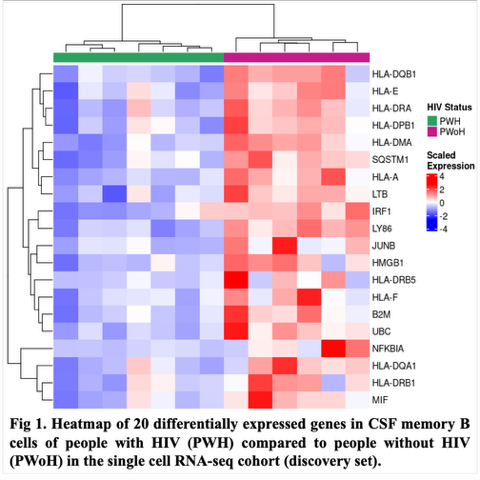
19,380 high quality B cells were included in the discovery set. These were sub-clustered into naive, atypical, memory B cells (MBC), and plasmablasts. Clonal diversity was similar between PWH and PWoH in both CSF and blood. Shared clonotypes between blood and CSF were detected in only 1/7 PWH and 2/6 PwoH, accounting for <1% of the total number of clonotypes in each individual. Both IgM and IgG MBC showed reduced V gene mutation frequencies in the blood of PWH compared to PWoH (1.74% v 3.97%, p=0.004 for IgM; 5.43% v 7.65%, p=0.004 for IgG), consistent with previous reports. However, IgG MBC exhibited a higher difference in mutation frequency across tissues (CSF minus blood) between PWH and PWoH (1.46% v -1.45%, p=0.008), suggesting potential antigen-driven BCR selection or altered B cell trafficking in the CSF of PWH. Differential gene expression in CSF revealed a distinct MBC transcriptional signature in PWH (Fig 1), with pathway analysis highlighting downregulation of antigen presentation and cytokine signaling. These transcriptomic changes were confirmed in a validation set of 10,711 B cell nuclei, where the top downregulated pathways in CSF MBC from PWH included MHC-I and MHC-II presentation, and interferon signaling.
Conclusions
Single cell BCR and RNA analyses suggest persistent immune alterations in MBC within the CSF of PWH. Further studies may elucidate the role of B cells in HIV CNS persistence and neuropathogenesis.
Table or Figure