Background
Antiretroviral therapy has resulted in a reduction in HIV-associated wasting among people with HIV (PWH) and a concomitant rise in overweight and obesity. Semaglutide has been difficult to obtain for some populations, we therefore evaluated use of semaglutide among PWH with medical indications assessing for potential disparities based on race/ethnicity.
Methods
Our study is set in the Centers for AIDS Research Network of Integrated Clinical Systems (CNICS) cohort at 9 sites. We identified PWH in CNICS eligible for semaglutide therapy, with either a body mass index (BMI) ≥30 or hemoglobin A1c (HbA1c) ≥6.5. The outcome was having been prescribed semaglutide between 2019-2023. We evaluated differences in semaglutide receipt by race/ethnicity using relative risk regression with robust standard errors to estimate the association between demographic/clinical characteristics and receipt of semaglutide including age, sex, site, maximum BMI and race/ethnicity defined as a four-level variable: non-Hispanic White, non-Hispanic Black, Hispanic, and Other. We repeated models stratifying by indication for semaglutide therapy (BMI or HbA1c).
Results
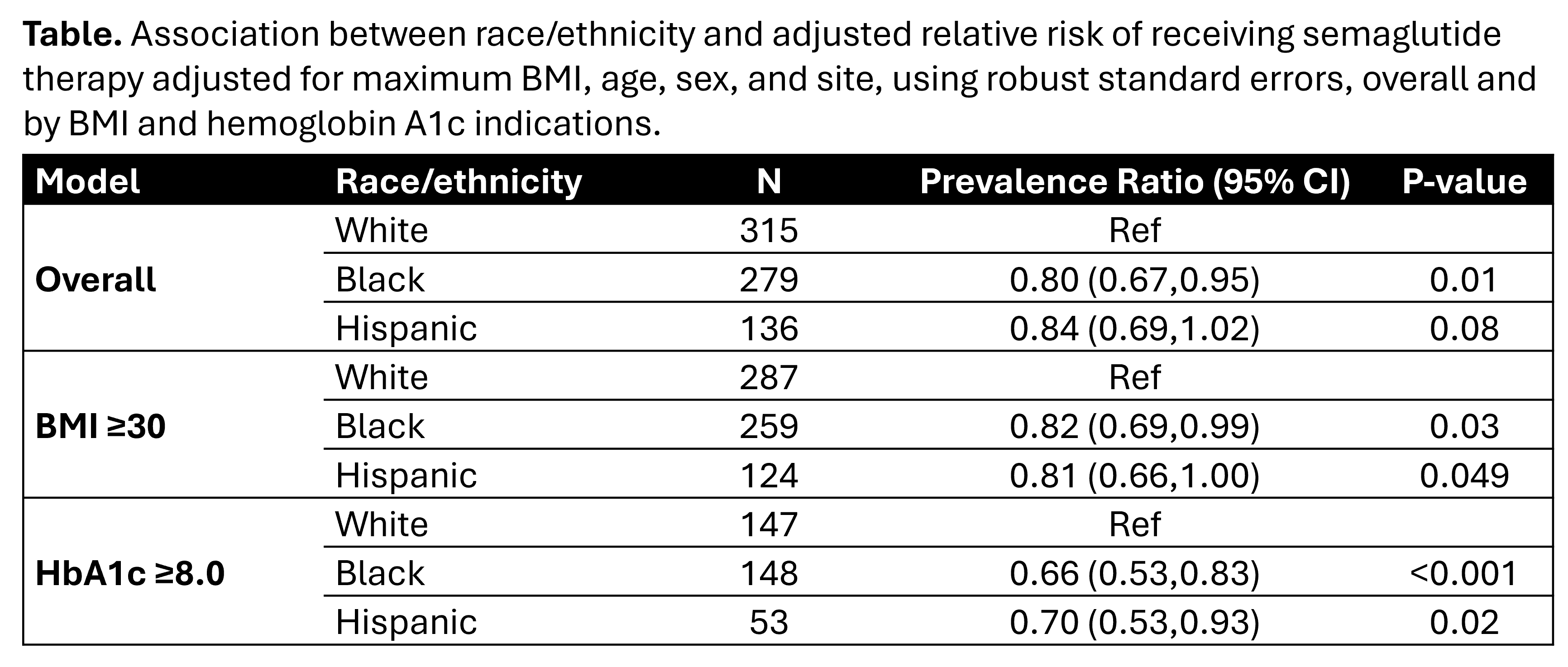
Among 11,617 people who met at least one criterion for semaglutide, 774 (6.7%) received it with higher rates in the later part of the time period. Of those who received semaglutide, 92% had a BMI ≥30, 62% had an A1c ≥6.5, and 54% met both criteria. A lower proportion of eligible Black PWH received semaglutide compared to White PWH (279 [36%] vs. 315 [41%]), despite making up a larger proportion of PWH qualifying for therapy (48% Black and 35% White). In adjusted models, Black PWH were 20% less likely to receive semaglutide therapy compared with White PWH with similar indications (Prevalence Ratio [PR]: 0.80, 95% Confidence Interval [CI]: 0.67,0.95). Hispanic PWH showed a non-significant trend towards lower initiation overall and for BMI ≥30 (Table). The lower rate of semaglutide use for Black PWH (PR: 0.66, 95%CI: 0.53-0.83), as well as for Hispanic PWH (PR: 0.70, 95%CI: 0.53,0.93), was even more pronounced among those with poorly controlled A1c (≥8.0) (Table).
Conclusions
We describe inequitable semaglutide use among PWH, with lower initiation rates in eligible Black PWH despite more frequent indication. Given our evidence that baseline diabetic severity at diagnosis is similar across race/ethnicity in PWH, this underscores the urgent need to improve equitable care for marginalized PWH and address potential implicit bias among providers.
Table or Figure