Background
Incidence of syphilis has increased over the last 20 years. This increase might be followed by a rise in neurosyphilis (NS), especially in the HIV population. Surveillance for NS is heterogeneous and thus the real incidence is not well known. These factors highlight the need for a standardized evaluation process. Therefore, we aim to describe a Cascade of Care of NS to evaluate the missed opportunities of screening and diagnosis, and the time between steps.
Methods
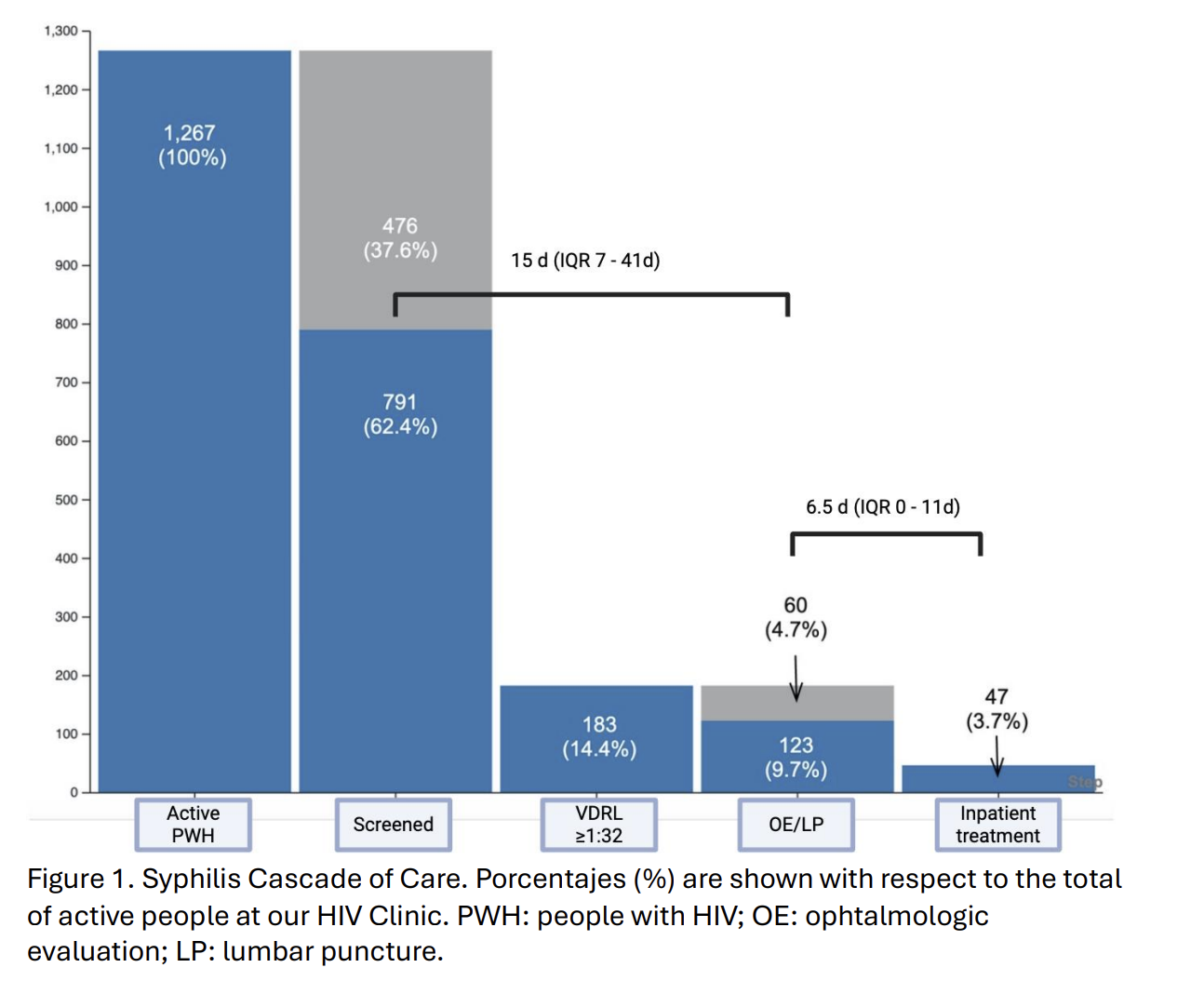
We retrospectively evaluated all active adults living with HIV (defined as those with at least one clinic visit/year) from 2021 to 2023 in a tertiary care Hospital in Mexico. At our center, people with a VDRL title ≥1:32 should undergo Lumbar Puncture (LP) and/or ophthalmologic evaluation (OE) in the absence of neurological symptoms (Martínez et al., 2022). We assessed the first event registered per patient. To describe the Cascade of Care, the following steps were reviewed: 1) active patients eligible to be screened with VDRL, 2) the ones screened, 3) asymptomatic patients with VDRL ≥1:32,-of which, 4) those who went through OE and/or LP, and 5) if there was an indication for treatment. Serologic follow-up (defined as any VDRL between 6 and 12 months) was evaluated. Time between each step of the cascade is described.
Results
During the study period, a total of 1,267 active people with HIV were registered and from those, 791 (62.4%) were screened for syphilis. 183 (14.4%) had VDRL title ≥1:32 and 123 (66.8%) went through OE and/or LP. 47 had ocular syphilis and/or NS confirmed by fundoscopy and a positive VDRL test in CSF, respectively (representing a 38.2% of positivity). All of them received treatment as inpatients. Median time from a positive VDRL ≥1:32 and OE/LP was 15 days (IQR 7 – 41 days), and from positive evaluation to treatment was 6.5 days (IQR 0 – 11days). (Figure 1). The proportion of those treated with a serological follow-up was 89.3%.
Conclusions
In this study, the Syphilis Cascade of Care, we found important gaps and missed opportunities of diagnosis with almost 40% of people not screened. Of those screened, two thirds had potential NS or ocular syphilis, with 38.2% of them having a positive result. Our findings support the need for implementing strategies to increase screening and improve the time to diagnosis and treatment.
Table or Figure