Background
Lenacapavir (LEN), a first in class capsid inhibitor approved by the FDA (22DEC2022) as a twice yearly long-acting injectable used with an optimized background regimen (OBR), is indicated for heavily treatment-experienced individuals with multidrug resistant HIV-1 infection who are failing their current antiretroviral therapy (ART) regimen due to resistance, intolerance, or safety concerns. We describe LEN use during its first-year post-approval in a US-based cohort using electronic health record data.
Methods
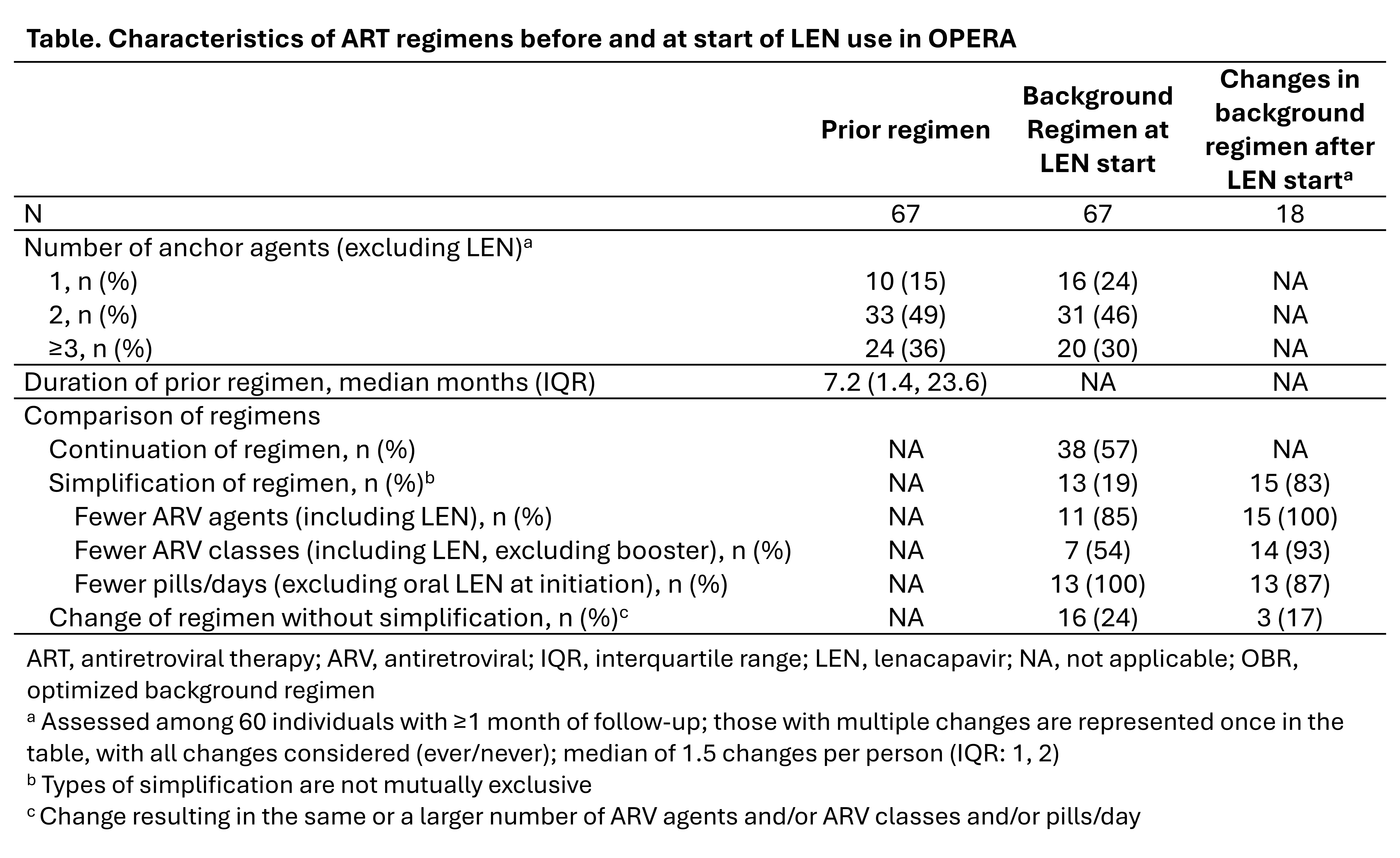
Patterns of LEN uptake (prescriptions [Rx] and injections received) and characteristics of all ART-experienced adults with HIV-1 who were prescribed LEN from 22DEC2022-31DEC2023 in the OPERA cohort were described. Antiretrovirals (ARV) in the background regimen (BR) at LEN initiation were compared to ARVs in the prior regimen and classified as a continuation (all ARVs maintained), simplification (fewer ARV agents and/or fewer ARV classes and/or fewer pills/days), or change without simplification. Subsequent BR changes during LEN use were assessed through 31DEC2023 in those with ≥1 month of follow-up.
Results
Of 104 individuals with a LEN Rx, 37 (36%) had no injection, with a median of 21 weeks (IQR: 9, 27) between Rx and study end (31DEC2023) or death. Among the 67 (64%) with ≥1 LEN injection visit (1 visit: 63%; 2 visits: 37%), the median time from Rx to 1st injection was 21 days (IQR: 8, 44), and the median time from 1st injection to study end or death was 24 weeks (IQR: 12, 35). The median age of LEN users was 55 years (IQR: 44, 62), 25% were women, 78% were Black, 15% were Hispanic, and 91% had ≥1 comorbidity. At LEN start, 68% had well controlled HIV viral loads (VL <50: 52%; VL ≥50 to <200: 16%). At the time of the 1st LEN injection, 38 (57%) continued the prior regimen and 13 (19%) simplified their regimen (Table). Among 61 individuals with ≥1 month of follow-up, 18 (30%) experienced ≥1 change in their BR while on LEN (median: 1.5; IQR: 1, 2). Of those 18 with a BR change after starting LEN, 15 (83%) experienced a BR simplification (Table).
Conclusions
While LEN is indicated for individuals who are failing their current regimen, this overview of the first year of LEN use in a large US cohort showed a varied but small group of people with HIV receiving LEN injections, most of whom had well-controlled HIV before LEN initiation. A subset of LEN users were able to simplify their ART regimen at LEN initiation or during follow-up in this real-world setting.
Table or Figure