Background
Antiretroviral therapy (ART) controls viral replication in people with HIV (PWH), but viral reservoirs (VR) persist and represent a cause for the occurrence of age-related comorbidities, e.g. cardiovascular disease (CVD). We demonstrated that retinoic acid (RA, a vitamin A derivative) increases HIV-1 outgrowth from VR and that microbiota components (e.g., Staphylococcus aureus) promote ALDH (aldehyde dehydrogenase that converts vitamin A into RA) activity in myeloid cells. We hypothesized that ALDH activity is a novel functional marker of immune activation that predicts subclinical atherosclerosis in ART-treated PWH.
Methods
This study was conducted on PBMCs of ART-treated PWH (HIV+ART; n=42) and uninfected subjects (HIV-; n=40) from the Canadian HIV and Aging Cohort Study (CHACS), with/without subclinical coronary artery atherosclerosis visualized as total (TPV) and low attenuated plaque volume (LAPV), and coronary artery calcium (CAC) score by computed tomography angiography. Flow cytometry was used for ALDH activity monitoring on immune cells identified based on the expression of lineage markers as dendritic cells (DC, CD3-HLA-DR+CD1c+), monocytes (CD3-HLA-DR+CD1c-) subdivided in classical (CD14+CD16-), intermediate (CD14+CD16+), and non-classical (CD14-CD16+) monocytes, and CD4+/CD8+ CD3+ T cells.
Results
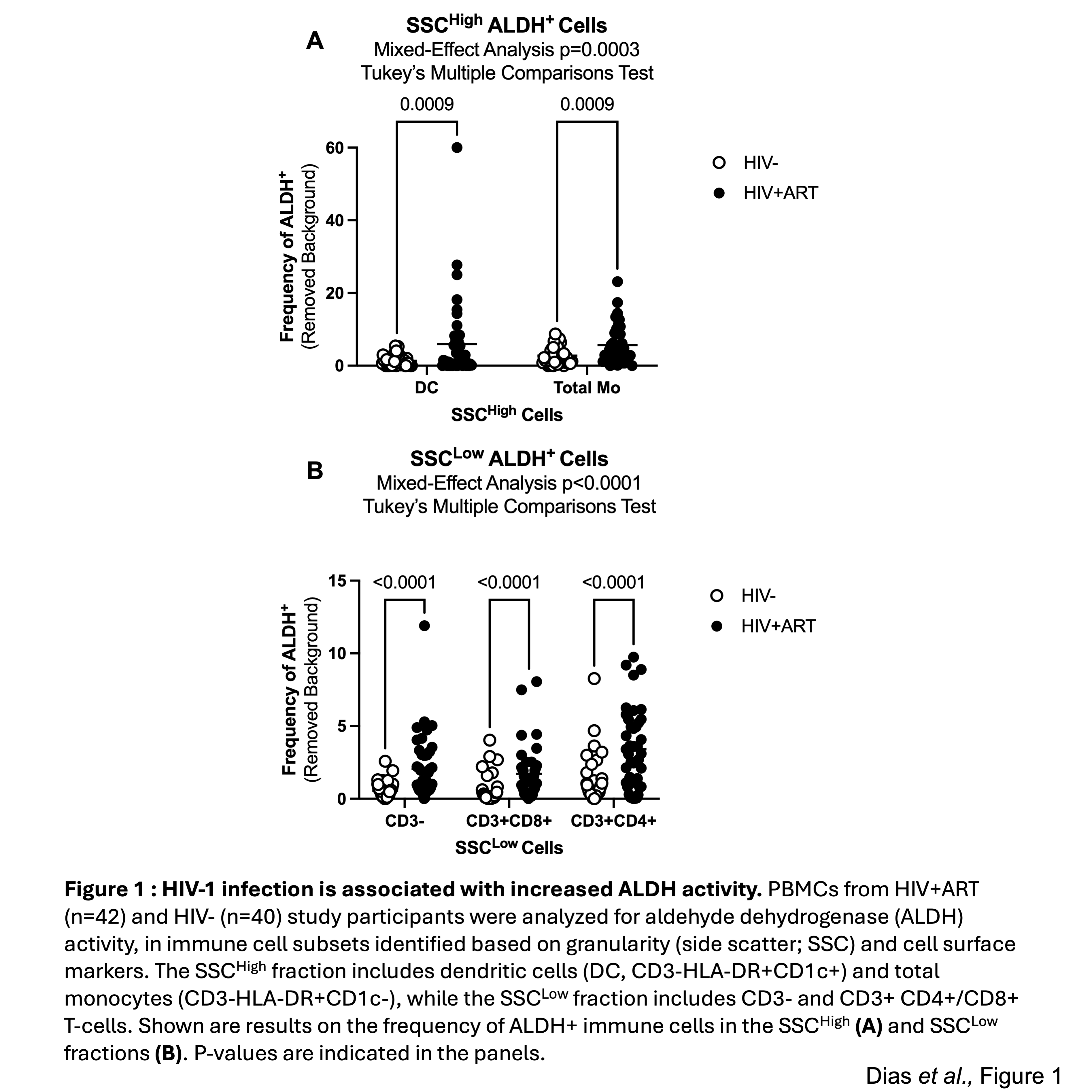
Groups were similar in age, sex, statins, and smoking, but median TPV values were higher in HIV+ART (851 mm3) vs. HIV- (143 mm3). There was an expected decrease in the frequencies of CD4+ T cells and DC, and an expansion of CD8+ T cells and classical monocytes in HIV+ART vs. HIV-. ALDH activity was predominant in cells with high granularity [side scatter high (SSChigh), i.e., DCs, monocytes] compared to SSClow (i.e., CD3+ T, CD3-). The frequency of ALDH+ DC and monocytes was significantly increased in HIV+ART vs. HIV- (Figure 1A), with the highest ALDH activity in intermediate monocytes. ALDH activity was also detected in SSClow CD4+ and CD8+ T-cells, as well as CD3- cells, at levels that were significantly increased in HIV+ART vs. HIV- (Figure 1B). Among HIV+ART with subclinical CVD, the CAC score, and at lower extend TPV and LAPV, positively correlated in a linear regression model with the frequency of ALDH+ SSCHigh (p=0.02, r2=0.24) and SSCLow (p=0.03, r2=0.22).
Conclusions
The increased ALDH activity in myeloid and lymphoid cells during HIV-1 infection may represent a new functional marker, associated to immune activation and calcified atherosclerotic plaque in ART-treated PWH.
Table or Figure