Background
Microbiome effects on mucosal HIV acquisition risk have received significant attention. Yet, little is known about mucosal microbiome variation between key populations, including cisgender men who have sex with men (MSM) and transgender women (TW) using feminizing hormone therapy (FHT) or across geographic locations.
Methods
We enrolled TW on FHT for ≥6 months [n=122; 25 in Atlanta, Georgia (ATL); 97 in Bangkok, Thailand (BK)] and MSM (n=83; 33 from ATL, 50 from BK) aged 18-59 years without HIV. We sequenced 16S rRNA in rectal secretions collected from all participants and neovaginal secretions from a subset of 13 TW in BK. We also collected rectal secretions from 21 TW before and median 4.7 months after FHT initiation. We used linear decomposition modeling (LDM) to compare the rectal microbiome between TW vs MSM, BK vs ATL, before/after FHT initiation, and to the neovagina.
Results
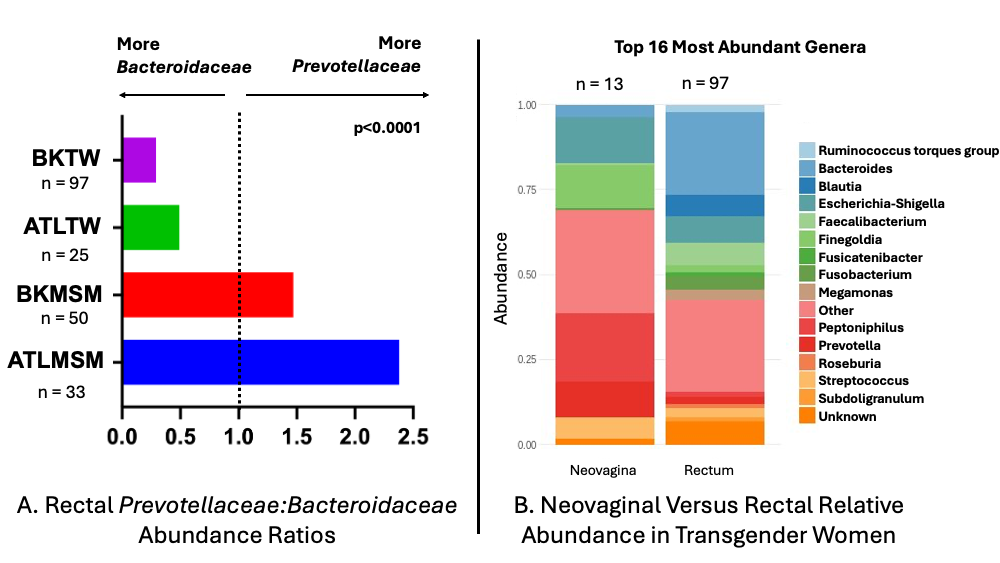
In ATL, we found no difference in rectal α diversity between TW and MSM, but microbiome composition differed (global LDM p=0.006, 17 genera FDR (false discovery rate) <5%). In BK, rectal global composition differed between TW and MSM (global LDM p=0.01), but there was no difference in α diversity or individual genera. We found no difference in rectal α diversity or microbiome composition among TW before/after FHT initiation. At both sites, the Prevotellaceae family was enriched over Bacteroidaceae among MSM but not TW (p<0.0001, Fig1A). Rectal α diversity did not differ in TW in BK vs ATL, but composition differed significantly (global LDM p=0.002, 24 genera FDR <5%). In MSM, rectal α diversity was higher in ATL than BK (p=0.008), and composition differed significantly (global LDM p=0.0004, 161 genera FDR <5%). Higher rectal α diversity and pronounced composition differences were seen in the neovagina vs rectum (global LDM p=0.0002, 125 genera FDR <5%: Fig1B) with neovaginal enrichment for anaerobic taxa such as Finegoldia, Prevotella, and Peptoniphilus.
Conclusions
Rectal microbiome differences were notable both between MSM and TW and by geography; however, we detected no effect of FHT initiation among TW. Lack of rectal enrichment for Prevotellaceae, as reported previously for MSM, and the distinct neovaginal microbiome typified by taxa previously associated with HIV acquisition in penile mucosa underscore the need to distinguish TW from MSM in HIV prevention research. Future studies examining microbiome impact on HIV acquisition should account for variations in composition among key populations.
Table or Figure