Background
Long-acting injectable PrEP (LAI-PrEP) offers a promising alternative for adolescents from sexual and gender minorities (ASGM), as adherence to oral PrEP is a challenge for this population. This study examines patterns of choice and switching between oral and LAI-PrEP among ASGM in Brazil.
Methods
PrEP15-19 Choices is an implementation study offering oral and LAI-PrEP (CAB) among cisgender men who have sex with men (MSM), transgender, and non-binary signed males at birth, aged 15 to 19, in three Brazilian cities. Data were collected through forms and PrEP prescription records. The outcomes analyzed included: i) initial PrEP choice after LAI-PrEP became available in the sites (April 2024); ii) switching, defined as the first change in modality after the initial choice; and iii) discontinuation, defined as 60 days without an injection for LAI-PrEP or 90 days without picking up oral PrEP from the scheduled return date. Descriptive and bivariate analyses were assessed using Pearson’s chi-square or Fisher’s exact test.
Results
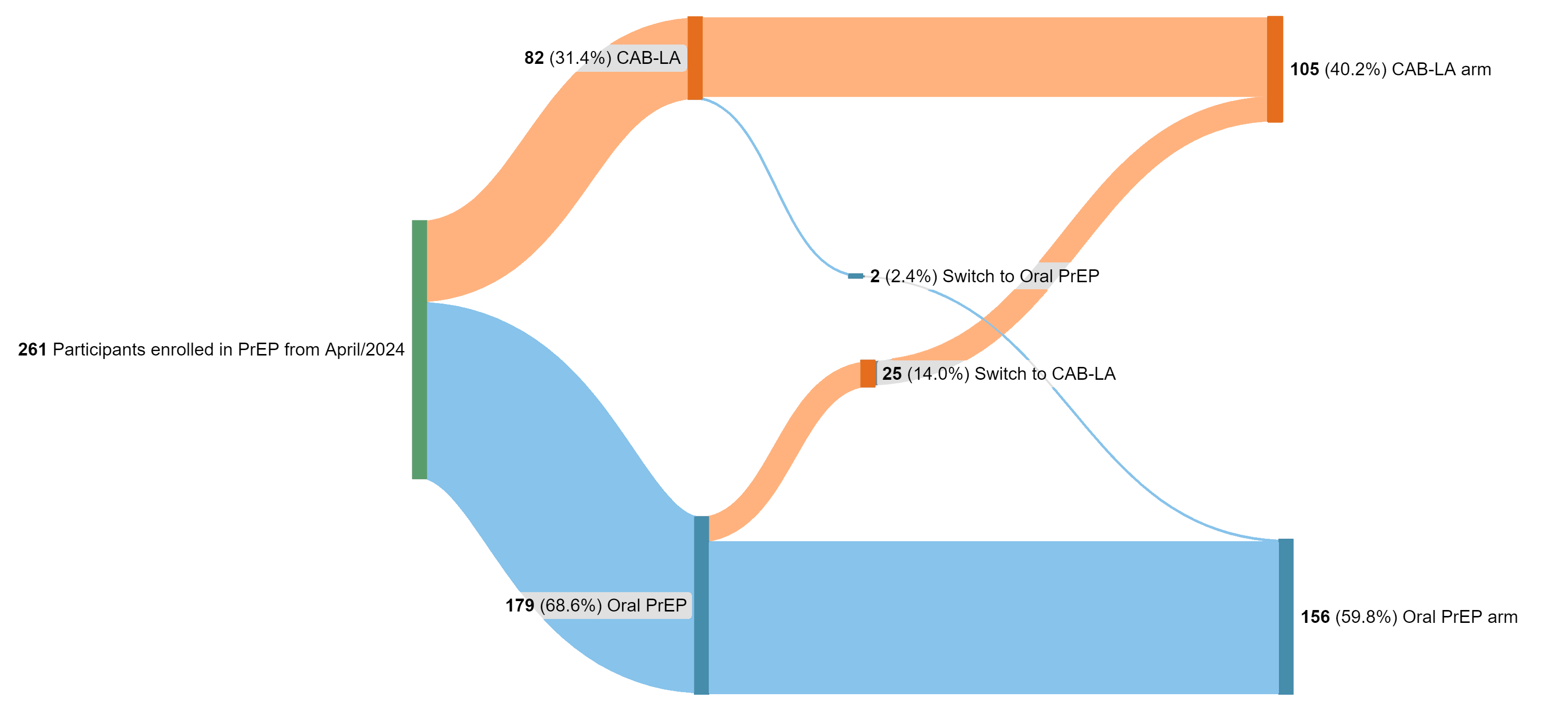
A total of 261 participants were enrolled, with 179 (69%) initiating oral PrEP and 82 (31%) choosing LAI-PrEP. Most were MSM (74%), Black (73%), and aged 18-19 (71%). The main reasons for choosing LAI-PrEP were: i) avoiding the need to take daily pills (80%), ii) preferring it over daily medication (78%), iii) not having to carry medication (52%). LAI-PrEP was more commonly chosen as a first option by those aged 15-17 (39% vs. 29%, p=0.110), by Black participants compared to White participants (35% vs. 20%, p=0.02), and by individuals with elementary or high school education compared to those with higher education (35% vs. 19%, p=0.02). No significant differences were observed based on gender identity, income, or prior experience with oral PrEP. By September 12, 2024, 25/179 (14%) had switched from oral PrEP to LAI-PrEP, while 2/82 (2%) had switched from LAI-PrEP to oral PrEP. The median time to switch was 43 days (IQR=52). Discontinuation rates were 5% (5/105) in the oral PrEP group and 3% (5/156) in the LAI-PrEP group.
Conclusions
Although oral PrEP was the initial preferred option among Brazilian adolescents from ASGM, the proportion of participants switching to LAI-PrEP highlights the importance of offering diverse PrEP choices. Future efforts should focus on increasing the uptake of LAI-PrEP by addressing concerns about injectable formulations and raising awareness of their advantages. This could improve adherence and HIV prevention outcomes in ASGM populations.
Table or Figure