Background
Despite scale-up of HIV testing, ART, and pre-exposure prophylaxis (PrEP), there continue to be over 140,000 new HIV infections in South Africa each year. Our objective was to estimate the optimal distribution of resources to HIV testing, ART, and PrEP to reduce HIV transmission in South Africa.
Methods
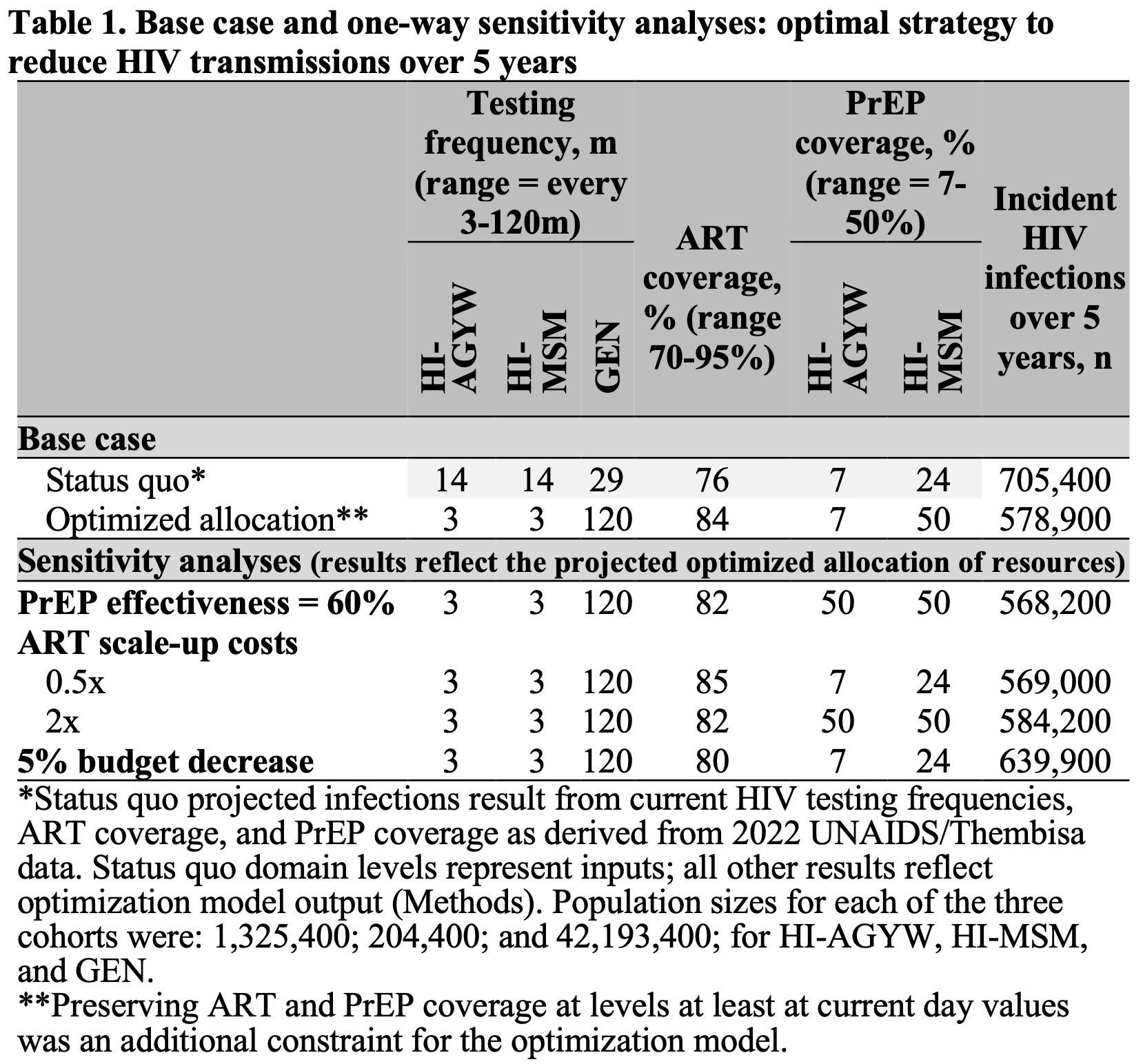
We developed an optimization model to determine what combination of testing, ART, and PrEP would lead to the minimum number of HIV transmissions over 5y in South Africa, parameterized with budget constraints ($9.1 billion/5y), intervention costs, and projected HIV transmissions from the CEPAC microsimulation model. We projected HIV transmissions in CEPAC based on varying uptake of 3 domains: HIV testing, ART coverage, and oral PrEP coverage. We modeled 3 sub-cohorts: high-incidence adolescent girls and young women (HI-AGYW), high-incidence men who have sex with men (HI-MSM), and the remaining general population >15y (GEN). HI sub-cohorts were defined as having HIV incidence of 3%/year and were offered PrEP (effectiveness: 41% AGYW, 50% MSM). Current HIV transmissions and domain levels were calibrated to UNAIDS/Thembisa projections: testing every 14m, 14m, and 29m for HI-AGYW, HI-MSM, and GEN; and coverage for ART (76%), and PrEP (HI-AGYW: 7%, HI-MSM 24%). Costs were $10/HIV test, $285/person-year (py) for ART, and $72/py for PrEP with scale-up costs for ART ($204/py) and PrEP ($50/py). We varied budget constraints, PrEP effectiveness, and ART scale-up costs in sensitivity analyses.
Results
With current levels of HIV testing, ART, and PrEP, we projected 705,400 incident HIV infections over 5y (Table 1). Optimizing allocation of the current HIV budget in South Africa could avert 126,500 infections. This allocation included substantially decreasing testing frequency in GEN (to every 10y) and using those resources to increase testing frequency among HI-AGYW and HI-MSM (to every 3m), increase ART coverage (to 84%), and increase PrEP coverage (to 50%) among HI-MSM. These conclusions were sensitive to budget constraints, PrEP effectiveness, and ART scale-up costs.
Conclusions
Prioritizing HIV testing and PrEP coverage among high-incidence groups and increasing ART coverage while decreasing HIV testing in the general population could avert over 125,000 HIV infections in South Africa over the next 5y without increased investment. As global HIV funding faces mounting pressure, policymakers and program planners should optimize existing resources to continue working towards ending the HIV epidemic.
Table or Figure