Background
Understanding preferences for HIV testing technologies could increase uptake. We conducted a mixed-methods study to explore testing preferences among participants in the GAIN Study.
Methods
Between June 2023-May 2024, we enrolled a convenience sample of persons seeking HIV testing, post-exposure prophylaxis, or pre-exposure prophylaxis (PrEP) care at a community testing site or HIV clinic in Seattle, WA. We used convergent parallel mixed-methods design with a discrete choice experiment (DCE) (N=142) and in-depth interviews (N=20). Participants were randomized to one of three blocks of 12 DCE questions. For each question, participants selected their most and least preferred option from three hypothetical tests with four attributes (specimen type, window period, time to results, and likelihood of false positive results) having three or four levels. Preference weights (PW) and relative importance were calculated using multinomial logistic regression. Greater PWs indicate stronger preference. Semi-structured interviews were analyzed using a Rapid Assessment Process.
Results
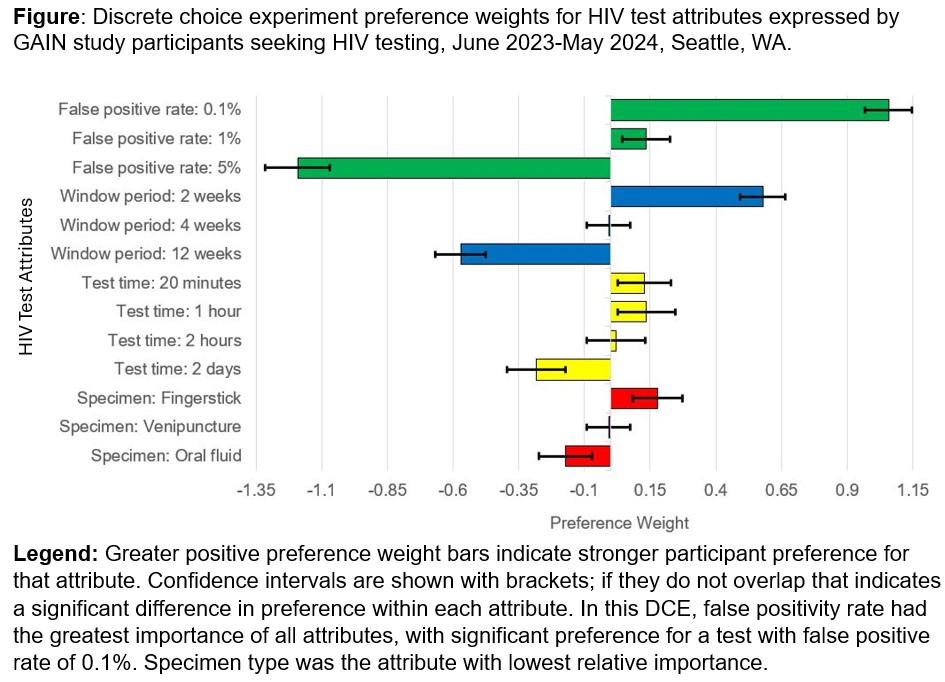
Most survey participants were cisgender men (70%) and white (57%). Reasons for HIV testing included regular testing (49%), new partner (33%), PrEP initiation (10%), and HIV/STI symptoms or exposure (8%). One-third were on PrEP. A 0.1% false positive rate (PW=1.06), 2-week window period (PW=0.58) and fingerstick specimen (PW=0.18) were the most preferred test characteristics (Figure). Faster tests were preferred with no difference between 20-minute and 1-hour tests (PW=0.13 and 0.14). Likelihood of false positives had highest relative importance (54%), and specimen type was the least important attribute (8%) to decision-making. Qualitative data was consistent with DCE findings. Test accuracy was the most important attribute although there was conflation of specificity and sensitivity and confusion about the window period. Participants preferred faster tests to reduce anxiety while waiting for results, especially when concerned about recent exposures. There was higher degree of trust in blood-based tests which were preferred over oral fluid tests.
Conclusions
Participants preferred fast, accurate blood-based tests with shorter window periods, but qualitative data identified misconceptions about HIV test properties. HIV testing should be paired with education to ensure persons understand results, and device development should focus on specificity and window period sensitivity while keeping time to results under one hour.
Table or Figure