Background
In 2015, the CDC estimated that 1.2 million Americans could benefit from PrEP; however, this may now be outdated, particularly given ambitious CDC HIV elimination goals.
Methods
Using responses to the most recent suitable NHANES survey (2015/16), including respondent age and sex, number and sex of sexual partners, number of times having sex, condom use frequency, prior anal sex and partners 5+ years older/younger, we stochastically imputed survey respondents’ detailed sexual practices over the prior year. This included the age and state of each sexual partner and the sexual acts (counts, activities, condom use) with each partner. Using CDC-disseminated estimates of HIV risk per sexual act, we calculated each respondent’s total HIV acquisition risk (prior year), conditioned on their partners’ HIV/STI statuses. We generated a probabilistic distribution for each HIV/STI status for each partner using CDC prevalence/incidence data, partner age, sex, and state, and a calibration parameter reflecting national HIV incidence. By aggregating respondents’ conditional HIV acquisition risks over the partner HIV/STI status probabilities, we estimated each respondent’s overall sexually-acquired HIV risk. We translated HIV risk into expected incidence and scaled to the US population 18-59, incorporating survey weights. Finally, assuming 100% PrEP efficacy, we estimated the population impact of PrEP under two PrEP distribution scenarios: “optimal,” where PrEP is perfectly distributed to those at highest risk, and “suboptimal,” where only 50% of highest-risk individuals get PrEP (i.e., N PrEP prescriptions spread across the 2*N highest risk people).
Results
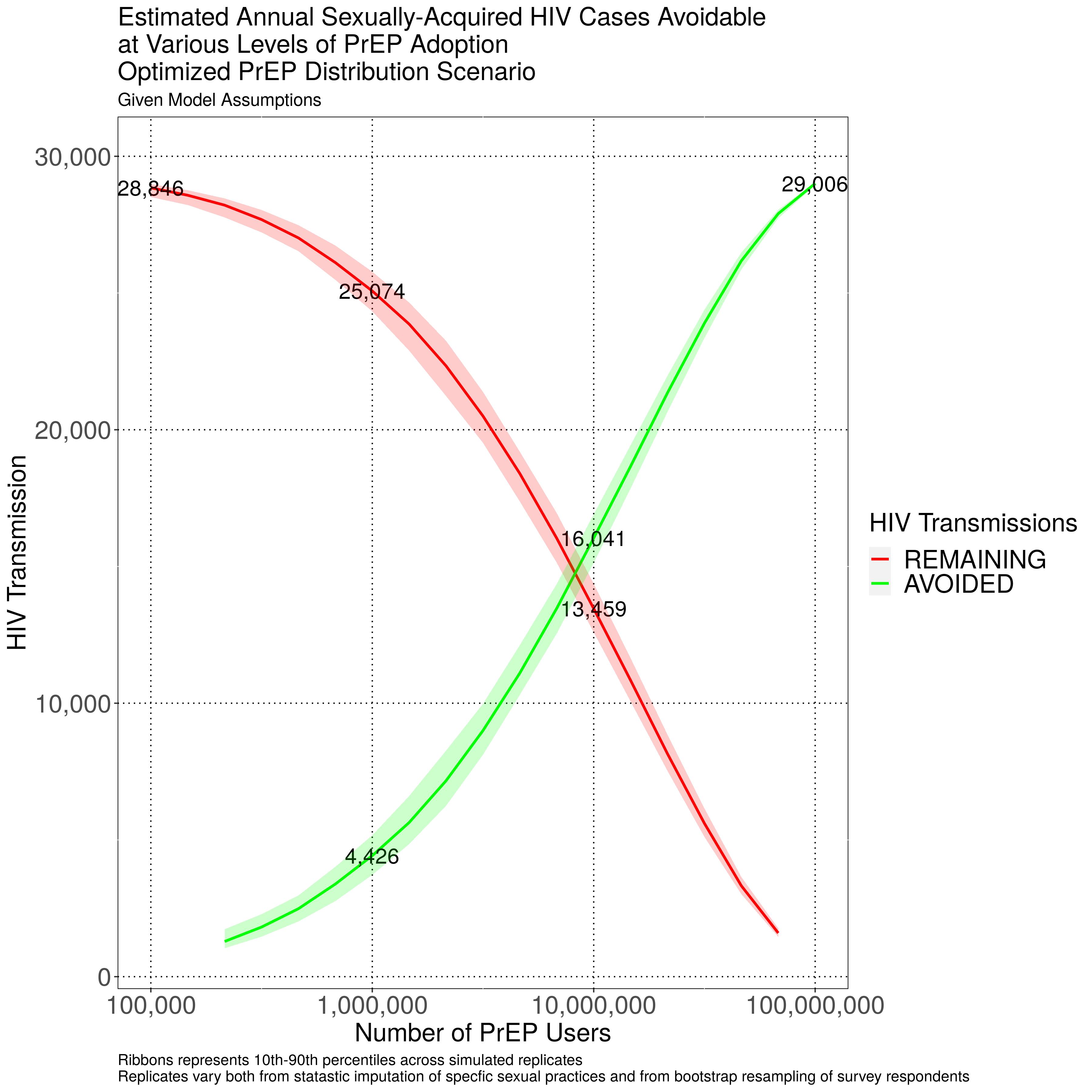
The model predicted PrEP use by 1 million and 10-million individuals, respectively, would prevent 4,400 and ~16,000 sexually-acquired HIV cases [number needed to treat (NNT) = 230 and 620] with optimal distribution (Figure) and 3,400 and 10,400 transmissions (NNT=290 and 960) with suboptimal distribution. A secondary analysis assuming correlation between respondents’ sexual practices and partners’ HIV risk (optimal distribution) estimated PrEP use by 1- and 10-million would avoid ~12,000 and ~26,100 transmissions.
Conclusions
Our model provides a framework to estimate the population impact of PrEP and its implications for public health policy. While model results vary depending on assumptions, findings strongly suggest that increases in PrEP uptake, substantially beyond prior CDC targets, may be required to achieve HIV elimination goals.
Table or Figure