Background
The distribution of HIV-1 genetic variants among people living with HIV (PLHIV) is important for the design of vaccines and broadly neutralising antibodies (bNAbs) as well as for the accuracy of tests for diagnosis and viral load. This study aimed to compare the distribution of HIV-1 variants from population-based national surveys in sub-Saharan countries.
Methods
Population-based national HIV survey data were available for 15 countries in sub-Saharan Africa during 2015-2022, including Population-based HIV Impact Assessments (PHIAs) in several countries, Nigeria’s HIV/AIDS Indicator and Impact Survey (NAIIS) and two South African National HIV Prevalence, Incidence and Behaviour Surveys (SABSSM). The Ethiopia survey was conducted in only urban areas. Genotyping was performed on the samples selected for resistance testing and in which amplification of HIV RNA/proviral DNA was successful. In most countries, samples from those with a recent HIV infection within the prior 12 months (applying an algorithm that included the Limiting-Antigen Avidity EIA, viral load, and the absence of antiretrovirals), all children younger than 18 months (except for Rwanda), and a country-specific selection of people living with HIV (PLHIV) with a long-standing infection (beyond 12 months) with VL>1,000 RNA copies/ml were analysed. In the two SABSSMs, the sampling included PLHIV with >1,000 RNA copies/ml. HIV-1 variants were identified using the REGA HIV-1 & 2 Automated Subtyping Tool. The unweighted percentage distribution of HIV-1 variants was determined for each survey and compared to other surveys.
Results
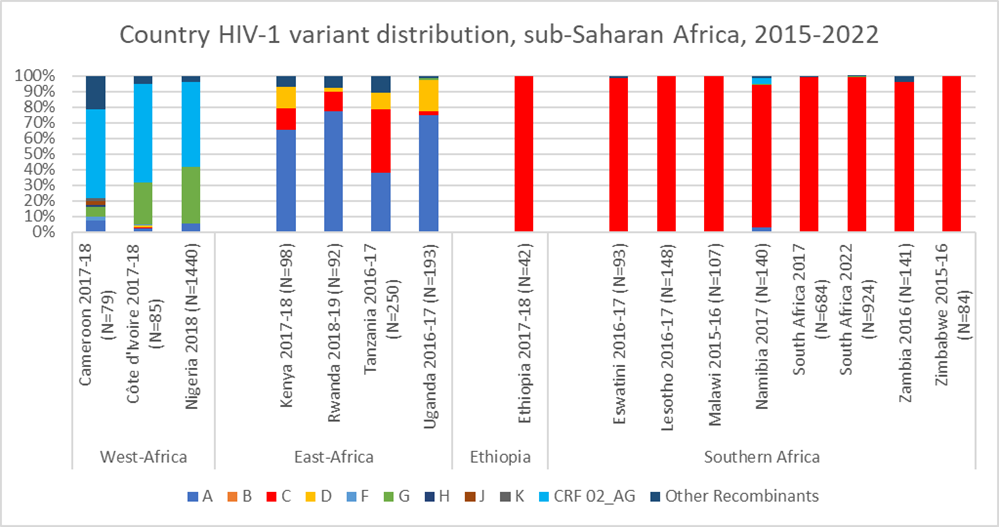
Sample sizes varied between 42 and 1,440 PLHIV by survey (Figure). Comparing country distributions of HIV-1 variants showed important variation among countries and regions: the dominant variant was the recombinant CRF02 AG in Cameroon, Côte d’Ivoire and Nigeria; subtype A in Kenya, Rwanda and Uganda; subtype C (40%) and subtype A (38%) in Tanzania and subtype C (>90%) in Ethiopia, Eswatini, Lesotho, Malawi, Namibia, South Africa (both surveys), Zambia and Zimbabwe.
Conclusions
HIV-1 variant distributions for countries in West Africa, East Africa, Ethiopia, and Southern Africa in population-based national surveys showed heterogeneity across these regions, with specific subtypes dominating in each region. HIV-1 diversity in sub-Saharan Africa may need to be accounted for during the development of HIV diagnostic and viral load tests, vaccines, and bNAbs.
Table or Figure