Background
Cardiovascular disease (CVD) is a leading cause of morbidity and mortality among PLHIV. The COVID-19 pandemic exacerbated existing health disparities, particularly affecting vulnerable populations. This study aims to investigate the impact of the COVID-19 pandemic on death rates due to CVD in Brazil.
Methods
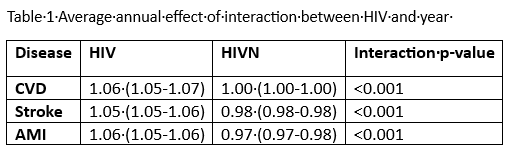
All data were sourced from Brazilian Mortality Information System (SIM) from 2018 to 2023 through the DATASUS open-access database. Population data were obtained from the Brazilian Census Bureau (IBGE) for the same period The analysis included all causes of death recorded on death certificates (DC), coded according to the International Classification of Diseases, 10th edition (ICD-10) as follows: COVID-19: B342, U071, U072. HIV: B20-B24 Acute Myocardial Infarction (AMI): I20-I25; Stroke: I60-I69; CVD: I00-I99 (excluding I46). We compared two scenarios: one including all deaths and one excluding those in which DC mentioned COVID-19. Mortality ratios (MRs) were calculated relative to 2018. Adjusted MRs were computed using Poisson models with population size as an offset, accounting for state of residence, age group, and sex. Mixed-effect models with random intercepts (GLMM) were applied to control for state variations. We also tested the interaction of HIV and year among those without COVID-19. All analyses were conducted with R 4.2.3.
Results
A total of 9,063,805 deaths were recorded in Brazil from 2018 through 2023. Among HIV negative individuals (HIVN), the MRs for CVD slightly increased in 2020, peaking in 2021 [1.26 (1.25-1.26)], but remained close to 1, when COVID-19-related deaths were excluded, as was the case of Stroke and AMI. In PLHIV, the scenario differed significantly. The MR for CVD in PLHIV (excluding COVID-19) increased from 1.07 (0.99-1.15) in 2019 to 1.32 (1.24-1.42) in 2023. For CVD, Stroke, and AMI, the annual effect (slope) was significantly different in PLHIV compared to the HIVN (p<0.001), consistently increasing. In contrast, non-HIV deaths either decreased or remained stable when COVID-19 was excluded.
Conclusions
Unlike HIVN, PLHIV in Brazil are experiencing a sustained and progressive rise in CVD mortality, independent of COVID-19, that may be linked to broader, underlying factors of worsening cardiovascular health
Table or Figure