Background
The NNRTI doravirine (DOR) and the investigational nucleoside reverse transcriptase translocation inhibitor (NRTTI) islatravir (ISL) have complementary mechanisms of action and resistance profiles. The primary analysis of the MK8591A-052 study in people living with HIV-1 demonstrated that switching to DOR/ISL 100 mg/0.25 mg was noninferior to continuing bictegravir/emtricitabine/tenofovir alafenamide (BIC/FTC/TAF) in maintaining virologic suppression at Week 48. Here we present Week 96 efficacy and safety data from this study.
Methods
Phase 3, double-blind clinical trial (NCT05630755) in adults with HIV-1 RNA <50 copies/mL for ≥3 months on BIC/FTC/TAF, CD4+ T-cell count ≥50 cells/mm3, and no prior therapy failure or known DOR resistance. Participants were randomized 2:1 to switch to DOR/ISL (100/0.25 mg) or continue BIC/FTC/TAF. Discontinuation was required for confirmed decline in total lymphocytes (≥30% and <1.0 x10⁹/L) or CD4+ T-cells (≥30% and either <350 cells/mm3 if ≥350 at baseline or <200 cells/mm3 if ≤349 at baseline). The proportion of participants with HIV-1 RNA ≥50 copies/mL (FDA snapshot) at Week 96 was a secondary endpoint. Other virologic outcomes (HIV-1 RNA <50 and <200 copies/mL), safety, and tolerability through Week 96 were also assessed.
Results
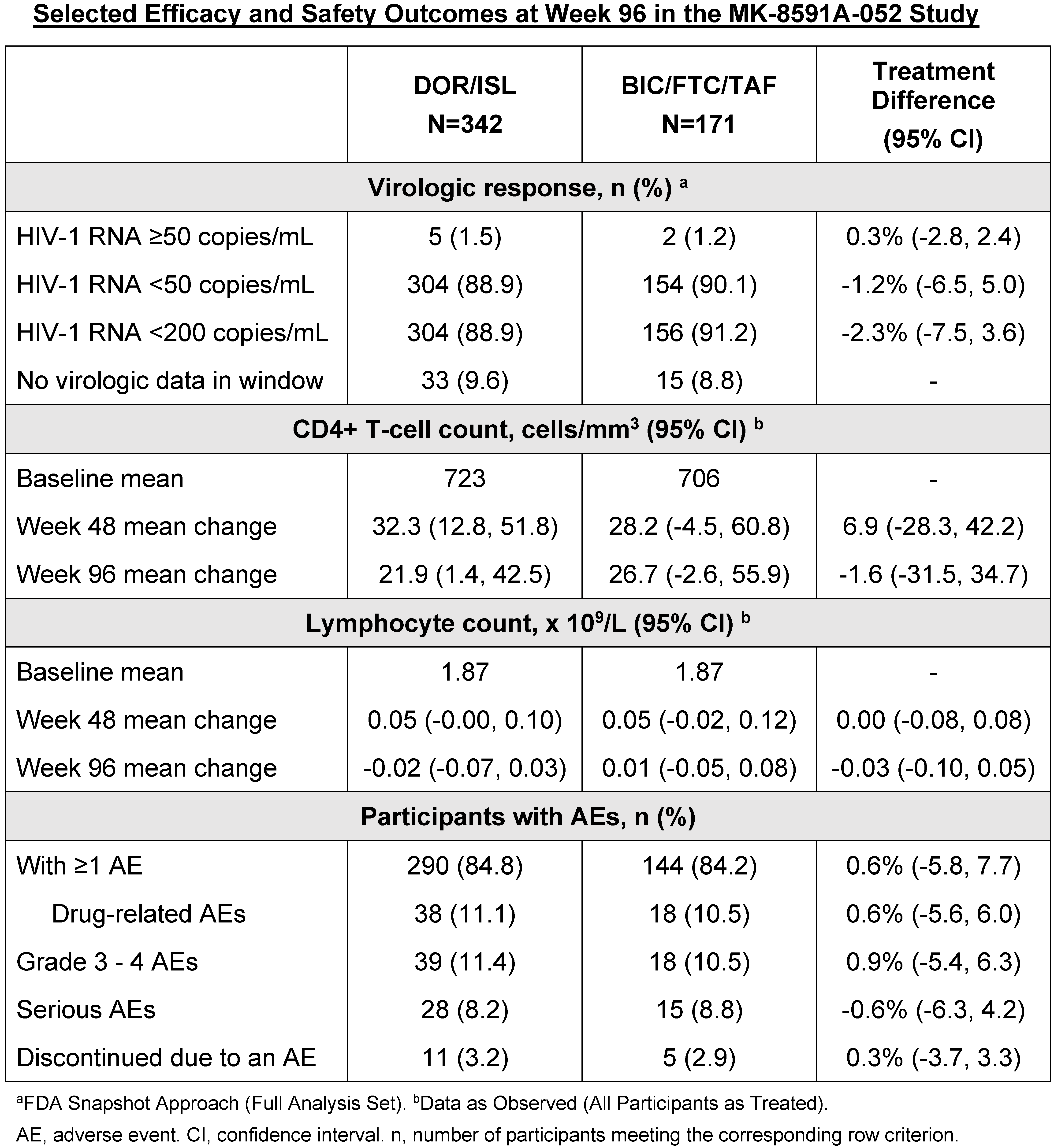
Overall, 342 participants were switched to DOR/ISL and 171 continued BIC/FTC/TAF. At Week 96 (Table), 5 (1.5%) participants on DOR/ISL vs 2 (1.2%) on BIC/FTC/TAF had confirmed HIV-1 RNA ≥50 copies/mL (difference: 0.3%, 95% confidence interval: -2.8, 2.4); 2 (0.6%) vs 0, respectively, had discontinued due to lack of efficacy; and 3 (0.9%) vs 1 (0.6%), respectively, had discontinued for other reasons with HIV-1 RNA ≥50 copies/mL at discontinuation. Proportions of participants with adverse events (AEs) through Week 96 were similar between groups (Table). The Week 96 DOR/ISL AE profile was similar to Week 48 with no new safety findings. There were no differences between arms in CD4+ T-cell or total lymphocyte count (TLC) changes through Week 96 (Table). In both groups, 0.6% (DOR/ISL n=2, BIC/FTC/TAF n=1) discontinued due to protocol-specified decreases in CD4+ T-cell and/or TLC counts.
Conclusions
DOR/ISL (100/0.25 mg) maintained a high rate of virologic suppression and had similar efficacy to BIC/FTC/TAF at Week 96. DOR/ISL demonstrated an AE profile comparable to BIC/FTC/TAF and did not adversely affect lymphocytes. These findings are consistent with the study’s primary Week 48 results.
Table or Figure