Background
Although single tablet regimens (STRs) have transformed the HIV treatment landscape, new and effective treatment options with novel mechanisms of action are still required to meet the diverse needs of people with HIV (PWH). A new STR of bictegravir (BIC), an integrase strand-transfer inhibitor, and lenacapavir (LEN), a first-in-class capsid inhibitor, is being investigated for safety and efficacy relative to standard-of-care treatment with bictegravir/emtricitabine/tenofovir alafenamide (B/F/TAF).
Methods
In the Phase 3, double-blind, multicenter ARTISTRY-2 (NCT06333808) trial, PWH with virologic suppression (VS) on B/F/TAF STR (for ≥6 months before screening) were randomized 2:1 to switch to once-daily oral BIC/LEN STR (75/50 mg) or continue B/F/TAF. The primary endpoint was HIV-1 RNA ≥50 copies (c)/mL at Week (W) 48 (US FDA Snapshot algorithm; noninferiority margin 4%). Secondary endpoints included HIV-1 RNA <50 c/mL (US FDA Snapshot algorithm) and change from baseline in CD4 cell count at W48, and incidence of treatment-emergent adverse events (AEs) through W48. HIV-1 RNA results through W48 were also analyzed using a missing=excluded approach.
Results
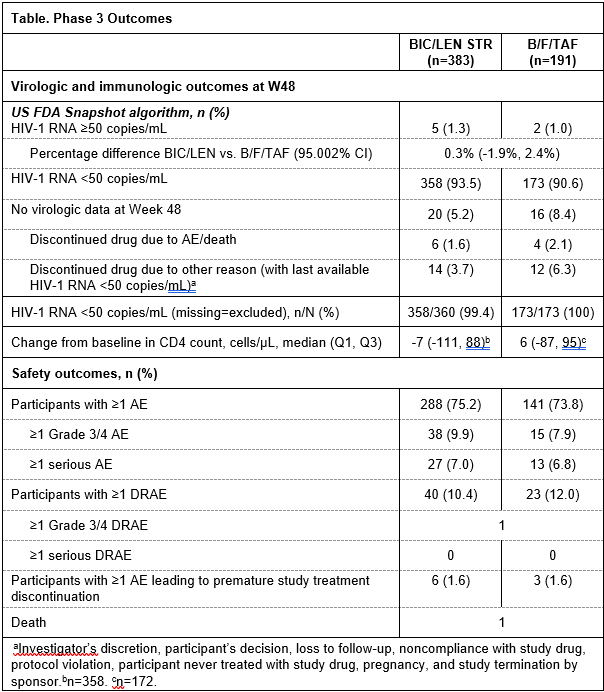
Overall, 574 PWH were randomized and treated; 383 switched to BIC/LEN and 191 continued B/F/TAF. Median (range) age at baseline was 49 (23-77) years; 19% of participants were female, 27% were Black, and 27% were Hispanic or Latine. Outcomes are shown in the Table. At W48, 1.3% (5/383) of participants on BIC/LEN and 1.0% (2/191) on B/F/TAF had HIV-1 RNA ≥50 c/mL, meeting the noninferiority margin (% difference [95.002% CI]: 0.3% [-1.9%, 2.4%]). VS (HIV-1 RNA <50 c/mL) was maintained in 93.5% of those on BIC/LEN and 90.6% of those on B/F/TAF. At W48, median (quartile [Q]1, Q3) change in CD4 count was -7 (-111, 88) cells/µL with BIC/LEN and 6 (-87, 95) cells/µL with B/F/TAF. Frequencies of AEs (75.2% and 73.8%) and drug-related AEs (DRAEs; 10.4% and 12.0%) were similar with BIC/LEN and B/F/TAF, respectively; most AEs were Grade 1/2. The frequency of AEs leading to discontinuation of study drug was low (1.6% in both groups).
Conclusions
A novel STR of BIC/LEN maintained VS in most participants at W48 and was noninferior to standard-of-care treatment with B/F/TAF. BIC/LEN was generally well tolerated, with few discontinuations due to AEs. These results support BIC/LEN STR for expanding treatment options for PWH with VS.
Table or Figure