Background
Temporary treatment interruption (TTI) is a novel strategy in which antiretroviral therapy (ART) is stopped to allow viral reactivation and transient viremia under close monitoring. In HIV cure trials that include broadly neutralizing antibodies (bNAbs) or therapeutic vaccines, TTI allows formation of antigen-antibody immune complexes and primes B and T cells with participant-specific antigen exposure prior to vaccination, which may then enable ART-free HIV remission.
Methods
RV630/DELIVER-01 (NCT06484335) is an ongoing study recruiting clinically stable and virally suppressed participants from the RV254 acute HIV infection (AHI) cohort in Bangkok, Thailand. Participants undergo TTI up to 8 weeks at study entry. Viral load and clinical exam with review of symptoms for acute retroviral syndrome (ARS) are done at least weekly. When VL>1,000 copies/mL, two bNAbs (VRC07-523LS, PGDM1400LS) are given IV and ART is restarted one week later. The study intervention also includes a vaccine regimen (ChAdOx1.tHIVconsv1, ChAdOx1.tHIVconsv62, MVA.tHIVconsv4 and A244d11gp120/ALFQ) or placebo and a second dose of bNAbs administered over the following 22 weeks before undergoing analytic treatment interruption (ATI).
Results
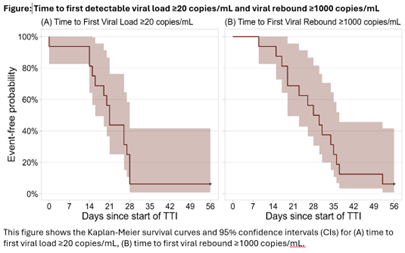
Sixteen participants have been enrolled since September 2025.15 met criteria to receive bNAbs while 1 maintained viral suppression through 8 weeks. All were male with a median (IQR) age of 36 (33-39) years. Median (95% CI) time to VL>20 copies/mL was 21 (16-28) days; to VL>1,000 copies/mL was 29 (19-37) days (Figure); to bNAb infusion was 33 (24-41) days. Median (IQR) peak VL at bNAb infusion was 11,100 (6,328-32,750) copies/mL, declining in all participants to 1,183 (300-3525) copies/mL after 1 week just before ART was restarted.
TTI was safe and well tolerated. Four adverse events (pharyngitis, diarrhea, and two headaches) were reported during the TTI prior to viral rebound (n=3) or during low-level viremia (41-94 copies/mL) and were deemed unrelated to the study. No signs or symptoms of ARS were reported during periods of viremia.
Conclusions
TTI was safe and well tolerated in this cohort of participants who initiated ART during AHI. Active surveillance observed no signs or symptoms of ARS during the brief period of viremia. bNAb infusions at peak viremia induced a median 1 log reduction in VL without ART.
Table or Figure