Background
HIV-1 sub-subtype A6 propels the growing HIV epidemic in Eastern Europe. Long-lasting migration, including war-related displacement from Ukraine, has introduced this lineage into multiple European countries resulting in expanding transmission dynamics in the region. Here we aimed to provide insight on the international A6 transmission patters across selected European regions including enrichment related to migration.
Methods
We assembled all publicly available HIV-1 A6 partial pol sequences (n=15,666) with an analytic subset with migration-related metadata from four countries (n=2,752: Poland – 2,067; Czechia – 304; Israel – 293; Germany – 88). Broad clusters were delineated by maximum-likelihood phylogenies (IQ-TREE; SH-aLRT > 70%) whenever a study-country sequence grouped with background references, integrating the global context. We then used distance-based network inference (HIV-TRACE) to select an epidemiologically plausible mean pairwise TN93 threshold and infer transmission links.
Results
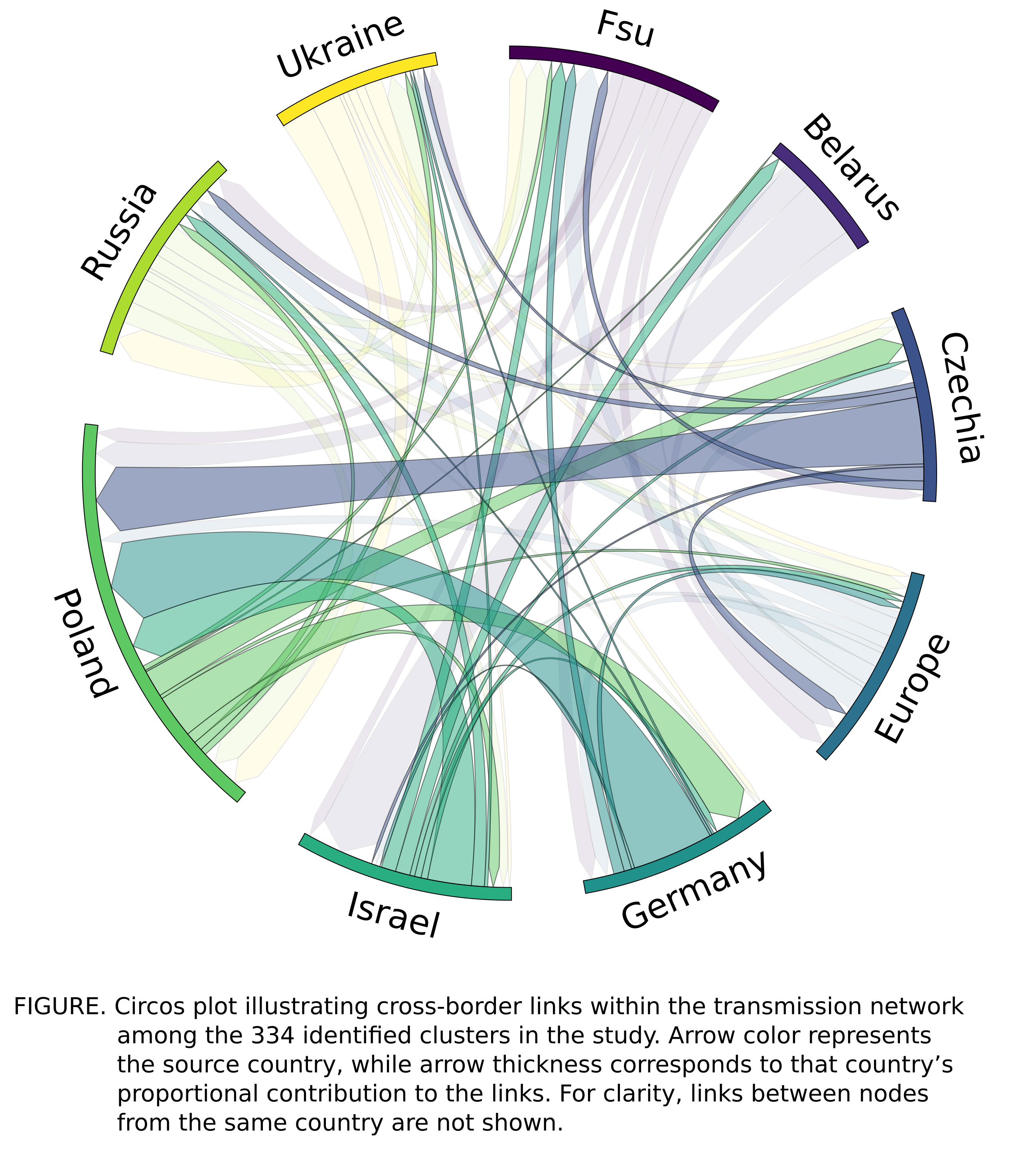
ML analysis identified 4,093 sequences (26.1%) forming broad transmission clusters, comprising 2,434 (59.4%) sequences from the four-country subset and 1,659 (40.6%) from background regions. A pairwise genetic distance (GD) threshold of 0.010 substitutions/site, selected based on sensitivity analysis for epidemiological plausibility, yielded a clustering rate of 44.5%. The resulting network included 5,093 links, with a mean node degree of 5.5 (range: 2–718). Over the study period, the probability of migrant inclusion in transmission links increased significantly (odds ratio [OR] per year 1.080; 95% confidence interval [CI] 1.047–1.114; p < 0.0001), rising from 6.3% in 2011 to 14.6% in 2023. Similarly, the proportion of transmission links involving female individuals increased (OR/year 1.088; 95% CI 1.010–1.172; p < 0.05), from 2.2% to 5.8%. After link-level normalization, within-country connections predominated; however, notable cross-border ties were observed, particularly between Germany and Poland (n = 107; 1.1%) and between Czechia and Poland (n = 67; 0.7%).
Conclusions
Migration is associated with the cross-border expansion of HIV-1 A6 molecular clusters in Europe, characterized by a growing migrant presence in transmission networks and rising female participation. These dynamics highlight the importance of implementing targeted, cross-jurisdictional interventions for mobile populations to address changes in the epidemic and prevent further HIV transmission.
Table or Figure