Background
A recent analysis from the RESPOND cohort found that INSTI exposure may increase CVD risk vs other antiretroviral therapy (ART). Following discussions of modelling approaches for addressing this potential safety signal, we re-analysed the RESPOND data using a target trial framework to assess the impact of different analysis methods.
Methods
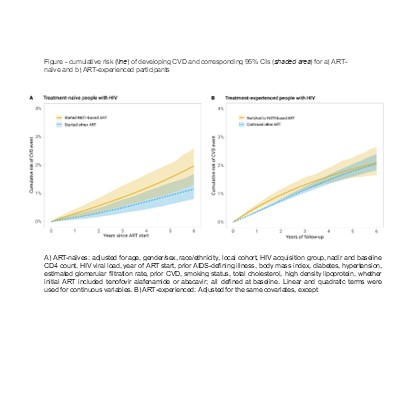
We included participants age ≥18 years and analysed ART-naïve and experienced participants separately. For the ART-naïve trial emulation, participants had to start first ART after Jan 2012. Participants were followed from start of first ART until the earliest of CVD, death, loss to follow-up, or database closure (Dec 2021). For the ART-experienced emulation, participants were on INSTI-free ART after Jan 2012 with no prior INSTI use. From 2012 onwards, a new trial was emulated each month, with baseline redefined and eligibility reassessed at each nested trial. We estimated standardised and relative risk (RR) of CVD (myocardial infarction, stroke, invasive cardiovascular procedure) between those starting or switching to INSTI vs other ART using pooled logistic regression adjusted for covariates (figure). Confidence intervals (CIs) were calculated using bootstrapping with 200 samples.
Results
Among 7111 ART-naïve participants (19% women, median age 38 years), 3354 (47%) initiated INSTIs. During a median of 62 months of follow-up, 95 CVD events occurred. Adjusted RRs comparing those starting INSTI vs other ART were 1.92 (95% CI 0.82–4.31), 1.83 (0.83–3.68), and 1.71 (0.99–3.04) at 1, 2 and 6 years, respectively (Figure). In the ART-experienced analysis, 22921 persons (28% women, median age 49 years), 11278 of whom switched to INSTIs, were followed for a median of 37 months (IQR 18–63). In total, 800 CVD events occurred; adjusted RRs were 1.41 (95% CI 1.20–1.74), 1.26 (1.07–1.52), 1.02 (0.80–1.28) at 1, 2 and 6 years, respectively. The absolute risk difference was small throughout, not exceeding 1.23 percentage points, for both treatment-naive and treatment-experienced individuals (Figure).
Conclusions
Consistent with our initial results, INSTI exposure in ART-experienced individuals was associated with an increased RR of CVD in the first two years compared with other ART. Among ART-naïve individuals, a similar trend toward increased risk was observed, although it was not statistically significant, likely due to the lower analytical power. Further research is needed to evaluate individual INSTIs and investigate underlying causal biological mechanisms.
Table or Figure