Background
Kaposi sarcoma (KS) is caused by human herpes 8 virus (HHV8); immunosuppression and inflammatory cytokines play a major role in its pathogenesis. We aimed to describe the clinical differences and outcomes of patients with disseminated KS, with and without pulmonary involvement.
Methods
We conducted a single-center retrospective cohort study from 2018 to 2024, including people with HIV and biopsy-confirmed KS, that were classified as disseminated KS by at least two of the following criteria: pulmonary, lymph-node, or gastrointestinal involvement, lymphedema, or ≥30 skin lesions. We excluded cases with lymphoma, KS inflammatory cytokine syndrome, those with less than 30 days of follow-up, or insufficient studies to diagnose or rule out pulmonary KS (pKS). We identified pKS with any of the following methods: pulmonary biopsy, direct visualization via bronchoscopy, or pulmonary lesions with negative Gallium-67 uptake. We described differences in clinical presentation and initial laboratory studies between the two groups. We created Kaplan-Meier curves to compare all-cause mortality between individuals with KS and pKS at 1 year following KS diagnosis. We performed multivariate Cox proportional hazards models to identify factors associated with 1-year mortality.
Results
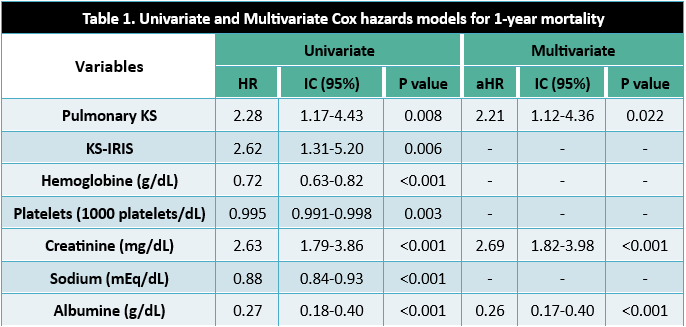
A total of 320 individuals with KS were identified; after applying exclusion criteria, 223 were included in the final analysis. Individuals with pKS had lower median hemoglobin (10.6 vs 11.7, p=0.023) and albumin levels (3.3 vs 3.6, p=0.037), as well as lower median CD4 counts (57 vs 86, p=0.036), and presented with KS-immune reconstitution inflammatory syndrome (KS-IRIS) more frequently (34.3% vs 53.8%, p=0.006). People with pKS had lower survival rates after 1 year of follow-up (74.24% vs 89.16%, p = 0.014). Having higher serum creatinine (aHR 2.39, 95%CI 1.82-3.98), having lower serum albumin (aHR 0.26, 95%CI 0.17-0.40) and having pulmonary KS (aHR 2.21, 95%CI 1.12-4.36) were independently associated with 1-year mortality.
Conclusions
Pulmonary KS was associated with more severe immunosuppression, lower hemoglobin and albumin levels, and a higher frequency of KS-IRIS. Having pKS, hypoalbuminemia, and elevated creatinine independently predicted 1-year mortality in KS. These findings underscore the importance of early recognition of pKS and the need for tailored management strategies to enhance survival outcomes in this population.
Table or Figure