Background
Integrase strand transfer inhibitors (INSTIs) are a cornerstone of HIV-1 treatment due to their potency, durability, and high barrier to resistance. Maintaining and improving these attributes are critical to meet the evolving needs of persons with HIV. VH4524184 (VH-184) is a third-generation INSTI with potential as a long-acting injectable that has demonstrated potent antiviral activity and an enhanced in vitro resistance profile vs second-generation INSTIs. We evaluated the resistance profile of VH-184 compared with bictegravir (BIC).
Methods
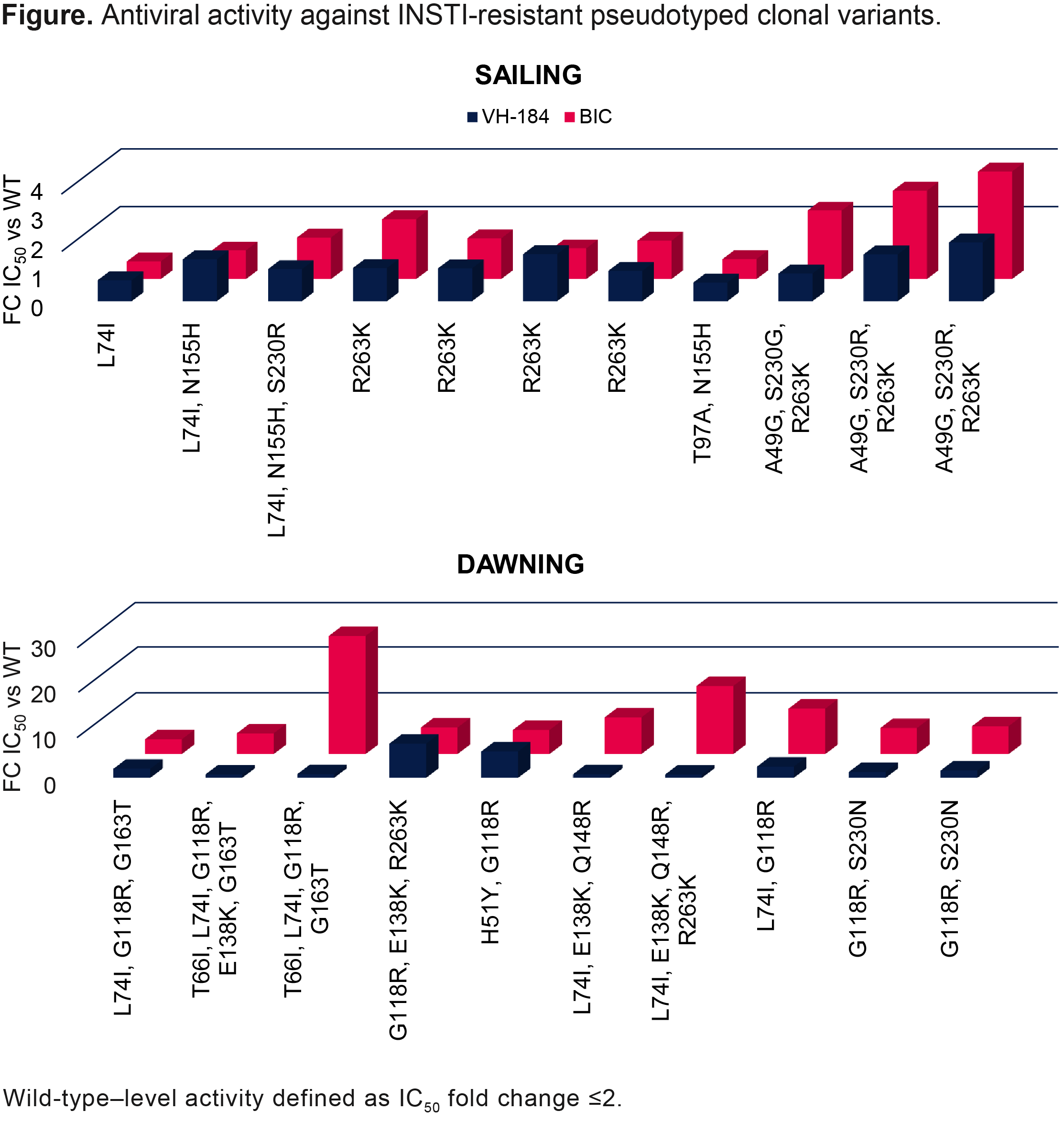
Resistance profiles were evaluated against a panel of second-generation INSTI-resistant HIV-1 pseudotyped viruses derived from 14 participants who met confirmed virologic withdrawal (CVW) criteria in the SAILING (n=7, through Week 132) and DAWNING (n=7, through Week 216) studies. SAILING was a phase 3 study of adults naive to INSTIs with resistance to ≥2 antiretroviral classes who received either dolutegravir (DTG) or raltegravir, with a 2-drug background regimen. DAWNING was a phase 3b study of adults on failing first-line therapy who received DTG or ritonavir-boosted lopinavir, plus 2 nucleoside reverse transcriptase inhibitors. Populations and clonal variants from on-treatment plasma samples were genotyped and tested in a phenotype assay. Wild-type–level activity was defined as IC50 fold change ≤2.
Results
VH-184 demonstrated potent in vitro antiviral activity against emergent INSTI resistance at CVW. When tested against pseudotyped virus populations and clonal variants from SAILING, VH-184 demonstrated improved potency vs BIC against viruses with R263K, S230G or S230R, and A49G, which increased BIC FC above wild-type level (Figure). Across populations and clonal variants containing G118R, either alone or in combination with additional substitutions, identified among participants in DAWNING, VH-184 generally showed improved potency vs BIC. VH-184 also demonstrated enhanced potency against pseudotyped viruses harboring L74I, E138K, and/or G118R as well as improved potency against virus with N155H, E138D, and S147G.
Conclusions
VH-184 demonstrated improved potency and an enhanced resistance profile vs BIC, retaining activity against second-generation INSTI-resistant pseudotyped viruses. These findings highlight the potential of VH-184 as a third-generation INSTI with activity against a broader spectrum of INSTI-resistant viruses and support its further development as a long-acting injectable treatment for HIV.
Table or Figure