Background
Small molecules targeting the HIV-1 capsid (CA) have been developed to target the FG-binding pocket (FG-BP). Lenacapavir (LEN) is FDA-approved both for individuals with multidrug-resistant HIV-1 infection and for pre-exposure prophylaxis. Here, we introduce a novel class of CA inhibitors based on cyclic peptides (CyPeps). CyPeps offer advantages of high oral bioavailability and structural versatility. They are designed by mimicking host factors that naturally bind the CA FG-BP, incorporating an FG-binding motif for precise recognition.
Methods
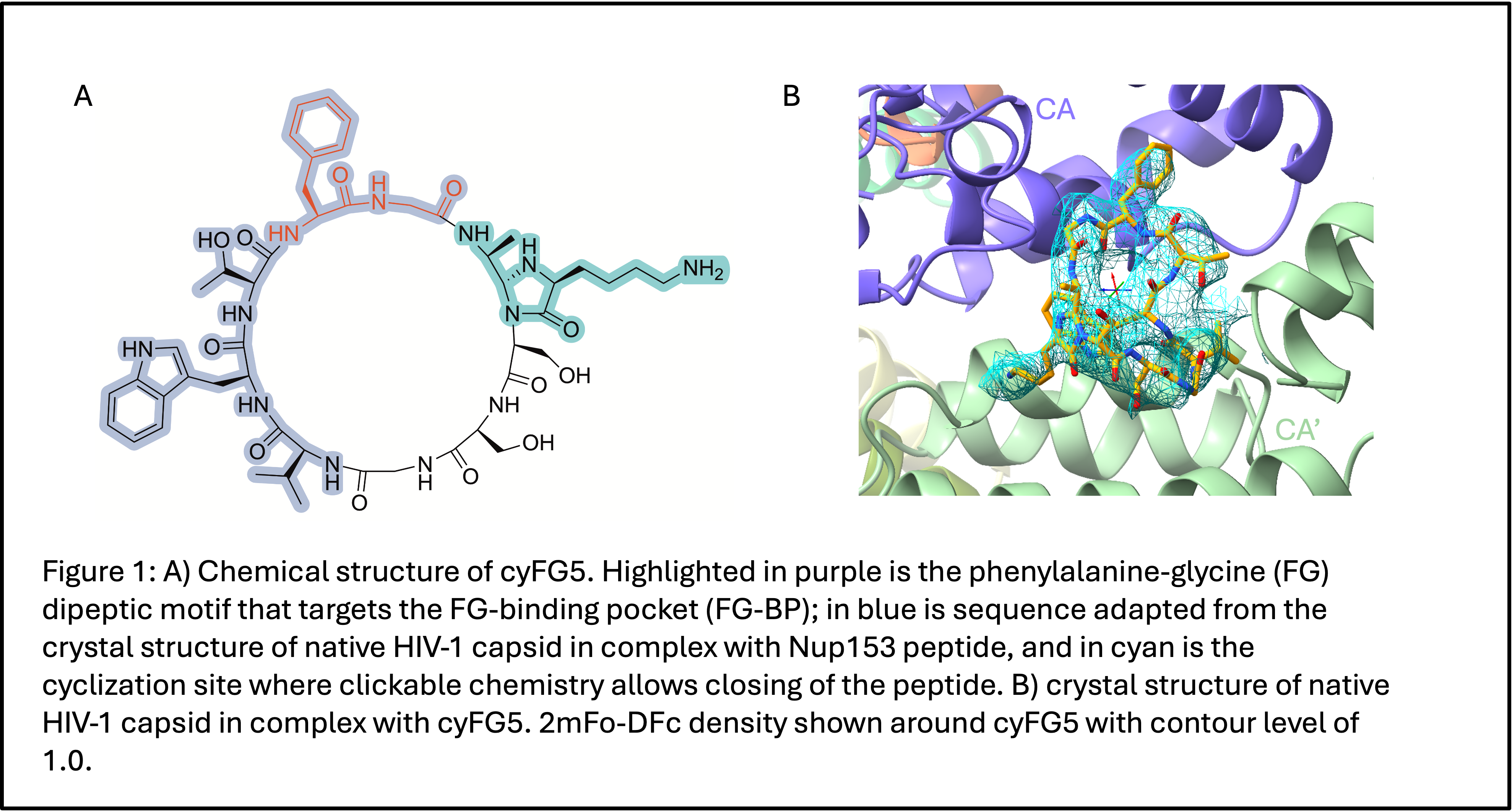
The IC50 of FG-BP targeting CyPep cyFG5 was assessed against wild-type (WT) HIV-1 virus-like particles (VLPs) using endogenous reverse transcription assay with NL4-3 ΔEnv VLPs. To elucidate the molecular basis of inhibition, we determined the first crystal structure of native WT CA in complex with cyclic peptide (cyFG5) by X-ray crystallography. This structure was compared to reported WT unliganded, PF74-bound, and Nup153 peptide-bound structures (PDB: 4XFX, 4XFZ, 6AYA). Site-directed mutagenesis was performed on CA residues that interact with cyFG5, and binding kinetics were quantified by biolayer interferometry (BLI) using disulfide-stabilized WT and mutant CA hexamers.
Results
cyFG5 exhibited low micromolar IC50 and KD against/to purified WT VLPs and stabilized CA hexamers, respectively. Structural analysis revealed that cyFG5 establishes unique interactions with the C-terminal region of the adjacent CA monomer, distinct from existing ligands. Key contacts included residues S41, R132, N139, and R173. Alanine or serine substitutions were introduced at the identified residues in disulfide-stabilized CA hexamers. BLI measurements demonstrated reduced or abolished binding for these mutants compared to WT, confirming the critical role of the C-terminal interactions.
Conclusions
Cyclic peptides represent a promising strategy for a new class of CA-targeting therapeutics for HIV-1 infection. We present cyFG5 as a prototype inhibitor that exploits a previously untargeted site: the C-terminal region of the neighboring subunit within the CA hexamer. This binding mode is distinct from that of all currently available FG-BP targeting compounds. Site-directed mutagenesis corroborated the structural model, validating cyFG5’s novel binding mechanism. These findings highlight the potential of structure-guided design to enhance the affinity and antiviral activity of cyclic peptides, establishing cyFG5 as a foundation for next-generation HIV-1 therapeutics.
Table or Figure