Background
Semaglutide, a glucagon-like peptide-1 receptor agonist, is now one of the most widely prescribed therapies for the treatment of type 2 diabetes and obesity. Concerns have been raised about its psychiatric safety, including effects on depression and suicidality. People with HIV (PWH) have high rates of depression and other mental health concerns, yet evidence on the mental health safety of semaglutide among PWH remains limited.
Methods
We conducted a quasi-experimental study examining changes in depressive symptoms among PWH who initiated semaglutide in routine clinical care at 9 sites in the Centers for AIDS Research Network of Integrated Clinical Systems (CNICS) cohort between April 2018 and October 2024. Depressive symptoms were assessed using the Patient Health Questionnaire-9 (PHQ-9), a patient-reported outcome collected approximately every six months at routine clinical visits. Mean changes in depressive symptoms, as measured by PHQ-9 scores, before and after semaglutide initiation were estimated with linear mixed models adjusted for age, sex, race/ethnicity, and time. Analyses were conducted overall and within subgroups defined by baseline PHQ-9 scores, to assess whether changes varied by initial depression severity.
Results
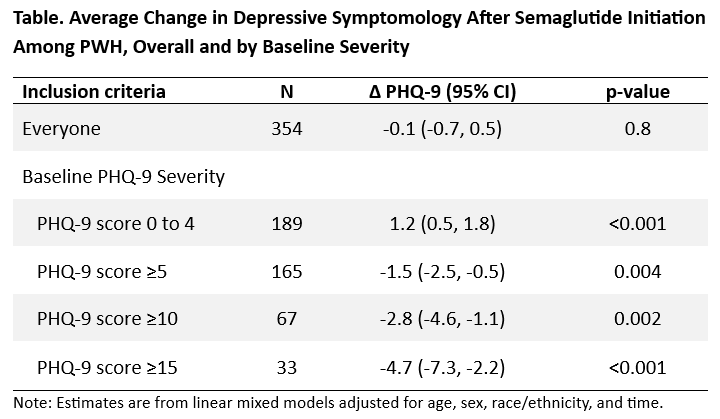
Among 354 PWH initiating semaglutide, the median follow-up was 36.5 months prior to and 9.4 months after initiation, with a median of 5 PHQ-9 assessments per person (IQR 3–7). At treatment initiation, mean age was 54 years (standard deviation: 10), 77% were male, 38% non-Hispanic White; 78% had obesity, 60% diabetes, and >95% had suppressed HIV viral loads; 53% had no/minimal depression (PHQ-9 score 0–4), 28% had mild depression (PHQ-9 score 5–9), and 19% had moderate-to-severe depression (PHQ-9 score ≥10). Overall, semaglutide initiation was not associated with changes in depressive symptoms (adjusted mean change −0.1; 95% CI −0.7 to 0.5). Analyses by baseline PHQ-9 severity showed a slight increase among those with no or minimal symptoms (PHQ-9 of 0–4: 1.2; 95% CI 0.5 to 1.8), whereas PHQ-9 scores decreased progressively among those with higher baseline severity: PHQ-9 ≥5 (−1.5; 95% CI −2.5 to −0.5), PHQ-9 ≥10 (−2.8; 95% CI −4.6 to −1.1), and PHQ-9 ≥15 (−4.7; 95% CI −7.3 to −2.2).
Conclusions
Semaglutide was not associated with worsening depressive symptoms among PWH with mild, moderate, or severe baseline depression. While individual impacts may vary, these findings suggest that overall, depression-related safety concerns are minimal in this population.
Table or Figure